
TL;DR

Get everyday essentials delivered free — and shop member deals
- Fast, free delivery on millions of items
- Access to Prime Big Deal Days deals on October 6–7
- Prime Video, Amazon Music and more included
IdeaClyst acts as a personal war room for your ideas, combining AI council debates, grounded research, and a founder’s workspace. It speeds validation and boosts confidence in decision-making, all local-first.
Imagine having a team of advisors, each with a different perspective, arguing about your latest idea—without the endless meetings or confusing notes. That’s what IdeaClyst brings to your desk. It’s not just another AI tool; it’s a strategic war room designed to help you pick the right idea before you pour months of time and thousands of dollars into it.
In a world where building fast is easy thanks to AI, deciding what to build is the real challenge. You need conviction. You need a space that digs into the details, challenges assumptions, and surfaces the blind spots. That’s what IdeaClyst offers—a local-first platform that keeps your ideas safe and in your control, but supercharges your decision process. You need conviction. You need a space that digs into the details, challenges assumptions, and surfaces the blind spots. That’s what IdeaClyst offers—a local-first platform that keeps your ideas safe and in your control, but supercharges your decision process.
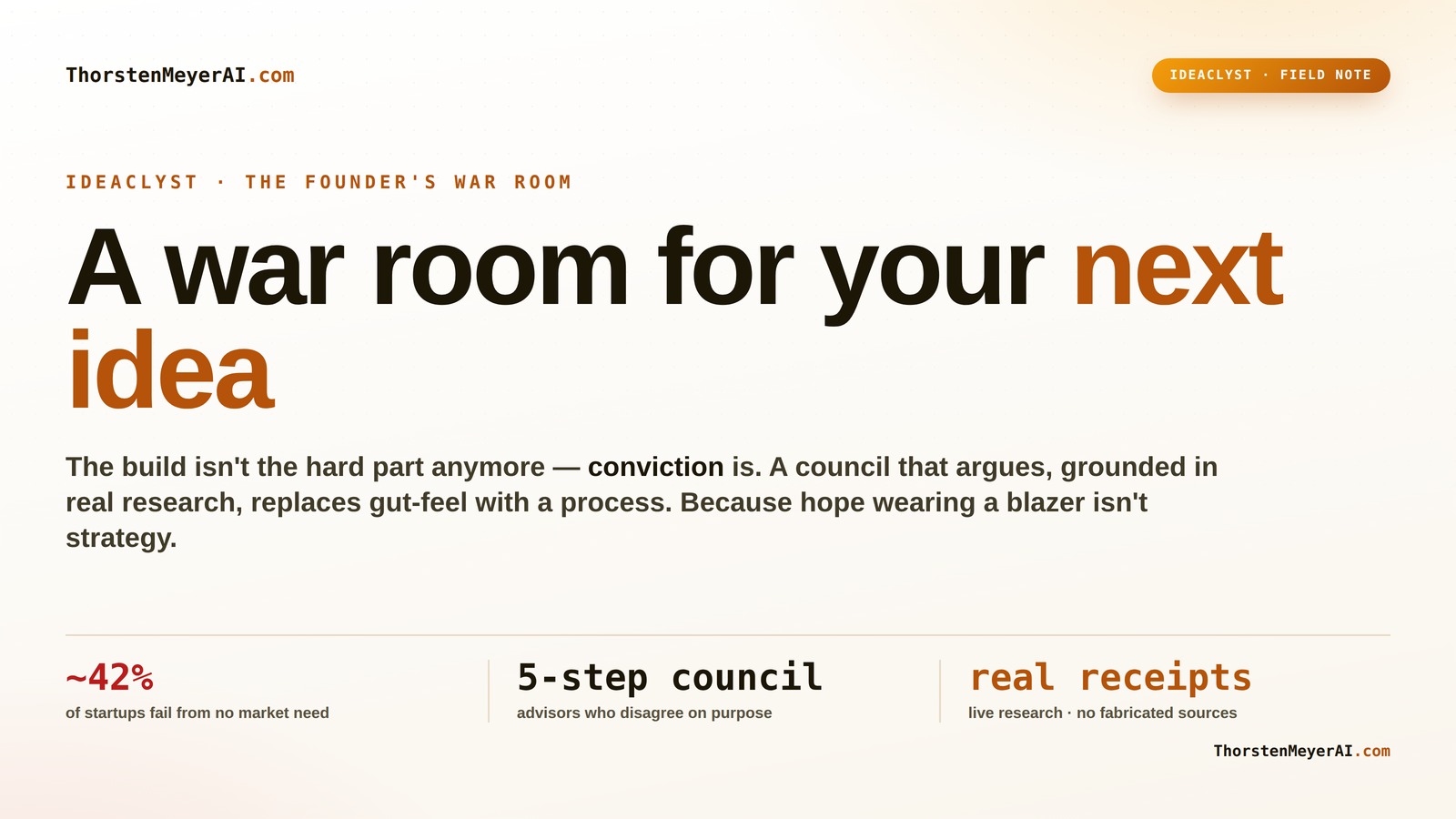
A war room for your next idea
The build isn’t the hard part anymore — conviction is. Knowing which idea deserves the next six months, and being able to defend it. Most founders answer with gut feel and optimistic math. That’s hope wearing a blazer. IdeaClyst replaces it with a process.
The most expensive decision is what to build
The single most valuable thing a tool can do is talk you out of the wrong six months. The numbers make the case better than any pitch.
Three tools in one — on your own machine
Strip away the framing and IdeaClyst is three things at once, all running locally with nothing leaving your laptop.
An AI council
Pressure-tests an idea you bring it — advisors who argue on purpose.
A discovery engine
Finds ideas you didn’t know to look for by hunting real demand signals.
A founder’s workspace
Carries winners from “interesting” all the way to “ready to build.”
Advisors who disagree on purpose
Not one confident, agreeable answer — a structured five-step deliberation where models play different roles and turn on their own work. The disagreement is the feature.
The five-step deliberation
A council that leads with the bad news surfaces the objections you’d otherwise find the expensive way, on month five.
Product strategy
Who’s it for, what’s the wedge, why now, what’s the business model.
Technical architecture
What would it actually take to build — and where’s the risk.
Critique pass
The council turns on its own work. Where’s the hand-waving? What kills this?
Second, independent critique
A different voice, a different angle — so blind spots don’t survive.
Final synthesis
Everything into one coherent founder packet: strategy, architecture, validation, plan.
When IdeaClyst cites a source, it actually fetched it
The hard departure from “ask an AI what it thinks of my startup.” It runs in a strict, real-data-only mode — if it can’t gather genuine evidence, it says so plainly rather than inventing a plausible paragraph.
Confidence with receipts
No fabricated statistics, no imaginary competitors, no made-up citations. The packet survives a skeptical co-founder or a sharp investor because the reasoning has receipts.
Market research first
Scouts the landscape before the council reasons about anything.
Competitor read
Real positioning, pricing signals, feature claims — differentiation vs. reality.
Validation with links
Not “talk to customers” — concrete signals & sources you can click.
From the blank page to build-ready
Evaluation is half the problem; the blank page is the other half. And a plan is worthless if it dies in a tab you never reopen.
Bring a space, not an idea
“AI for accountants,” “tools for indie game studios” — plus your goal and real capacity. It hunts demand signals across HN, Reddit, Product Hunt, GitHub, pricing pages.
- An honest market read — leads with the bad news when a space is hard
- An opportunity map — high pain, thin competition
- Ranked candidates — wedge, who pays, effort, risk, confidence
- each with KILL CRITERIA — when to walk away
A home and a forward path
Every promising idea gets carried forward, with every artifact in plain files on your disk.
- Validation tooling — sprint board, interview list, evidence browser
- Founder profile — a personal-fit lens; same discovery, different advice
- Build workspaces — funnel, personas, landing draft, version history
- “Build this idea” → a PRD + task queue, ready for a coding agent
Key Takeaways
- IdeaClyst turns idea validation into a structured debate, surfacing risks early and avoiding costly mistakes.
- Grounding AI insights with live web research boosts decision accuracy and confidence.
- A local-first platform keeps your proprietary ideas safe and under your control.
- The structured council process helps transform fuzzy concepts into concrete, actionable plans.
- Using a war room mindset accelerates innovation and aligns teams faster than traditional brainstorming.
AI-powered decision-making software for startups
As an affiliate, we earn on qualifying purchases.
As an affiliate, we earn on qualifying purchases.
Why a War Room for Ideas Changes the Game
The idea of a war room isn’t new—think military strategy or emergency response teams. It’s a centralized, intense space where everyone’s focus is on one goal: winning. For startups and innovators, that means avoiding the costly trap of building the wrong thing. IdeaClyst makes this concept accessible for your ideas.
Take Sarah, a SaaS founder. She had three features she was debating for her app. Instead of endless debate, she used IdeaClyst’s council to scrutinize each option. The result? Clearer priorities and a plan rooted in debate, not guesswork. That’s the power of a dedicated idea war room.
As an affiliate, we earn on qualifying purchases.
How IdeaClyst’s AI Council Sparks Better Decisions
IdeaClyst’s core is a structured debate among AI models, each playing a different role—like a product strategist, a tech critic, and a market skeptic. Instead of one cheerleader, you get a panel that challenges your assumptions from multiple angles. This multi-model debate surfaces flaws early, saving you months of wasted effort.
For example, when a startup pitches a new health app idea, the council questions its target market, technical feasibility, and revenue model. The back-and-forth uncovers overlooked risks—like regulatory hurdles or integration challenges—that might have been missed otherwise.
According to structured debate is a proven way to surface risks and assumptions in complex projects, making it ideal for early-stage validation.
Why this matters: Engaging multiple AI perspectives forces founders to confront uncomfortable truths they might overlook in traditional brainstorming. It encourages a more rigorous, skeptical mindset that’s essential for avoiding costly pitfalls. The tradeoff, however, is that this process requires careful framing and interpretation—over-relying on AI debate without human judgment can lead to false confidence. Therefore, it’s crucial to treat these debates as a guide, not an absolute verdict.
founders strategic planning software
As an affiliate, we earn on qualifying purchases.
As an affiliate, we earn on qualifying purchases.
Grounded Research That’s More Than Just Model Vibes
Many AI tools give you vague, confidence-boosting statements. Not IdeaClyst. It integrates live web research directly into its council process. Instead of taking guesses, it pulls in real-time data—market trends, competitive landscapes, recent news—grounding every critique and suggestion in current facts.
Imagine you’re exploring a new subscription model for your eco-friendly apparel startup. IdeaClyst fetches recent data from industry reports, customer reviews, and market stats, making your decisions based on fresh, concrete evidence. That’s how it helps prevent the ‘mirror effect’—where your ideas only reflect your biases.
Why this matters: Grounding AI insights in real-world data dramatically improves decision accuracy, especially in fast-changing markets. It reduces the risk of overconfidence based on outdated or incomplete information. The tradeoff is that sourcing and interpreting live data adds complexity and requires founders to critically evaluate the relevance and credibility of the information. This process emphasizes the importance of human judgment in validating AI-driven insights, ensuring decisions aren’t just data-driven but also contextually sound.
local-first project management platform
As an affiliate, we earn on qualifying purchases.
As an affiliate, we earn on qualifying purchases.
Your Ideas, Your Data: Why Local-First Matters
IdeaClyst runs entirely on your machine, keeping everything private and under your control. Learn more about privacy-focused tools. No cloud, no subscription—just plain files stored safely on your disk. This might seem like a small detail, but it’s a game-changer for founders concerned about data privacy or wanting full control over their ideas.
Picture this: you brainstorm late at night, your laptop’s battery low, and you’re wary of uploading sensitive concepts to a third-party server. With IdeaClyst, everything stays local. Your raw ideas, critiques, and plans are yours alone.
This approach mirrors the philosophy of tools like Threlmark, emphasizing ownership and privacy in early-stage innovation.
Why this matters: Local-first design isn’t just about privacy—it also offers flexibility, resilience, and peace of mind. Founders avoid vendor lock-in and data breaches, maintaining ownership over their intellectual property. The tradeoff is that managing all data locally can require more manual organization and backup strategies, but for many, the benefits of control outweigh these challenges, especially when dealing with sensitive or proprietary information.
The Founder’s Playbook: From Idea to Action
Use IdeaClyst as your discovery engine, debate chamber, and planning hub all in one. Discover how a war room accelerates innovation. Start by feeding it a rough idea—say, a new social enterprise for urban gardening. The council debates its market, tech, and risks. Then, it synthesizes those insights into a clear plan with validation tests, architecture, and next steps.
For instance, a nonprofit team used it to vet a new volunteer management platform. After structured critique, they identified the core user needs and designed a prototype aligned with real data. It’s a process that turns fuzzy concepts into actionable plans faster than traditional methods.
Here’s how to get started:
- Input your initial idea or problem statement.
- Let the council debate and critique from multiple angles.
- Review the synthesized plan and validation steps.
- Refine and prepare to build based on solid, debated insights.
How Does IdeaClyst Compare to Traditional Brainstorming?
| Feature | Traditional Brainstorming | IdeaClyst |
|---|---|---|
| Debate Style | Free-flowing, often unstructured | Structured, multi-model disagreement |
| Data Grounding | Mostly gut feelings and assumptions | Real-time web research and facts |
| Ownership | Notes scattered, often lost | Markdown files, version control, full control |
| Decision Confidence | Relies on intuition and luck | Data-driven, debated, documented |
Real Results: When Founders Use IdeaClyst
Consider Tom, a SaaS founder who used IdeaClyst to vet a new customer onboarding feature. The structured debates highlighted overlooked risks, like onboarding complexity and integration issues. He decided to delay development until further testing, saving him a potential six-figure mistake.
Or Sarah, who launched a new eco product line after using the platform to challenge her assumptions. Her team’s confidence soared, and they shipped a product that truly resonated with their target market—without wasting months on ideas that never fit.
These real-world examples show how structured debate and grounded research can turn fuzzy ideas into confident, validated plans—faster and safer.
Frequently Asked Questions
What exactly is IdeaClyst?
IdeaClyst is a local-first platform that acts as a war room for your ideas. It combines an AI council that debates your concepts from multiple angles, grounded real-time research, and a workspace that keeps everything safe and under your control.
How does the structured debate process work?
When you input an idea, IdeaClyst stages five steps: product strategy, technical architecture, critique, independent critique, and final synthesis. Each step involves different AI models arguing, questioning, and refining, helping you surface risks and validate assumptions early.
Who created IdeaClyst, and why?
IdeaClyst was built by a team of entrepreneurs and AI developers to address the costly risks of blind guesswork in startups. Their goal was to create a private, grounded, and debate-driven space that accelerates decision-making without sacrificing control or privacy.
Can I use IdeaClyst for non-startup projects?
Absolutely. Its flexible structure makes it perfect for nonprofits, creative teams, or any group needing a focused, grounded space to test and refine ideas before committing resources.
What are the main limitations I should be aware of?
While powerful, IdeaClyst relies on your input and the quality of your initial ideas. It’s a tool to guide your thinking, not replace human judgment or market validation through real customer interactions. Over-reliance on structured debate without real-world testing can lead to false confidence. Additionally, the depth and accuracy of insights depend on the quality of input and the relevance of the data sources used, emphasizing the importance of critical human oversight to interpret AI suggestions effectively.
Conclusion
Think of IdeaClyst as your personal battlefield for ideas—where conflicting opinions and real-world data collide to reveal the truth. It’s a strategic space that cuts through guesswork, giving you clarity and confidence to choose your next move.
If you’re tired of flying blind and want a proven way to validate smarter, faster, and safer, then creating your own idea war room today might just be the smartest investment you make. After all, in the race of innovation, clarity is power—and IdeaClyst is the secret weapon.
Halloween Picks
halloween
As an affiliate, we earn on qualifying purchases.