
TL;DR
APEC leaders met in Shenzhen on November 19, 2026, with artificial intelligence, digital trade and work among the issues before them. Draft proposals had been sent to leaders, but whether they would adopt them was not known at the time of reporting; APEC decisions are voluntary and non-binding.
Leaders of the 21 APEC member economies met in Shenzhen on November 19, 2026, with artificial intelligence, digital trade and employment among the issues on their agenda. China’s President Xi Jinping described the digital economy and AI as “the engines of innovation-driven growth,” while draft proposals sent to leaders were still awaiting a decision, according to material available that morning.

Get everyday essentials delivered free with Prime
- Fast, free delivery on millions of items
- Prime Video, Amazon Music and more included
- Member-only deals all year
APEC senior officials sent leaders a proposed statement on the digital economy and AI “for people’s well-being,” a proposed Trade Digitalization Cooperation Framework for 2027–2030, and a draft statement on a Free Trade Area of the Asia-Pacific. The leaders’ declaration had not been published by 05:45 UTC on November 19, so it was not yet clear whether leaders would adopt those proposals or what final wording they might use.
The summit follows work through the year. At a May meeting, APEC trade ministers committed to “harnessing AI’s benefits for trade” and encouraged economies to share AI policies with smaller firms. In September, labor ministers adopted a joint statement on jobs, vocational skills and social security. Those ministerial outcomes form part of the agenda, but do not establish that leaders have agreed to new binding rules.
Xi said China would provide US$20 million for APEC cooperation and establish cooperation institutions covering digital technology, cross-border data flows, clean energy and small businesses. The announcement concerns China’s contribution and proposed institutions; the source material does not specify a delivery schedule or detail how the institutions will operate.
AI Meets Regional Trade and Jobs
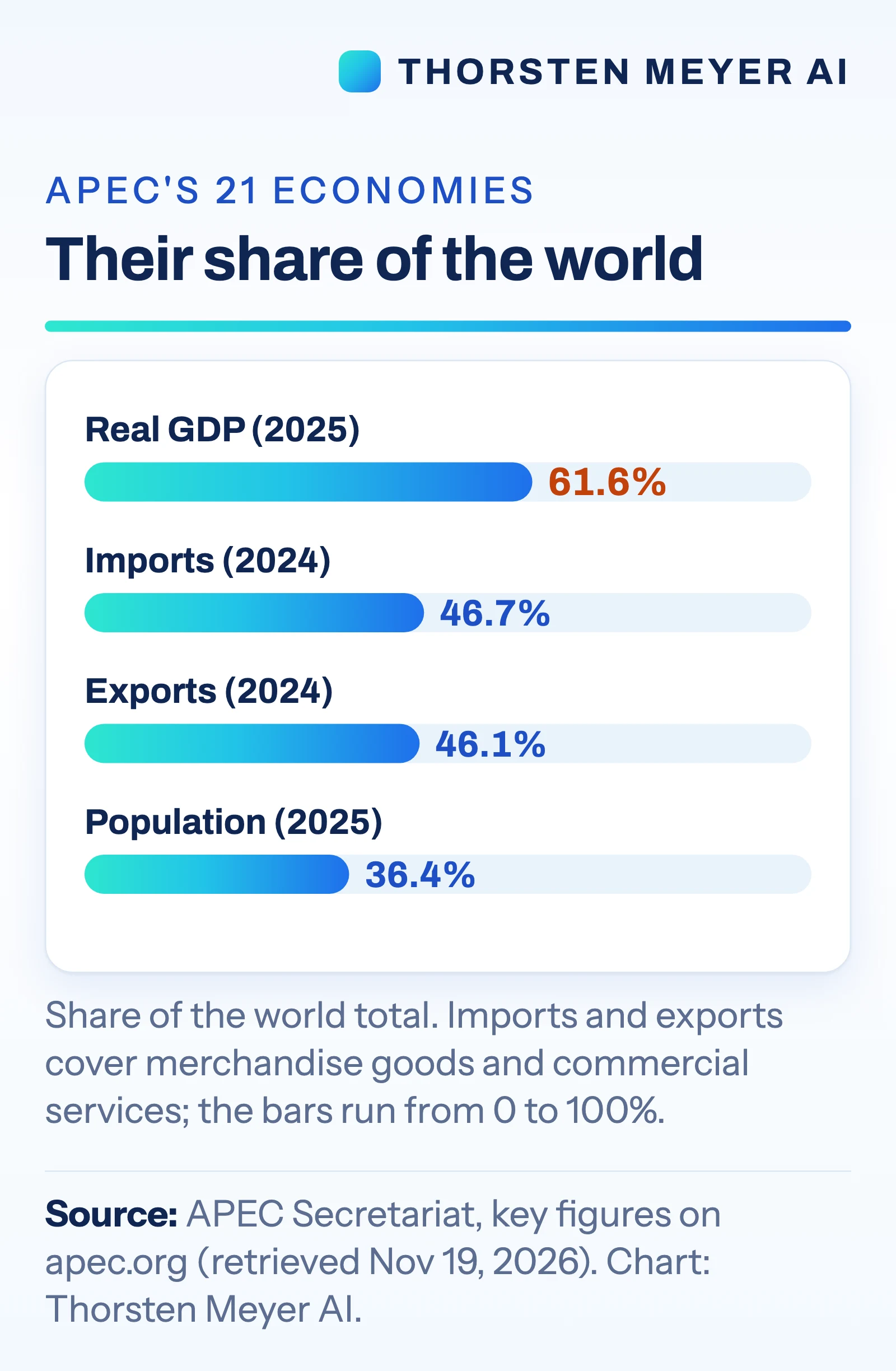
The summit’s decisions could signal how economies in a region central to global production and trade want to approach AI, digital services and workforce changes. APEC’s 21 members account for 61.6% of world GDP in 2025 and about 46% of world trade in goods and commercial services in 2024, according to the APEC Secretariat. Shared priorities could give businesses and governments a common direction, even if they do not create enforceable rules.
The economic stakes include both opportunity and uneven effects. APEC’s Policy Support Unit raised its 2026 regional growth forecast to 3.4% from 3.2% on November 15, citing strong technology-related investment and trade. It also cautioned that the benefits of technology investment could be uneven. The labor ministers’ focus on skills and social security points to a related concern: how workers and employers adapt as AI changes tasks and demand for skills.
For companies moving goods or data across borders, cooperation on digital trade could eventually affect how processes are coordinated. But the summit documents alone cannot be assumed to change tariffs, national laws or chip controls. APEC says its decisions are made by consensus and its commitments are voluntary.
Popular right now

TCL 75-Inch QM8L Series 4K QLED Smart Google TV

Vitamix Nano Personal Blender with SmoothiePilot Technology, Black

Ninja Foodi 6-in-1 DualZone FlexBasket Air Fryer, 7-Qt MegaZone, Black, DZ071
As an affiliate, we earn on qualifying purchases.
Proposals After a Year of Meetings
APEC, founded in 1989, is a regional economic forum whose members are called economies. Its leaders’ meeting follows ministerial and senior-official discussions that shape proposals for consideration. Trade ministers addressed AI and trade in May; labor ministers issued their statement on jobs and skills in September; and foreign and trade ministers prepared the leaders’ agenda in a November 3 meeting held by video.
Senior officials met in Shenzhen on November 14 and 15 and sent the draft AI, digitalization and free-trade-area texts to leaders. They remained proposals as of the reporting cutoff. The distinction matters: an item on a leaders’ agenda is not proof of adoption, and an adopted APEC statement would still be voluntary rather than a change to domestic law.
The economic figures offer context for the discussions. The APEC Policy Support Unit reported that export values in the region rose 22.5% year on year in the first half of 2026 and export volumes rose 10.8%, supported by semiconductor demand. It forecast growth of 3.1% for 2027 and warned that technology gains may be uneven. These are regional forecasts and observations, not evidence that AI alone caused the growth.
“They committed to “harnessing AI’s benefits for trade.””
— APEC trade ministers
Drafts Await Leaders’ Decision
As of 05:45 UTC on November 19, the leaders’ declaration had not been published. It was therefore unknown whether the draft AI statement, digital trade framework or free-trade-area statement would be adopted, revised or left out, and what commitments the final text would contain.
Even if leaders endorse proposals, the practical effects would depend on follow-up by member economies. APEC commitments are voluntary and made by consensus; the source material does not describe a mechanism that would make the proposed texts binding or change national regulations. Details of the institutions China said it would establish, including their structure and timetable, were also not provided.
Declaration and Follow-Up
The next key development is publication of the leaders’ declaration, which will show whether the draft proposals became agreed summit language and what direction leaders set for cooperation. Subsequent APEC work and actions by individual economies will determine whether the statements lead to concrete programs or policy changes.
Xi also welcomed U.S. President Donald J. Trump in Shenzhen on November 18, and the source material said Xi would hold a China-Russia-U.S. summit with Trump and Russian President Vladimir Putin on November 19. Those meetings take place days after the United States tightened rules on remote access to advanced AI chips. The available information does not establish that those separate talks will produce changes to chip rules or determine APEC outcomes.
Key Questions
What AI proposals were before APEC leaders?
Drafts included a statement on the digital economy and AI “for people’s well-being” and a proposed Trade Digitalization Cooperation Framework for 2027–2030. Whether leaders adopted them was not known by 05:45 UTC on November 19.
Did the summit change AI or trade laws?
No such change was confirmed in the source material. APEC decisions are voluntary and non-binding; an agreed statement would not by itself change national laws, tariffs or chip rules.
Why does APEC matter to trade?
APEC’s 21 member economies account for about 46% of world trade in goods and commercial services, using the 2024 comparison reported by the APEC Secretariat.
What has APEC already said about AI and work?
Trade ministers committed in May to “harnessing AI’s benefits for trade.” Labor ministers adopted a September statement addressing jobs, vocational skills and social security.
Source: Thorsten Meyer AI