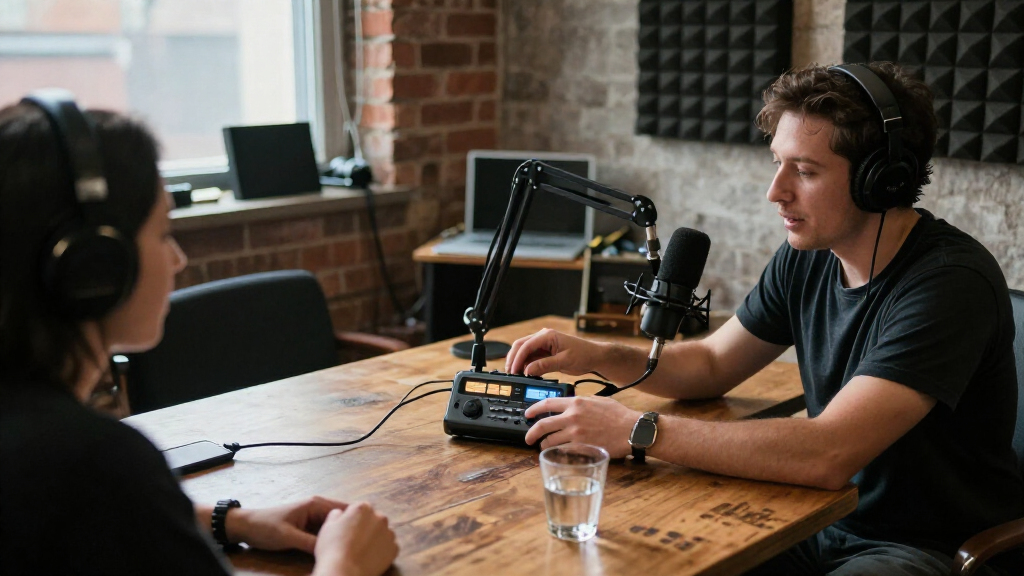

The Zoom PodTrak P4 is my best overall pick among portable podcast recorders because its podcast-focused controls and multi-mic setup suit small in-person shows. The PodTrak P4next is a strong alternative for buyers who want a newer podcast-oriented workflow, while the Zoom H1essential is a simpler fit for solo recording and field audio. The main tradeoff is between dedicated podcast features, compact size, and broader recording flexibility. Bundles can provide a ready-to-start kit, but may include gear you do not need. Read on for the full comparison and guidance by recording style.

Get everyday essentials delivered free with Prime
- Fast, free delivery on millions of items
- Prime Video, Amazon Music and more included
- Member-only deals all year
Key Takeaways
- The PodTrak P4 is the most balanced pick for a small in-person podcast: its podcast-focused design gives it a clearer role than the handheld H-series recorders.
- The P4next and original P4 serve related but distinct needs: compare their workflows and included features before choosing based on model name alone.
- The H1essential favors simplicity and portability: it makes more sense for solo recording or capturing audio on location than managing a multi-person podcast.
- The H1 XLR and H4essential offer different paths to external microphones: check the number and type of inputs your sessions require before deciding.
- Bundles mainly change what arrives in the box: P4 kits with two or four mic packs, accessory sets, and card bundles suit different starting points, but add little value if you already own the gear.
| Zoom PodTrak P4 Portable Podcast Recorder |  | Best Overall for Small In-Person Shows | Microphone inputs: 4 XLR inputs with phantom power | Headphone outputs: 4 with individual volume control | Recording: Multitrack WAV | VIEW LATEST PRICE | See Our Full Breakdown |
| Zoom H1 XLR 2-Channel Portable Recorder |  | Best for Two XLR Sources on the Move | Recording format: WAV | Recording resolution: 32-bit float, up to 96 kHz | Inputs: 2 locking XLR/TRS combo inputs; 3.5 mm stereo input | VIEW LATEST PRICE | See Our Full Breakdown |
| Zoom H1essential Portable Audio Recorder |  | Best Compact Recorder for Solo Creators | Microphones: Built-in X/Y stereo microphones | Recording format: WAV | Recording: 32-bit float | VIEW LATEST PRICE | See Our Full Breakdown |
| Zoom PodTrak P2 Podcast Recorder with Two USB Mic Inputs |  | Best for a Two-Person USB-Mic Setup | Microphone inputs: 2 USB | Headphone outputs: 2 | Audio format: WAV | VIEW LATEST PRICE | See Our Full Breakdown |
| Zoom PodTrak P4 Portable Multitrack Podcast Recorder Bundle with Four ZDM-1 Podcast Mic Packs |  | Best Complete Kit for a Four-Person Show | Recorder: Zoom PodTrak P4 | Microphone inputs: 4 high-gain XLR inputs with +48V phantom power | Headphone outputs: 4 independent | VIEW LATEST PRICE | See Our Full Breakdown |
| Zoom PodTrak P4 Portable Multitrack Podcast Recorder Bundle with Two ZDM-1 Podcast Packs |  | Best Starter Bundle for Two Hosts | Microphone inputs: 4 high-gain XLR inputs with +48V phantom power | Headphone outputs: 4 independent outputs | Sound pads: 4 | VIEW LATEST PRICE | See Our Full Breakdown |
| Zoom PodTrak P4next Podcast Recorder |  | Best for Portable Multitrack Control | Microphone inputs: 4 XLR inputs | Maximum gain: +70 dB | Headphone outputs: 4 with separate volume controls | VIEW LATEST PRICE | See Our Full Breakdown |
| Zoom H1 XLR Recorder Bundle with 64GB microSD Card and SD Adapter |  | Best Compact Two-Input Recorder | Inputs: 2 XLR/TRS combo inputs | Recording format: WAV | Recording resolution: 32-bit float | VIEW LATEST PRICE | See Our Full Breakdown |
| Zoom PodTrak P4 Portable Multitrack Podcast Recorder Bundle with Microphones and Accessories |  | Best Complete Four-Person Kit | Microphone inputs: 4 XLR | Headphone outputs: 4 with individual volume controls | Recording format: 16-bit / 44.1 kHz WAV | VIEW LATEST PRICE | See Our Full Breakdown |
| Zoom PodTrak P4next Podcast Recorder Bundle with 64GB microSDXC Card |  | Best P4next Bundle for Self-Supplied Mics | Microphone inputs: 4 XLR | Headphone outputs: 4 with individual volume controls | Maximum microphone gain: Up to +70 dB | VIEW LATEST PRICE | See Our Full Breakdown |
| Zoom H2essential Handheld Recorder |  | Best for Flexible Mic Placement | Microphones: 3 built-in | Recording patterns: 9 | Recording modes: Mono, stereo, and surround | VIEW LATEST PRICE | See Our Full Breakdown |
| Zoom H4essential Handheld Recorder |  | Best for External Microphones | Recording tracks: 4 | Recording format and resolution: WAV, 32-bit float | Maximum sample rate: 96 kHz | VIEW LATEST PRICE | See Our Full Breakdown |
| portable podcast recorder | Microphone inputs | Headphone outputs | Power | Weight |
|---|---|---|---|---|
| Zoom PodTrak P4 Portable Podca | 4 XLR inputs with phantom power | 4 with individual volume control | 2 AA batteries; up to 3.5 hours | 130 g |
| Zoom H1 XLR 2-Channel Portable | — | — | — | 6.4 ounces |
| Zoom H1essential Portable Audi | — | — | 2 AAA batteries | 92 g |
| Zoom PodTrak P2 Podcast Record | 2 USB | 2 | — | 7.04 oz |
| Zoom PodTrak P4 Portable Multi | 4 high-gain XLR inputs with +48V phantom power | 4 independent | 2 AA batteries required | — |
| Zoom PodTrak P4 Portable Multi | 4 high-gain XLR inputs with +48V phantom power | 4 independent outputs | Includes 2 AA batteries | — |
| Zoom PodTrak P4next Podcast Re | 4 XLR inputs | 4 with separate volume controls | 2 AA batteries | 10.56 ounces |
| Zoom H1 XLR Recorder Bundle wi | — | — | — | — |
| Zoom PodTrak P4 Portable Multi | 4 XLR | 4 with individual volume controls | 4 AA rechargeable batteries included; also supports USB power | — |
| Zoom PodTrak P4next Podcast Re | 4 XLR | 4 with individual volume controls | — | — |
| Zoom H2essential Handheld Reco | — | — | — | 6.72 oz |
| Zoom H4essential Handheld Reco | — | — | — | — |
More Details on Our Top Picks
Zoom PodTrak P4 Portable Podcast Recorder
The PodTrak P4 is my strongest fit for a small podcast crew that records around a table. Its four XLR inputs and four independently controlled headphone outputs let each speaker use a separate mic and monitor at a comfortable level, while multitrack WAV recording keeps voices on separate tracks for editing. Compared with the PodTrak P2, it supports two more microphone channels and works with XLR mics rather than USB mics, making it the more flexible choice as a show grows. The P2, in turn, is simpler for a two-person USB-mic setup. The P4 also handles phone guests through Mix-Minus and offers programmable sound pads. Its main limitation for location sessions is up to 3.5 hours on two AA batteries, so longer recording days call for another power plan.
Pros:- Four XLR inputs with phantom power support a range of microphones
- Four individually controlled headphone outputs suit a group recording in one room
- Multitrack WAV recording keeps voices separate for editing
- TRRS phone connection with Mix-Minus supports remote guests
Cons:- Battery life is up to 3.5 hours on two AA batteries
- Four XLR inputs may be unnecessary for solo hosts or two-person USB-mic shows
Best for: Small podcast teams recording with up to four XLR microphones who want separate headphone feeds and occasional phone guests
Not ideal for: Hosts recording long sessions away from outlets who need more than 3.5 hours of battery life without changing power arrangements
- Microphone inputs:4 XLR inputs with phantom power
- Headphone outputs:4 with individual volume control
- Recording:Multitrack WAV
- Phone connection:TRRS jack with automatic Mix-Minus
- USB interface:USB 2.0; 2-in/2-out
- Power:2 AA batteries; up to 3.5 hours
- Dimensions:6.1 × 4.41 × 1.85 inches
- Weight:130 g
Our verdict“Choose the PodTrak P4 for a portable, four-person XLR setup with separate headphone feeds and phone guest support.”
Zoom H1 XLR 2-Channel Portable Recorder
The Zoom H1 XLR suits a host who wants to record two external microphones or instruments without carrying a full podcast mixer. Its locking XLR/TRS inputs help keep cables seated during mobile recording, and 32-bit float WAV capture gives more room to handle unexpectedly loud or quiet sources. That makes it a different kind of portable podcast tool from the PodTrak P4: the P4 is better equipped for a group, with four mic inputs and four headphone feeds, while the H1 XLR keeps the setup compact and limited to two inputs. A waveform display and support for SDXC cards up to 1 TB aid on-location recording. The tradeoff is that it lacks the P4’s four-person monitoring arrangement, and its two AA batteries still need to be packed and replaced.
Pros:- Two locking XLR/TRS combo inputs accommodate microphones and instruments
- 32-bit float recording at up to 96 kHz can handle a broad range of input levels
- OLED waveform display provides a visual recording check
- SDXC support up to 1 TB allows substantial local storage
Cons:- Only two combo inputs, with no four-person mic or headphone setup like the PodTrak P4
- Requires two AA batteries for portable operation
Best for: Mobile interviewers and two-person podcast teams recording with external XLR or TRS microphones
Not ideal for: Four-person roundtables or hosts who need several independent headphone feeds and onboard group controls
- Recording format:WAV
- Recording resolution:32-bit float, up to 96 kHz
- Inputs:2 locking XLR/TRS combo inputs; 3.5 mm stereo input
- Headphone output:3.5 mm
- Storage support:SDXC cards up to 1 TB
- Display:0.96-inch OLED
- Battery:2 AA batteries; up to 10 hours
- Weight:6.4 ounces
Our verdict“Pick the H1 XLR when two external sources and a compact recorder matter more than group podcast controls.”
Zoom H1essential Portable Audio Recorder
For a solo host who wants to capture a quick interview, voice note, or room sound without connecting an external mic, the H1essential keeps the kit small. Its built-in X/Y stereo microphones record directly to an SD card, and 32-bit float recording can accommodate sudden changes in volume without requiring the same level adjustment before recording. Compared with the Zoom H1 XLR, this model favors grab-and-go stereo capture over two locking inputs for external microphones and instruments. USB-C microphone mode also lets it serve with compatible computers and mobile devices, adding a use beyond standalone recording. The compact body weighs 92 g, but standalone use depends on an SD card, and its two AAA batteries are a separate item to manage. For a group podcast, the PodTrak P4 has the connections and headphone feeds this model lacks.
Pros:- Built-in X/Y microphones capture stereo audio without an external mic
- 32-bit float recording helps accommodate sudden changes in volume
- USB-C microphone mode supports use with computers and mobile devices
- Compact 92 g body is easy to carry
Cons:- Standalone recording requires an SD card
- Two AAA batteries must be supplied for portable use
- Lacks the external XLR inputs and multiple headphone outputs found on the PodTrak P4
Best for: Solo podcasters, video creators, and interviewers who need a light recorder with built-in stereo microphones
Not ideal for: Podcast teams using multiple external XLR mics or needing separate headphone monitoring for guests
- Microphones:Built-in X/Y stereo microphones
- Recording format:WAV
- Recording:32-bit float
- USB interface:USB Type-C
- Headphone jack:3.5 mm
- Power:2 AAA batteries
- Maximum memory capacity:1 TB
- Weight:92 g
Our verdict“Choose the H1essential for lightweight solo recording with built-in stereo mics rather than a multi-mic podcast session.”
Zoom PodTrak P2 Podcast Recorder with Two USB Mic Inputs
The PodTrak P2 is tailored to two-person shows built around USB microphones. It provides two mic inputs and two headphone outputs, with voice processing that includes compression, de-essing, tone shaping, and AI noise reduction. Mix-Minus helps reduce echo on remote call-ins, and the P2 can record to an SD card while streaming, a useful combination for creators who publish live and recorded versions. Compared with the PodTrak P4, it takes USB mics instead of four XLR microphones, so it asks less of a small two-host setup but leaves less room for a larger panel. Its mono microphone operation is a tradeoff for podcasters seeking stereo source capture. Battery power lasts up to four hours on four AA batteries; USB or an AC adapter offers other power options when available.
Pros:- Two USB microphone inputs and two headphone outputs suit a two-host setup
- Mix-Minus helps prevent echo during remote guest calls
- Can record to SD card while streaming
- Includes voice processing and AI noise reduction
Cons:- Microphone operation is mono
- Battery life is up to four hours on four AA batteries
- Two inputs offer less room for a growing panel than the PodTrak P4
Best for: Two-host podcasts using USB microphones that need remote call-ins, voice processing, and simultaneous streaming and recording
Not ideal for: Groups with three or more speakers, or podcasters who need XLR microphone inputs or stereo mic operation
- Microphone inputs:2 USB
- Headphone outputs:2
- Audio format:WAV
- Memory capacity:Up to 1 TB
- Battery life:Up to 4 hours on 4 AA batteries
- USB interface:USB 3.0 Type-C
- Headphone jack:3.5 mm
- Weight:7.04 oz
Our verdict“Choose the P2 for a two-host USB-mic podcast with built-in call-in and streaming support.”
Zoom PodTrak P4 Portable Multitrack Podcast Recorder Bundle with Four ZDM-1 Podcast Mic Packs
This PodTrak P4 bundle makes sense for a host building a four-person recording setup from the ground up: it includes the recorder plus four ZDM-1 mic packs with microphones, headphones, stands, cables, and accessories. The recorder offers four high-gain XLR inputs, four independent headphone feeds, sound pads, and TRRS and USB connections for remote guests. Compared with the standalone PodTrak P4, the recording and podcast controls are familiar, but the bundle supplies the core gear for each speaker in one package. That convenience comes with a larger equipment haul and accessories a solo host may not need. Its two-AA battery power also means field sessions depend on a power plan. For a small two-host setup, the PodTrak P2 with USB microphones is a more focused alternative.
Pros:- Includes four ZDM-1 podcast mic packs with microphones, headphones, stands, and cables
- Records up to four microphones simultaneously
- Four independent headphone outputs support group monitoring
- TRRS and USB connections support remote call-ins with Mix-Minus
Cons:- Included accessories add bulk for mobile recording
- Two-AA battery operation requires a separate power plan for extended sessions
- Four complete mic packs may be unnecessary for a solo or two-person show
Best for: New or expanding podcast teams who need a recorder, four microphone kits, and individual headphone feeds for a roundtable
Not ideal for: Solo podcasters or two-person shows that would leave most of the included mic packs and accessories unused
- Recorder:Zoom PodTrak P4
- Microphone inputs:4 high-gain XLR inputs with +48V phantom power
- Headphone outputs:4 independent
- Call-in connections:TRRS and USB
- Sound pads:4
- Microphone operation mode:Cardioid
- Power:2 AA batteries required
- Bundle contents:PodTrak P4 recorder and four Zoom ZDM-1 Podcast Mic Packs
Our verdict“Choose this bundle when you need a ready-to-assemble four-person XLR podcast kit with the P4’s multitrack controls.”
Zoom PodTrak P4 Portable Multitrack Podcast Recorder Bundle with Two ZDM-1 Podcast Packs
The PodTrak P4 gives a small podcast team a ready-made path to recording: it has four XLR inputs, four independent headphone outputs, and two included ZDM-1 microphone packs with headphones, stands, and cables. That leaves room to add guests without replacing the recorder. Compared with the four-mic bundle, this package carries less equipment and suits a two-person setup, though it does not supply a microphone kit for every input. Its simultaneous TRRS and USB call-ins with mix-minus help when a remote guest joins, while limiters and low-cut filters offer basic recording control. The tradeoff is power flexibility: it needs AA batteries or another supported power source, so hosts should plan for power on location.
Pros:- Four XLR inputs allow the setup to grow beyond two hosts
- Four independent headphone outputs let participants monitor separately
- Two remote call-in methods and mix-minus support remote guests
- Includes two microphone packs with headphones, stands, and cables
Cons:- Only two microphone packs are included for four available inputs
- Requires AA batteries or another supported power source
Best for: Two-person podcast teams who want microphones and monitoring gear included, with spare inputs for occasional guests
Not ideal for: Four-person shows that need a complete microphone kit for every participant, or crews that want to avoid managing batteries
- Microphone inputs:4 high-gain XLR inputs with +48V phantom power
- Headphone outputs:4 independent outputs
- Sound pads:4
- Remote call-ins:Simultaneous TRRS and USB call-ins
- Microphone operation:Multi-channel
- Power:Includes 2 AA batteries
- Bundle contents:2 ZDM-1 Podcast Mic Packs
Our verdict“Choose this bundle for a two-host show that needs a portable recorder and its first two microphone kits in one package.”
Zoom PodTrak P4next Podcast Recorder
The PodTrak P4next is aimed at small crews that want separate tracks and useful processing in a compact, battery-powered recorder. Its four XLR inputs and individually controlled headphone outputs let each participant connect and monitor from the same unit, while up to +70 dB of gain supports quieter microphones. AI noise reduction and Tone and COMP effects provide tools for shaping a recording without adding external processors. Compared with the original PodTrak P4, this model adds those processing features and phone audio capture, but the listed call-in support is for one guest rather than the P4’s simultaneous TRRS and USB call-ins. It records WAV to an SD card, so storage is another item to bring, and the two-AA power requirement means longer sessions need a battery plan.
Pros:- Records up to four microphones on separate tracks
- AI noise reduction and Tone and COMP effects add onboard audio shaping
- Four headphone outputs have separate volume controls
- Phone connection supports direct audio capture for video
Cons:- Requires two AA batteries for battery-powered operation
- SD card storage media is needed and is not listed as included
Best for: Mobile podcast crews recording up to four people who want separate WAV tracks and onboard noise reduction
Not ideal for: Shows that regularly need two simultaneous remote call-ins or want a recorder bundle with microphones and storage included
- Microphone inputs:4 XLR inputs
- Maximum gain:+70 dB
- Headphone outputs:4 with separate volume controls
- Recording format:WAV
- Storage:SD card, up to 2 TB
- Power:2 AA batteries
- Weight:10.56 ounces
Our verdict“Pick the P4next for a portable four-person setup that values separate tracks and built-in processing over bundled microphones.”
Zoom H1 XLR Recorder Bundle with 64GB microSD Card and SD Adapter
The Zoom H1 XLR fits a different kind of portable podcast kit from the PodTrak P4 models: it offers two XLR/TRS combo inputs in a small recorder suited to interviews, two-person conversations, and location audio. Its 32-bit float WAV recording at up to 96 kHz gives more room to handle changing input levels in the recording workflow, while the OLED waveform display helps with quick monitoring. This bundle includes a 64GB microSD card and adapter, so it is ready to capture audio without sourcing storage first. Compared with the four-input PodTrak P4next, the H1 XLR is better suited to a lean two-source setup, but it lacks the lineup’s four separate headphone feeds and dedicated podcast conveniences. External microphones are not included, so the compact recorder is only part of the kit.
Pros:- Two XLR/TRS combo inputs accept microphones or line-level sources
- 32-bit float WAV recording at up to 96 kHz
- OLED waveform display supports quick recording checks
- Includes a 64GB microSD card and SD adapter
Cons:- External microphones are not included
- The stated one-year recorder warranty excludes the memory card and adapter
Best for: Solo producers and interviewers who need a compact recorder for two external microphones or line-level sources
Not ideal for: Roundtable hosts who need four XLR microphones and separate headphone monitoring for each participant
- Inputs:2 XLR/TRS combo inputs
- Recording format:WAV
- Recording resolution:32-bit float
- Maximum sample rate:96 kHz
- Display:OLED waveform display
- Storage:microSDHC and microSDXC cards up to 1TB
- Included storage:64GB microSD card and SD adapter
- USB interface:USB Type-C
Our verdict“Choose the H1 XLR bundle for a portable two-input recording kit when small size and flexible capture matter more than multi-guest monitoring.”
Zoom PodTrak P4 Portable Multitrack Podcast Recorder Bundle with Microphones and Accessories
This PodTrak P4 bundle is the most ready-to-record group package in this batch: it pairs four XLR inputs and separate-track WAV recording with four microphones, headphones, stands, windscreens, and pop filters. That gives each participant a more complete starting setup than the two-pack P4 bundle, and the four individually controlled headphone outputs help guests adjust their own monitoring. It suits a portable panel show, though the extra included gear means more pieces to set up and pack. The recorder runs on rechargeable AA batteries for a listed duration of up to three hours, or USB power, so it offers options but not unlimited untethered sessions. Compared with the P4next, this package emphasizes a full group kit rather than the newer model’s AI noise reduction and processing.
Pros:- Four XLR inputs support recording a full group
- Four headphone outputs have individual volume controls
- Separate-track WAV recording gives more flexibility in editing
- Includes four microphones, headphones, stands, windscreens, and pop filters
Cons:- Battery operation is listed for up to three hours
- The microphones and accessories add setup and packing overhead
Best for: Four-person podcast teams who want microphones, headphones, and recording accessories included with a multitrack recorder
Not ideal for: Solo or two-person creators seeking a minimal travel kit, or crews recording long sessions away from USB power
- Microphone inputs:4 XLR
- Headphone outputs:4 with individual volume controls
- Recording format:16-bit / 44.1 kHz WAV
- Storage:64GB memory card included; supports SD, SDHC, and SDXC up to 1 TB
- USB interface:2 inputs and 2 outputs
- Screen:2 inches
- Power:4 AA rechargeable batteries included; also supports USB power
- Included accessories:4 microphones with headphones, windscreens, XLR cables and tabletop stands; 4 pop filters
Our verdict“Choose this package for a four-person show that needs a recorder and a complete set of participant gear in one bundle.”
Zoom PodTrak P4next Podcast Recorder Bundle with 64GB microSDXC Card
This P4next bundle pairs the four-input recorder with a 64GB microSDXC card and SD adapter, removing the need to source storage before recording. Its separate headphone volume controls help a group monitor comfortably, and up to +70 dB of microphone gain supports a range of XLR mics. AI noise reduction and compression can help manage common recording challenges without adding standalone processing gear. Compared with the four-microphone PodTrak P4 bundle, this package is lighter on included equipment and keeps the focus on the recorder; compared with the unbundled P4next, it supplies the card needed for recording. The clear tradeoff is that microphones are not included, so buyers bringing their own kit get a more practical package than first-time hosts starting from scratch.
Pros:- Four XLR inputs support multi-person recording
- Four headphone outputs have separate volume controls
- Includes a 64GB microSDXC card and SD adapter
- AI noise reduction and compression provide onboard audio tools
Cons:- Microphones are not included
- The listed bundle does not include headphones or stands
Best for: Podcasters who already own XLR microphones and want a portable four-person recorder with storage included
Not ideal for: New podcast teams who need microphones, headphones, and stands as part of the purchase
- Microphone inputs:4 XLR
- Headphone outputs:4 with individual volume controls
- Maximum microphone gain:Up to +70 dB
- Recording format:WAV
- Storage:64GB microSDXC card with SD adapter
- Headphone jack:3.5 mm
- Compatible devices:Personal computers
- Warranty:1 year manufacturer warranty
Our verdict“Pick this P4next bundle if you already have microphones and want the recorder and storage for portable group sessions.”
Zoom H2essential Handheld Recorder
The H2essential stands out for podcasters who want to adapt the recorder’s built-in microphones to different setups. Its three microphones and nine recording patterns cover mono, stereo, and surround capture, giving it more placement options than the simpler Zoom H1essential. 32-bit float recording can preserve usable audio across sudden volume changes without manual gain adjustment, which helps in interviews or field conversations where levels are hard to predict. It can also act as a USB microphone while recording to an SD card, making it useful for a streamed conversation with a local backup. Compared with the H4essential, though, it lacks XLR/TRS inputs for external microphones and other audio gear. The two AA batteries keep it portable, but mean carrying spares for longer sessions.
Pros:- Three built-in microphones and nine patterns support varied recording positions
- 32-bit float recording helps handle unpredictable volume levels
- Can function as a USB microphone while recording to an SD card
- Audible menus support navigation in seven languages
Cons:- No XLR/TRS inputs for external microphones or instruments
- Requires two AA batteries
- Bluetooth timecode syncing requires compatible H2essential units
Best for: Solo podcasters and interviewers who want flexible built-in mic patterns, portable recording, and USB use with an SD card backup
Not ideal for: Podcasters who need to connect XLR microphones or instruments directly; the H4essential has two XLR/TRS inputs
- Microphones:3 built-in
- Recording patterns:9
- Recording modes:Mono, stereo, and surround
- Recording quality:32-bit float, up to 96 kHz
- Storage capacity:Up to 2 TB
- Connectivity:USB 3.0 Type-C, Bluetooth
- Power and battery life:2 AA batteries; up to 20 hours
- Weight:6.72 oz
Our verdict“Choose the H2essential for adaptable built-in mic recording and USB sessions; pick the H4essential if you need external inputs.”
Zoom H4essential Handheld Recorder
For a portable podcast setup that may grow beyond built-in microphones, the H4essential is the more adaptable pick here. Its two XLR/TRS inputs let you connect microphones, instruments, or a mixer, while four-track recording gives you room to capture multiple sources. Like the H2essential, it records in 32-bit float up to 96 kHz and can work over USB-C while saving a backup to an SD card. The tradeoff is bulk and a shorter stated recording time: it weighs 243 g and runs for up to 10 hours, compared with the H2essential’s 6.72 oz and up to 20 hours. Its built-in stereo microphones still suit quick interviews, but podcasters who mainly want a light recorder with flexible onboard mic patterns may find the H2essential a better fit.
Pros:- Two XLR/TRS inputs support external microphones, instruments, and mixers
- Four-track recording accommodates multiple audio sources
- 32-bit float recording helps handle changing sound levels
- USB-C recording or streaming can run alongside an SD card backup
Cons:- Heavier than the H2essential
- Up to 10 hours of recording time is shorter than the H2essential’s stated battery life
- Requires two AA batteries
Best for: Mobile podcasters who need to connect two XLR/TRS microphones, instruments, or a mixer and record several sources
Not ideal for: Traveling solo podcasters who prioritize the lightest recorder and long battery life over external inputs
- Recording tracks:4
- Recording format and resolution:WAV, 32-bit float
- Maximum sample rate:96 kHz
- Microphones:Built-in stereo microphones
- Inputs:2 XLR/TRS
- Storage:SD card, up to 1 TB
- Power and recording time:2 AA batteries; up to 10 hours
- Weight and dimensions:243 g; 66.9 × 156.1 × 38 mm
Our verdict“Choose the H4essential if your portable podcast setup needs external inputs and four-track recording; choose the H2essential for a lighter, longer-running recorder with flexible built-in mics.”
How We Picked
I ranked these recorders by how well they serve real portable podcast workflows: recording people on location, connecting the microphones a show needs, and making common recording tasks manageable without a studio setup. I gave more weight to podcast-specific usability and practical input options for a multi-person show than to general-purpose recording breadth. For handheld models, portability and their fit for solo or field capture mattered more.
I also compared setup complexity, versatility, and what each bundle adds. The PodTrak P4 leads as the most balanced podcast-first choice; the P4next follows as a distinct newer option, while H-series models rank according to the recording situations their more general-purpose format suits. Bundle variations sit behind their base recorder where they mainly add microphones, accessories, or storage. I treat those extras as useful only when they match a buyer’s existing setup and intended number of guests.
Factors to Consider When Choosing Portable Podcast Recorders
Start with the recording situation you need to support, then choose a recorder around that workflow. A portable recorder can be easy to carry yet awkward for a group session if its connections or controls do not match your setup.
Count People and Microphones Before Choosing
Write down how many people need separate microphones at the same time, including a remote guest or a host who prefers a dedicated mic. A recorder with too few suitable inputs can force you to change the session plan or add equipment. Also check what kind of microphone connection each person will use; a count of channels alone does not tell you whether your microphones will connect directly. Leave room for a guest you may add later, but avoid buying for a large panel if most episodes are solo. This simple inventory often narrows the choice more reliably than comparing feature lists.
Decide Whether You Need a Podcast Console or a Field Recorder
Podcast-focused recorders are built around managing spoken sessions, while handheld recorders are often a better fit for capturing audio on the move or handling varied recording tasks. Think through what you will do during a session: start and stop quickly, adjust several mic levels, capture ambient sound, or record a voice memo between interviews. A device that excels at field capture may take more work to manage as a group podcast setup. A dedicated podcast unit can feel oversized if you only record one voice. Choose for the action you repeat every week, not the rare feature that sounds most impressive.
Plan for the Whole Recording Chain
The recorder is only one part of a usable session. Check whether you also need microphones, stands, cables, headphones, memory media, or power accessories, and confirm that any bundle includes the specific pieces you lack. Bundled microphones can simplify a first setup, but they may not suit every voice, room, or mounting preference. If you already own compatible gear, a bundle can leave you with duplicates rather than a better recording. Confirm compatibility before assuming that a product name or kit label tells the whole story.
Think About the Place You Record
A portable recorder can capture a conversation wherever you take it, but room noise and handling still shape the result. For a quiet room, prioritize a setup that makes mic placement and level control straightforward. For travel or interviews in changing locations, consider how quickly you can unpack, connect microphones, and monitor the recording. Small handheld models are easier to carry, while multi-mic setups can bring more cables and accessories. A little planning around the actual room and travel routine can prevent a compact recorder from becoming a bulky kit.
Choose Connections for Your Next Format
Podcast formats change: a solo show can become a co-hosted conversation, and an audio-only interview may later need a computer-based workflow. Before buying, list the connections and recording paths you expect to use, then confirm them in the model’s documentation. Do not assume that a USB connection means every computer workflow will work the way you expect. At the same time, avoid paying for flexibility you are unlikely to use. The right amount of headroom is enough to support a plausible next step without turning every purchase into a studio build.
Set a Repeatable Setup Routine
Portability helps only if you can reliably prepare and check a session. Decide where files will be stored, how you will monitor voices, and what you will do to confirm recording has started before a guest speaks. For a traveling show, make a short checklist for cables, media, headphones, and power so one forgotten accessory does not derail an interview. For a group session, agree on mic positions and speaking distance before recording. A repeatable routine can matter more to clean episodes than choosing the recorder with the longest feature list.
Frequently Asked Questions
Which of these recorders makes the most sense for a two-person podcast?
Start by checking how each person’s microphone will connect and whether the recorder supports both simultaneously in the way your session requires. The PodTrak P4 is the clearest podcast-first starting point in this lineup for a small in-person show. The P2 may fit a simpler two-microphone USB setup, while handheld models make more sense if portability or field recording matters more than podcast controls. Confirm the exact connection requirements for your microphones before choosing.
Should I choose the P4 or the P4next?
Both are aimed at podcast recording, so compare the specific workflow and features you need rather than treating the newer name as an automatic upgrade. Consider how many people you record, which controls you expect to use during a session, and what connections your setup needs. If the original P4 already covers your routine, the P4next may not add enough to change your decision. Check the model specifications side by side before buying, especially if a bundle is part of the comparison.
Is a recorder bundle a good choice if I am starting a podcast?
A bundle can reduce setup guesswork when it includes microphones and accessories you actually need. The P4 kits in this roundup vary in the number of mic packs and other included gear, so compare the contents rather than relying on the bundle title. A larger kit may suit a planned group show but can add unnecessary equipment to a solo setup. Make a list of what you already own and what your first recording requires before choosing a kit.
Can I use a handheld recorder for a multi-person podcast?
Possibly, but the fit depends on the model’s inputs and the way you want to manage microphones during a conversation. Handheld recorders such as the H-series can appeal when field capture and varied uses matter, but their general-purpose format may be less direct for a podcast session. Check how many compatible microphones you can connect and how you will monitor and control each voice. If the show regularly has several speakers, a podcast-focused recorder may make the session easier to manage.
Which recorder should I choose if I mainly record alone while traveling?
Look first at the compact handheld options, since a solo traveling setup usually benefits more from easy transport and quick recording than from multi-mic podcast controls. The H1essential is a straightforward candidate for that role, while the H1 XLR may suit a workflow built around an external microphone. If you also expect to host guests or use several mics, compare those needs against a PodTrak model before settling on the smallest option. The best choice depends on whether travel convenience or session expansion will shape most of your recordings.
Conclusion
For most small in-person shows, I recommend the Zoom PodTrak P4 as the best overall pick because its podcast-first design balances group recording needs and portable use. For value, compare the base P4 with the P2 and choose according to the microphones and workflow you need; a bundle is worthwhile only when its included gear fills a real gap. For a premium, more adaptable handheld direction, consider the H4essential if its broader recording role fits your sessions. For beginners recording alone or on the move, the H1essential is the simpler starting point. For a two-mic USB setup, examine the P2; for a newer podcast workflow, compare the P4next; and for a planned multi-person kit, pick the P4 bundle whose mic count matches your show.
Halloween Picks
halloween
As an affiliate, we earn on qualifying purchases.