
TL;DR

Get everyday essentials delivered free with Prime
- Fast, free delivery on millions of items
- Prime Video, Amazon Music and more included
- Member-only deals all year
The 2026 Nobel Prize in Physics was awarded to Belgian physicist Francis Halzen for his work on the IceCube neutrino observatory. The prize recognizes the detection of high-energy neutrinos from space, a field rooted in a 1960 proposal by Soviet physicist Moisey Markov. IceCube uses Antarctic ice to detect these elusive particles, confirming a decades-old theoretical concept.
The Nobel Committee cited Halzen’s role in building and operating IceCube, a massive detector located at the South Pole. The project’s origins lie in a presentation Markov gave at a conference in Rochester in 1960. Unlike many scientific ideas that emerge in isolation, Markov’s proposal was immediately recognized by Western physicists, including Halzen, as a viable path to neutrino astronomy. Markov argued that instead of building small laboratory detectors, scientists should use the Earth itself as part of the detection apparatus.
The core principle involves detecting Cherenkov radiation. When a high-energy neutrino collides with a proton in the ice or water, it triggers a nuclear reaction that emits a blue light. Because neutrinos are the only particles capable of passing through the Earth, detecting this light confirms the particle’s cosmic origin. Halzen has frequently cited this mechanism, noting that the detector essentially looks for flashes of blue light in a kilometer cube of dark ice or water.
The field benefits from complementary facilities, such as the Baikal-GVD observatory in Russia. Located in the opposite hemisphere, Baikal-GVD operates in water rather than ice. This geographic separation allows scientists to triangulate the sources of incoming neutrinos, while the water medium offers higher precision than ice, where light scatters more readily. The collaboration between these facilities underscores the global nature of modern astrophysics.
Opening a New Window on the Universe
The award validates the emergence of neutrino astronomy as a distinct and powerful field of study. Traditional astronomy relies on electromagnetic radiation, such as light and radio waves, which can be blocked by dust and gas. Neutrinos, however, interact weakly with matter and travel unimpeded through space. This allows them to carry information from the most extreme environments in the universe, such as black holes and supernovae, without distortion.
Halzen’s success demonstrates the value of long-term, large-scale scientific infrastructure. The IceCube project required decades of development and international cooperation. By confirming the detection of high-energy neutrinos, the observatory has provided the first direct evidence of cosmic accelerators, objects capable of boosting particles to near-light speeds. This achievement bridges the gap between particle physics and astrophysics, offering new tools to understand the fundamental forces governing the cosmos.
As an affiliate, we earn on qualifying purchases.
From Soviet Theory to Antarctic Reality
The journey from theory to reality began with Moisey Markov, a member of the Soviet Academy of Sciences. In his 1964 monograph, Markov described the neutrino as a particle that had initially been considered a theoretical concept to explain energy conservation in radioactive decay. He proposed that large natural volumes of water or ice could serve as detectors, a radical departure from the laboratory-based approaches of the time.
While the Soviet Union began constructing a similar neutrino telescope in the early 1980s, it was Halzen who championed the concept in the West. His efforts led to the construction of IceCube, which was completed in 2010. The project’s history is documented in Mark Bowen’s book The Telescope in the Ice, which details the logistical and scientific challenges of building an observatory in one of the most hostile environments on Earth. The collaboration between Soviet and Western scientists in the 1960s laid the groundwork for this international scientific endeavor.
“What you do is build a Cherenkov detector. You go deep in the ocean, or in the case of Russia, you go deep into Lake Baikal. It is dark. You install light sensors, filling a kilometer cube of water with them.”
— Francis Halzen, Nobel Laureate
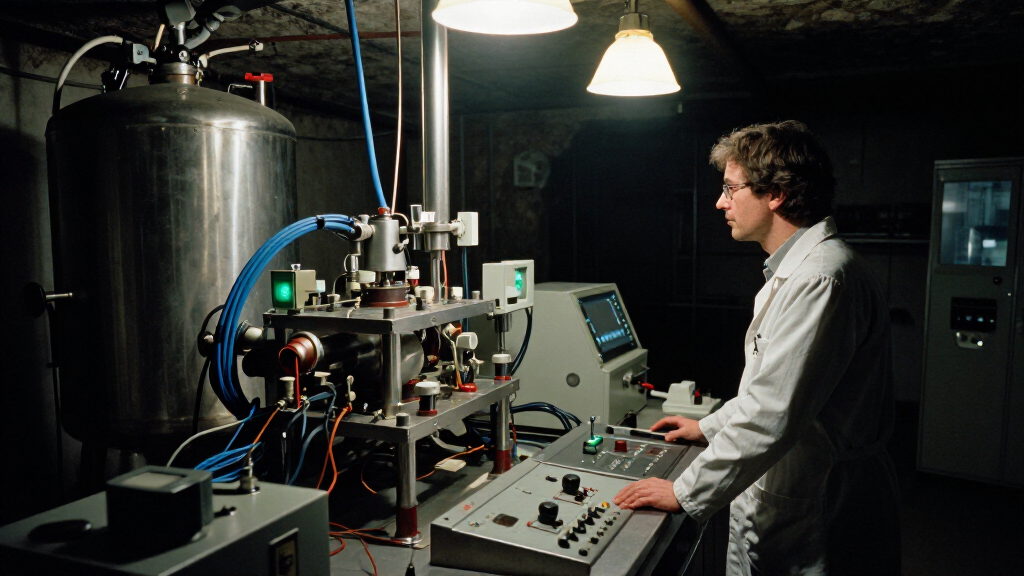
Cherenkov radiation detection equipment
As an affiliate, we earn on qualifying purchases.
As an affiliate, we earn on qualifying purchases.
Unresolved Questions in Neutrino Sources
While the detection of high-energy neutrinos is confirmed, the exact sources of many of these particles remain unclear. Scientists have identified some neutrinos as originating from blazars, a type of active galaxy, but the majority of detections cannot yet be definitively linked to specific cosmic objects. The challenge lies in the difficulty of pinpointing the direction of neutrino arrival with high precision.
Additionally, the precise mechanisms by which cosmic accelerators generate these particles are still under investigation. While theoretical models exist, direct observational evidence is limited by the low interaction rate of neutrinos. Researchers continue to refine detection methods and data analysis techniques to improve resolution and sensitivity.
As an affiliate, we earn on qualifying purchases. As an affiliate, we earn on qualifying purchases.IceCube neutrino observatory model
Future Observatories and Enhanced Precision
The next phase of neutrino astronomy involves the construction of even larger and more sensitive detectors. Projects like P-ONE in the Pacific Ocean and upgrades to existing facilities aim to increase the volume of detectable material, thereby improving the chances of capturing rare high-energy events. These efforts seek to enhance the ability to localize neutrino sources with greater accuracy.
International collaboration will remain critical. The synergy between facilities like IceCube and Baikal-GVD will continue to provide complementary data, allowing for more robust triangulation of cosmic sources. As technology advances, scientists expect to uncover more detailed information about the extreme environments that produce these high-energy particles, further integrating neutrino astronomy with multi-messenger astrophysics.
As an affiliate, we earn on qualifying purchases.
Key Questions
Why are neutrinos difficult to detect?
Neutrinos interact very weakly with matter. They can pass through the entire Earth without hitting anything. Detecting them requires massive volumes of material, like ice or water, to increase the probability of a rare collision event.
What is Cherenkov radiation?
Cherenkov radiation is the blue light emitted when a charged particle moves through a medium, such as water or ice, faster than the speed of light in that medium. In neutrino observatories, this light is produced when a neutrino collides with a proton, creating a shower of secondary particles.
How did Moisey Markov’s idea differ from previous approaches?
Before Markov, physicists focused on small, laboratory-based detectors. Markov proposed using large natural bodies of water or ice as the detection medium, effectively turning the Earth into a giant detector. This allowed for the detection of much higher energy neutrinos from space.
Why is the Baikal-GVD observatory important?
Baikal-GVD is located in the opposite hemisphere from IceCube. This geographic separation allows scientists to triangulate the sources of neutrinos. Additionally, water provides a clearer medium for detecting Cherenkov light than ice, offering higher precision in measurements.
Source: rss
Halloween Picks
halloween
As an affiliate, we earn on qualifying purchases.