
TL;DR

Get everyday essentials delivered free with Prime
- Fast, free delivery on millions of items
- Prime Video, Amazon Music and more included
- Member-only deals all year
OpenAI launched a beta on November 10 that lets businesses claim ChatGPT profiles, add product feeds and track aggregated engagement. The company also acquired AI travel startup Odessia, while media reports put third-quarter revenue at about $10 billion and operating losses at $10.9 billion. Together, the developments point to a larger commercial role for ChatGPT, though OpenAI has not disclosed the acquisition terms or published financial statements.
OpenAI began testing business profiles and shopping agents in ChatGPT on November 10, giving companies new ways to manage how they appear in the chatbot and connect with potential customers. The launch coincided with the company’s acquisition of AI travel startup Odessia and reports that quarterly revenue reached about $10 billion, developments that suggest OpenAI is expanding ChatGPT’s role in business discovery and commerce.
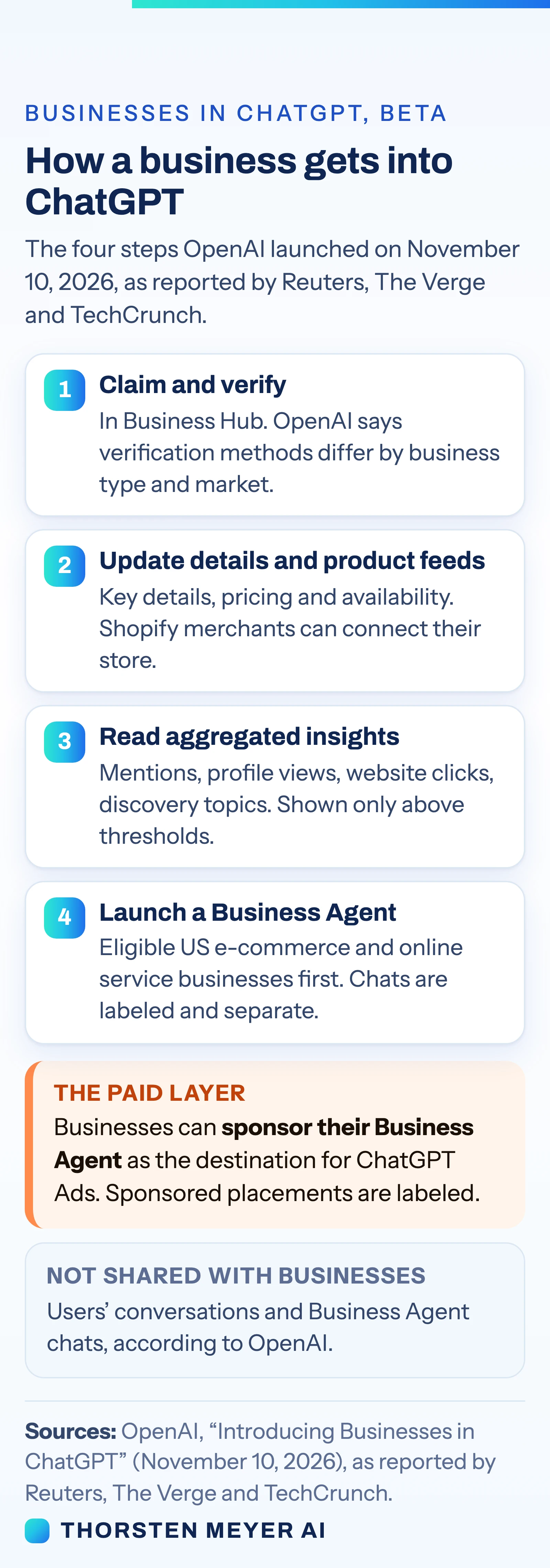
The beta, called Businesses in ChatGPT, includes a Business Hub where companies can claim and verify profiles, update business details and submit product feeds with prices and availability. OpenAI says the Hub will show aggregated measures such as mentions in ChatGPT responses, profile views, website clicks and topics associated with discovery, according to Reuters, The Verge and TechCrunch.
A second feature lets eligible U.S. e-commerce and online service businesses offer Business Agents. Users can open a separate conversation with an agent to ask about a company’s offerings or compare products. Businesses supply the agent’s context and instructions. OpenAI says these conversations are labeled and separated from a user’s main ChatGPT conversation.
OpenAI says it does not share users’ conversations or Business Agent chats with businesses. Business insights appear only after activity reaches unspecified thresholds. Companies can sponsor their agents and use them as destinations for ChatGPT Ads, with sponsored placements labeled. At launch, the agent feature is limited to eligible businesses in the United States.
ChatGPT Becomes a Business Channel
For businesses, the new Hub creates a way to monitor whether ChatGPT mentions them and whether those mentions lead to profile views or website visits. That could make chatbot visibility a practical concern alongside conventional search and advertising, particularly when customers use conversational tools to compare services or products. The metrics may help companies understand activity, though OpenAI has not detailed the thresholds or how businesses can influence recommendations.
The agent feature adds a direct interaction between a company and a prospective customer inside ChatGPT. OpenAI says agents are separate and labeled, and that chats are not shared with the business. At the same time, sponsorship provides a paid route to make an agent a destination for ChatGPT Ads. How users distinguish useful product information from advertising, and how prominently sponsored agents will appear, may shape trust in the feature.
The financial reports add another dimension. The Information reported third-quarter revenue of about $10 billion, while Bloomberg reported growth of nearly 50% from the prior quarter, citing a person familiar with the matter. The Wall Street Journal, as reported by Reuters, put operating losses at $10.9 billion for the quarter. The figures indicate a business scaling alongside significant reported costs, but OpenAI has not released financial statements for independent review.
Popular right now

Apple AirPods Pro 3 Wireless Earbuds with Active Noise Cancellation

Samsung 43-Inch M70H Series 4K Mini LED Smart TV (2026)

Hisense E6SR Series 55-Inch 4K UHD Hi-QLED Roku Smart TV
As an affiliate, we earn on qualifying purchases.
From ChatGPT Ads to Business Profiles
OpenAI describes the launch as an early step toward bringing businesses further into ChatGPT, beginning with business information, insights and conversations intended to help users make decisions. The company previously pursued direct shopping checkout and commissions in ChatGPT. TechCrunch reported that the effort did not gain traction and was retired in March.
Advertising is already part of OpenAI’s commercial plans. In August, the company said ChatGPT Ads had reached a $1 billion annualized revenue run rate. The new Business Hub and agents build on that direction by combining business information, engagement measurements and sponsored destinations within the product.
Odessia’s founder, Francis Davidson, announced the acquisition and said he is joining OpenAI. An OpenAI spokesperson confirmed Davidson’s hire to TechCrunch. The companies did not disclose the deal’s financial terms. The revenue figure also remains a media report rather than a published company result: The Information first reported the $10 billion figure, and Bloomberg separately reported quarter-over-quarter growth.
“Davidson announced that OpenAI had acquired Odessia and that he was joining OpenAI.”
— Francis Davidson, Odessia founder
Costs, Terms and Controls Remain Unclear
OpenAI has not disclosed the terms of the Odessia acquisition, and the company has not published financial statements confirming the reported revenue, growth or operating-loss figures. The revenue and loss numbers should be treated as reported figures, not audited results presented by OpenAI.
The company has also not explained the detailed Business Hub verification process, the activity thresholds for aggregated insights or how product-feed information will affect answers. The beta’s availability may change, and OpenAI has not said when Business Agents will expand beyond eligible U.S. businesses. Its statements about chat privacy describe OpenAI’s stated policy; the launch materials do not provide further detail here about data handling or enforcement.
Business Hub Beta Sets the Next Test
The immediate next step is the rollout and use of the beta by eligible businesses, including how profile verification, product feeds and Business Agent conversations work in practice. OpenAI has not announced a broader launch date or a schedule for expansion beyond the initial U.S. business eligibility.
Businesses and users will be watching whether the new tools generate useful discovery and customer activity, and how sponsored agents are presented alongside other ChatGPT results. Further company disclosures could clarify the acquisition terms and financial picture; until then, the reported quarterly figures and the commercial impact of the beta remain subject to confirmation.
Key Questions
What did OpenAI launch for businesses in ChatGPT?
OpenAI launched a beta Business Hub for claiming profiles, updating details, adding product feeds and viewing aggregated engagement insights. It also introduced Business Agents for eligible U.S. e-commerce and online service businesses.
Can businesses read users’ conversations with ChatGPT?
OpenAI says it does not share users’ conversations or Business Agent chats with businesses. It says insights are aggregated and appear only after activity reaches certain thresholds, which it has not specified.
Did OpenAI confirm $10 billion in third-quarter revenue?
The $10 billion figure was reported by The Information, with Bloomberg reporting nearly 50% growth from the prior quarter based on a person familiar with the matter. OpenAI has not published financial statements confirming the figures.
What is known about OpenAI’s acquisition of Odessia?
Odessia founder Francis Davidson announced that OpenAI acquired the AI travel startup and that he is joining the company. An OpenAI spokesperson confirmed his hire to TechCrunch. The acquisition terms were not disclosed.
Source: Thorsten Meyer AI