
TL;DR
A large language model converts a question into tokens and numbers, then uses transformer layers to predict and generate a response one token at a time. The supplied explainer describes how training, sampling and optional reasoning steps shape answers, while noting that models can make errors and need verification.
The explainer lays out a five-step process. First, a tokenizer divides a prompt into tokens, which may be characters, parts of words, whole words or punctuation. The model converts those pieces into numerical representations called embeddings. Its transformer layers process the representations, using attention to relate tokens to one another, before the model assigns scores to possible next tokens.

Get everyday essentials delivered free with Prime
- Fast, free delivery on millions of items
- Prime Video, Amazon Music and more included
- Member-only deals all year
A sampling step selects a token, which is added to the response; the model then repeats the process. The explainer says temperature affects how adventurous that selection is, so the same prompt can produce different answers. It presents token splits and probability bars in its illustration as approximate rather than exact.
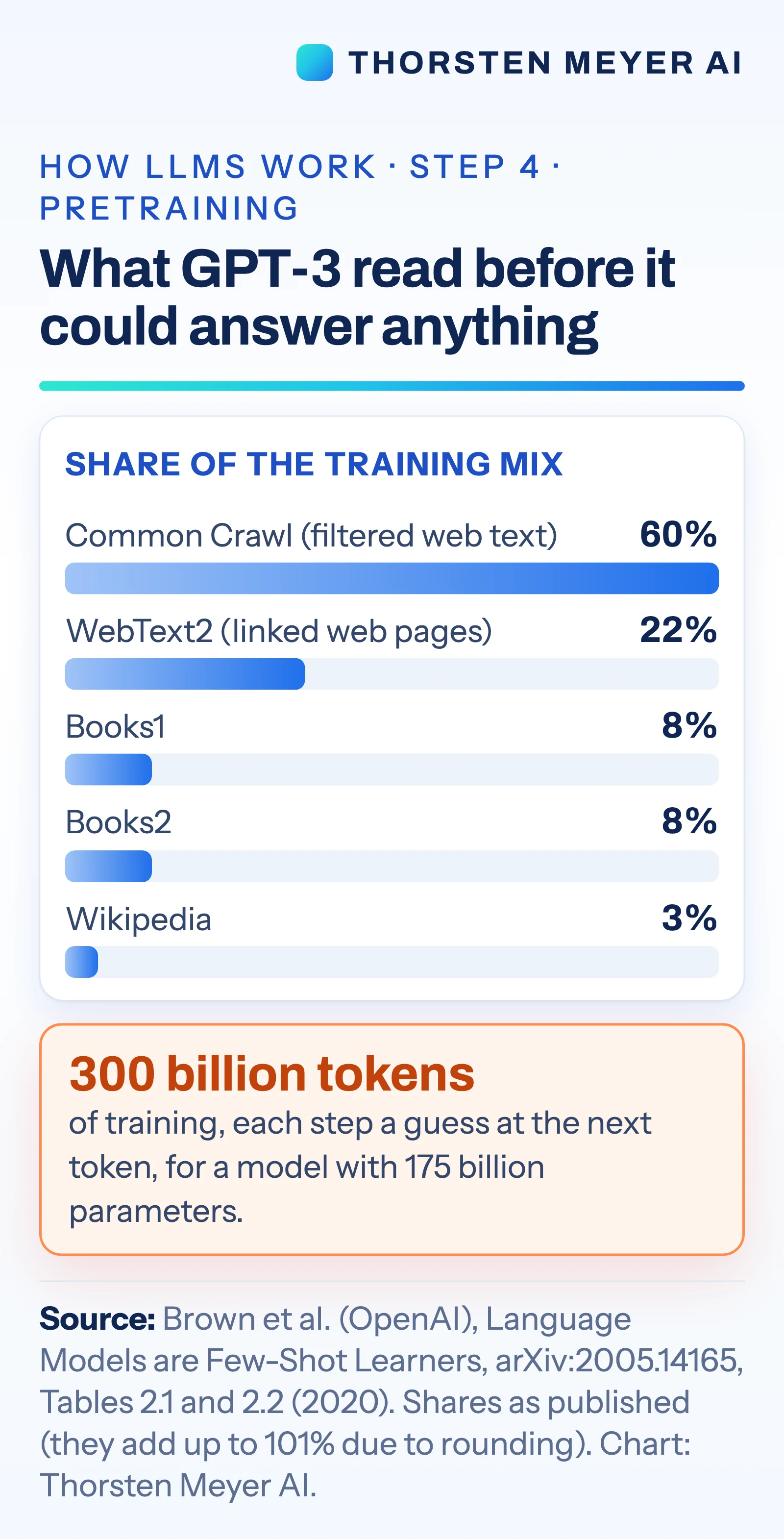
The article also distinguishes pretraining, in which a model learns to continue text from a large corpus, from post-training, which is used to make it follow instructions. The source describes human feedback and AI feedback guided by written principles as two approaches. It says reasoning models may use additional compute to generate hidden reasoning tokens before producing an answer, and that those tokens count as output tokens for billing.
Why Generated Answers Need Checking
The process helps explain why a chatbot can sound confident without having verified its response. As the explainer describes it, the model generates text by selecting likely next tokens; that mechanism can produce useful answers, but it can also produce plausible errors. A fluent response alone does not establish that the information is accurate.
For workplace users, the mechanics also affect cost and limits. Tokens are the units used in model input and output, and they count toward usage limits and charges. The source notes that tokenization varies by model, so the same text may use different token counts in different systems. Users should check important claims and account for token use when working with long prompts or generated responses.
Popular right now

Ninja CM401 Specialty Coffee Maker with 10-Cup Carafe and Fold-Away Frother

Vitamix 5200 Professional-Grade Blender with 64 oz Container, Black

TCL 75-Inch Class 4-Series 4K UHD HDR Smart Google TV (75S446, 2022)
As an affiliate, we earn on qualifying purchases.
From Text Prediction to Assistants
The source traces the transformer architecture to the 2017 paper Attention Is All You Need. It says the architecture lets tokens attend to other tokens, helping the model use relationships within the prompt as it calculates what may come next.
Learning to continue text does not by itself make a system a conversational assistant. The explainer says post-training methods, including feedback from people or AI systems following written principles, are used to steer models toward following instructions. It cites an OpenAI study in which a 1.3 billion-parameter model trained with human feedback was preferred to the 175 billion-parameter GPT-3. That is a result reported by the study, not a general guarantee that smaller models outperform larger ones.
Limits the Explainer Identifies
The source warns that models can make things up and do not know information that appeared after their training data ended, although it does not provide a cutoff date for any particular model. It also says that token sizes are estimates and vary across systems. The article does not specify which model a reader may be using, its training data, current cutoff, sampling settings or tool access; those details must be checked for the individual system.
The supplied source text ends partway through its section on embeddings. It therefore does not provide the full discussion promised in its introduction about tool calls or the complete treatment of reasoning models. The account describes a general process and should not be read as a technical specification for every chatbot.
What Users Should Check
Readers can use the explainer’s process as a guide when evaluating chatbot output: check consequential claims against reliable sources, especially where accuracy affects a business decision. For model-specific questions, consult the provider’s current documentation on token counting, context limits, training cutoff, tool use and billing.
The source points readers to separate explainers on neural network arithmetic, deep learning and context windows for further detail. It does not identify a scheduled follow-up or a next publication date.
Key Questions
Does a large language model look up the answer to a question?
The supplied explainer says a model generates an answer by predicting and selecting tokens one at a time. That description does not rule out a particular chatbot using search or other tools; the source does not detail those integrations.
What is a token?
A token can be a character, part of a word, a whole word or punctuation. The source quotes OpenAI’s estimate of about four English characters per token, while stressing that the figure is approximate and model-dependent.
Why can a chatbot give different answers to the same prompt?
The explainer says a sampler chooses from scored possible next tokens and that temperature affects how adventurous the choice is. As a result, the same prompt can produce different responses.
Can users rely on a fluent answer?
Fluency does not show that an answer is correct. The source says models can make things up, so users should verify important information against reliable sources.
Source: Thorsten Meyer AI