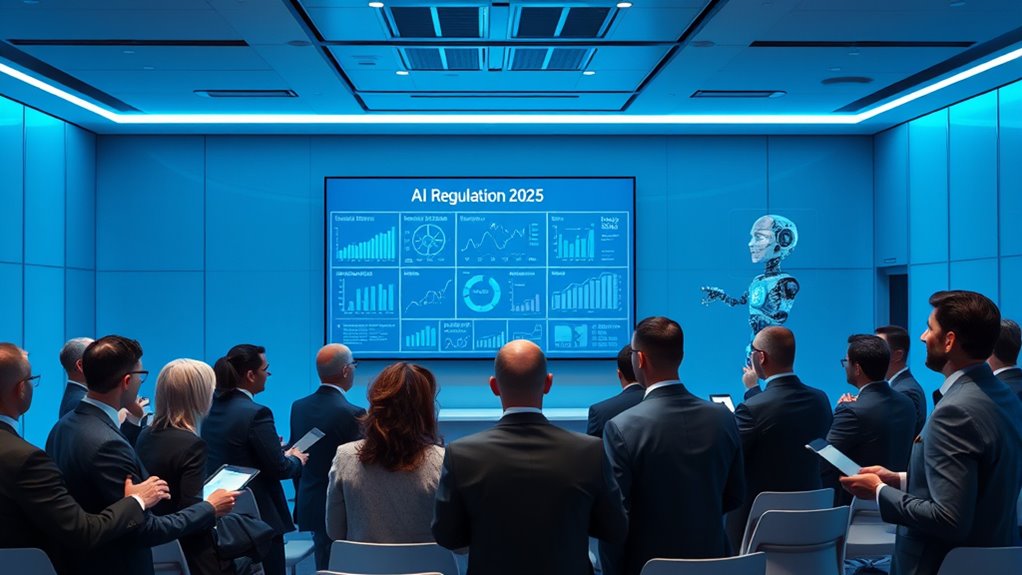

In 2025, the US is making significant progress on AI regulation, focusing on responsible innovation and societal safety. You’ll see proposals that emphasize transparency, ethics, and fairness, with stricter oversight for high-risk applications. The government, industry, and academia are working together to develop adaptable standards that promote responsible growth without stifling progress. Keep exploring to discover how these efforts aim to shape AI’s future and guarantee it benefits everyone.
Key Takeaways
- The US is developing responsible AI regulations emphasizing transparency, fairness, and safety to balance innovation with societal safeguards.
- Policymakers are proposing frameworks that set boundaries against bias and misuse while promoting ethical AI development.
- Regulations focus on testing for bias, ongoing oversight, and accountability throughout AI systems’ lifecycle.
- A risk-based approach favors stricter oversight for high-risk AI applications, easing restrictions on lower-risk tools.
- Collaboration among government, industry, and academia aims to create adaptable standards aligned with AI advancements.

As artificial intelligence continues to advance rapidly, the United States is increasingly focused on establishing effective regulations to guarantee its responsible development and deployment. This push stems from the ongoing ethics debate surrounding AI, which questions how to assure these technologies serve society fairly and safely. You’re likely aware that AI’s influence touches many aspects of daily life, from healthcare to finance, making it essential to balance innovation with safeguards. The challenge lies in creating policies that foster technological progress without compromising ethical standards or public trust.
In 2025, policymakers are actively working on proposals that aim to address these concerns. They recognize that excessive regulation could stifle innovation, but without clear guidelines, AI’s growth might lead to unintended consequences, such as bias or misuse. You’ll see efforts to establish frameworks that encourage responsible innovation while setting boundaries to prevent harmful applications. These proposals often emphasize transparency, requiring developers to disclose how AI models make decisions, which helps mitigate bias and build user confidence.
Policymakers aim to promote responsible AI innovation through transparency and clear guidelines to prevent bias and misuse.
The ethics debate is central to these regulatory efforts. Experts argue that AI systems should be designed with fairness and accountability in mind, especially since many algorithms learn from biased data. You’re probably aware that unchecked AI can perpetuate discrimination or misinformation, so regulations are being crafted to promote ethical standards across the industry. This includes guidelines for testing AI systems before deployment to identify and eliminate biases and ensuring that developers maintain oversight throughout the AI lifecycle. Additionally, implementing comprehensive coverage options can help protect against potential risks associated with AI failures or misuse, fostering greater public trust and safety.
The impact of these regulations on innovation is a key concern. On one hand, strict rules might slow down development, but on the other, they can incentivize better design practices that prioritize safety and fairness. You might see the US adopting a flexible, risk-based approach, where higher-risk applications like autonomous vehicles or medical diagnostics face more rigorous oversight, while lower-risk tools enjoy more leniency. This balance aims to foster innovation without sacrificing societal values.
Additionally, there’s a push for collaboration between government, industry, and academia to develop standards that adapt as AI evolves. You’ll notice that these efforts aim to create a dynamic regulatory environment that can keep pace with technological advancements. By doing so, the US seeks to lead in responsible AI innovation, ensuring that progress benefits everyone while addressing the foundational ethics debate that continues to shape the future of AI policy.

AI Laptop Docking Station with Dual 4K Monitor, Language Translator & Voice Transcription Dock, TOPOINT 7-in-1 USB C Hub 100W PD Charging for MacBook Dell HP, Home Office Remote Work Business Travel
🎁3-in-1 Value: One AI Docking Station = Docking Hub + Voice Recording & Translation + AI Tools Suite
As an affiliate, we earn on qualifying purchases.
As an affiliate, we earn on qualifying purchases.
Frequently Asked Questions
How Does US AI Regulation Compare Internationally?
You’ll find that US AI regulation lags behind some countries with stricter laws, but it’s gaining ground by emphasizing ethical frameworks. Compared internationally, the US advocates for global cooperation to create consistent standards, though approaches vary widely. While regions like the EU enforce rigorous rules, the US balances innovation with regulation. Your role is vital in supporting policies that promote ethical AI development and foster international collaboration.
What Are the Penalties for Non-Compliance?
If you don’t comply with US AI regulations, you could face significant compliance penalties, including hefty fines and legal actions. Enforcement challenges may make it harder to detect violations, but penalties remain strict to encourage adherence. You need to stay updated on evolving rules and guarantee your AI systems meet regulatory standards. Failing to do so risks costly consequences, so proactive compliance is essential to avoid enforcement issues.
How Will AI Regulation Impact Innovation?
Like Pandora’s box, AI regulation sparks both hope and caution for your innovation journey. It encourages you to prioritize ethical concerns, ensuring your advancements align with societal values. While strict rules might slow some experiments, they also foster a balanced innovation environment, promoting responsible growth. You’ll find that clear guidelines can actually protect your creative edge, helping you innovate confidently without risking ethical pitfalls or public trust.
Who Will Oversee AI Regulation Enforcement?
You’ll see AI oversight primarily fall to enforcement agencies like the Federal Trade Commission and the Department of Commerce. These agencies will ensure compliance with AI regulations, monitor industry practices, and handle violations. They’ll work together to develop guidelines, conduct audits, and enforce penalties. Your role involves staying informed about these agencies’ actions and understanding how their oversight impacts AI development, safety standards, and consumer protection.
What Are the Privacy Implications of New AI Laws?
Privacy problems pop up with new AI laws, primarily impacting data privacy and consent management. You might worry about your personal info being mishandled or misused, as regulations aim to tighten protections. These laws could require clearer consent protocols and stricter data safeguards, meaning you’ll have more control over your information. Stay alert—these changes are designed to protect your privacy but need your understanding to ensure your rights are respected.

Artificial Intelligence and Software Testing: Building systems you can trust
As an affiliate, we earn on qualifying purchases.
As an affiliate, we earn on qualifying purchases.
Conclusion
As you watch AI regulation unfold in the US, the next moves remain uncertain. Will policymakers strike a balance between innovation and safety, or will gaps emerge that challenge your trust? The future of AI oversight holds the power to reshape industries and everyday life, but the final chapter is yet unwritten. Stay tuned—what happens next could redefine the very fabric of technology and society you rely on every day.

Serious Managers Guide To AI Guardrails: A Practical Guide to AI Governance, Safety, Ethics, and Enterprise‑Ready Guardrails
As an affiliate, we earn on qualifying purchases.
As an affiliate, we earn on qualifying purchases.

AI That Works: How to Build Scalable, Reliable, and Production-Ready AI Systems from End to End (The AI Engineer's Library)
As an affiliate, we earn on qualifying purchases.
As an affiliate, we earn on qualifying purchases.

Elena’s passion for the arts and culture shines through in her vivid reporting. From film festivals to gallery openings, her coverage is an essential source for anyone interested in the latest cultural trends and artistic movements.