
TL;DR

Get everyday essentials delivered free with Prime
- Fast, free delivery on millions of items
- Prime Video, Amazon Music and more included
- Member-only deals all year
Anthropic’s $965 billion valuation signals a shift where compute capacity, not just funding, becomes the key to AI dominance. The round focuses on infrastructure, chips, and scaling safety research, highlighting the real race in AI today.
Forget the headline-grabbing valuation. What really matters in Anthropic’s $965 billion Series H isn’t just the size of the check. It’s what the money represents: a fierce, unprecedented push for compute power. This isn’t just about funding AI models; it’s about building the infrastructure that will power the next wave of AI breakthroughs.
In a market where scale and speed are everything, Anthropic’s move signals a critical shift. This round isn’t just a record—it’s a statement. The real story is in the chips, datacenters, and the relentless race to add more compute capacity. That’s what will determine who leads in AI’s next chapter.
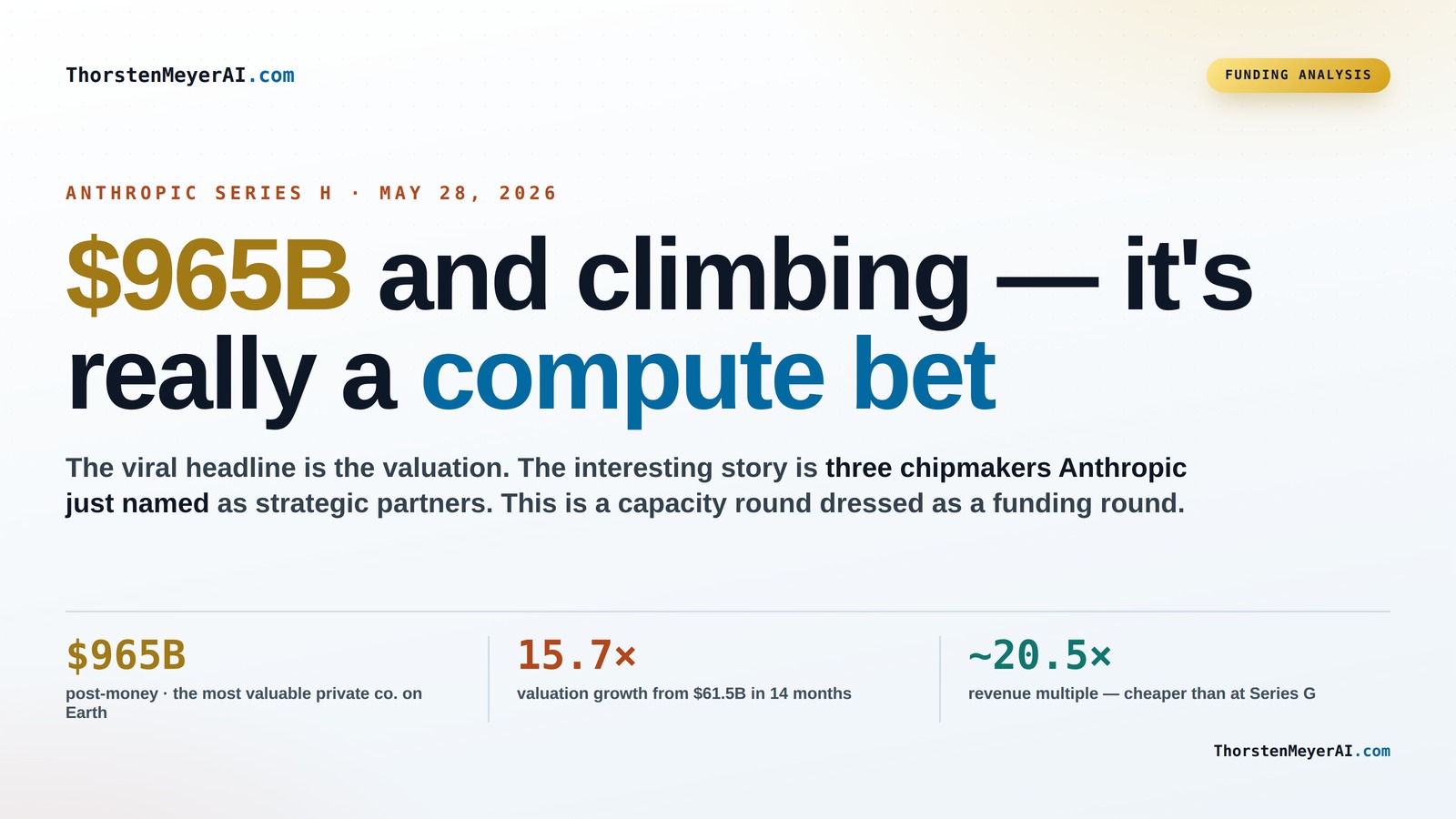
$965B and climbing — it’s really a compute bet
The viral headline is the valuation. The interesting story is in the press release’s middle paragraphs — and in three chipmakers Anthropic just named as strategic partners. This is a capacity round dressed as a funding round.
The numbers nobody can quite parse in sequence
Read together they describe a trajectory with no precedent in enterprise software. Read individually, each looks like a typo.
From $61.5B to $965B in fourteen months
Salesforce took roughly two decades to reach revenue numbers Anthropic just blew past. The sequence below is the part most coverage skips — it’s not the size, it’s the shape.
Anthropic’s valuation ladder · Mar 2025 → May 2026
Five rounds, fourteen months. Bar height is the valuation; the climb itself is the story. Tap any milestone for context.
The multiple actually got cheaper
Bubbles look like multiples expanding while revenue lags. Anthropic’s pattern is the inverse — the valuation tripled, but revenue grew faster, and the multiple compressed.
Revenue-to-valuation multiple · Series G → Series H
Same company, three months apart. The denominator (revenue) is outrunning the numerator (valuation) — exactly the opposite of what a bubble narrative predicts.
10+ gigawatts and three chipmakers
When you name Micron, Samsung & SK hynix alongside your equity backers, you’re saying the binding constraint isn’t demand or model quality — it’s the physical supply of memory chips. The Series H is a capacity round.
Compute commitments backing Anthropic’s capacity bet
$200B+ in announced compute spend across multi-year contracts. The $65B Series H raise has to be read against that bill, not against operating losses.
A genuinely durable bet — or a structural exposure?
Both readings can be true at once. The answer arrives over the next 18–24 months as the gigawatts come online and either fill with paying demand or don’t.
Revenue growth has no precedent in B2B software ($1B → $47B in 17 months). The multiple is compressing, not expanding. Claude is the only frontier model on all 3 major clouds. Enterprise AI spend share went from ~10% to >65% in a year. Compute commitments are tied to specific contracts with capacity dates.
20× revenue is not cheap by any historical software-investing standard. Revenue is reported gross of cloud-reseller pass-throughs, which inflates the top line. Profitability is 2 years out. Amodei’s own warning: a 12-month delay in AI progress “would make him bankrupt” — the compute commitments are a structural exposure to demand persistence.
The valuation race — and the IPO context
Anthropic shipped Opus 4.8 the same morning as Series H — not a coincidence. One week after OpenAI filed confidentially for IPO. The late-2026 frame is set: two frontier AI companies racing to public markets, each pitching durability.
Key Takeaways
- Anthropic’s $965 billion valuation is primarily a signal of its massive compute capacity commitments, not just company worth.
- The round’s focus on chips and datacenter expansion highlights that compute power is now the critical strategic asset in AI.
- Revenue growth is outpacing valuation, shrinking the multiple and indicating real market traction behind the hype.
- Compared to OpenAI, Anthropic trades at a more reasonable multiple, emphasizing infrastructure as its true competitive edge.
- Safety and interpretability remain central to Anthropic’s strategy, integrating technical and ethical priorities in a capacity-driven race.
Popular right now

De'Longhi Linea Classic Espresso Machine with Adjustable Milk Frother

Sony WH-1000XM6 Wireless Noise-Canceling Over-Ear Headphones, Blue, Bundle

Ninja Luxe Café Mini Plus Espresso and Drip Coffee Machine with AutoFroth, Stainless Steel, ES351
As an affiliate, we earn on qualifying purchases.
Why a $965 Billion Valuation Is Less About Money and More About Compute
Anthropic’s eye-popping valuation isn’t just a market hype number. It’s a reflection of how much AI infrastructure the company is lining up. Think of it this way: the valuation is a mirror, showing how much capacity—chips, servers, datacenters—the company plans to deploy.
For example, Anthropic has committed to over 10 gigawatts of compute capacity—equivalent to the output of multiple large-scale data centers. That’s enough to train and run models that could rival or surpass the biggest public AI systems today.
This shift from valuing AI companies on their models alone to valuing their infrastructure capabilities signals a new era. The real currency now isn’t just the data or the model size—it’s the raw power of compute.
Implication: This means that future competitive advantage will increasingly hinge on who can secure and efficiently utilize vast compute resources. Companies that focus only on algorithms without investing in infrastructure risk obsolescence. Decision-makers should consider prioritizing hardware partnerships and capacity planning now, as these are becoming the true strategic assets in AI development.

How This Round Changes the AI Infrastructure Landscape
The $65 billion raised isn’t just a fundraise; it’s a capacity expansion plan on steroids. The money is earmarked for chips, datacenters, and safety research—covering everything needed to make large models faster, safer, and more scalable.
Imagine this: Anthropic is partnering with giants like Micron, Samsung, and SK hynix, securing strategic access to the latest memory chips. This is a move to dominate the supply chain for AI hardware, much like how Apple secures its chip supply.
Compared to traditional startups, this kind of capacity investment is rare. It’s a clear signal that in AI, the bottleneck isn’t data or algorithms—it’s raw compute power.
Implication: This shift means that competitors should evaluate their own hardware supply chains and consider strategic alliances or investments to avoid being left behind. Building or securing access to high-quality hardware now becomes a critical decision for AI firms aiming for scale. The race is no longer just about developing better models but about controlling the physical infrastructure that enables them.

Revenue Growth Is Outpacing Valuation—What It Means
Anthropic’s revenue is exploding. From around $9 billion at the end of 2025 to over $47 billion in just a few months—an astonishing 5.4× jump in revenue in about 14 weeks.
This rapid growth is making the multiple—valuation divided by revenue—shrink even as the valuation hits new highs. At $965 billion valuation and $47 billion in run-rate revenue, the multiple is roughly 20.5×.
Compare that to OpenAI’s 65× multiple. Despite the massive valuation, Anthropic is trading at a more “reasonable” multiple, signaling that its growth is driven by real revenue, not just hype.
Implication: For investors and executives, this signals that revenue growth—especially when it outpaces valuation—can be a more reliable indicator of sustainable market traction than hype alone. Companies should focus on scaling revenue streams and demonstrating real market demand to justify high valuations, rather than relying solely on valuation multiples.

How Anthropic’s Valuation Compares to OpenAI and What It Means
At around a 20.5× multiple, Anthropic trades cheaper than OpenAI’s estimated 65×. But it’s bigger, growing faster, and investing heavily in infrastructure—shifting the narrative from size to strategic capacity.
For example, while OpenAI’s valuation reflects a focus on models and early market dominance, Anthropic’s is increasingly about the raw power behind those models. The message? Infrastructure is the real moat now.
This comparison underscores how the AI race is shifting: it’s less about who has the best model today and more about who can build the biggest, fastest, most scalable compute foundation.
Implication: Investors and strategists should consider that future AI leadership may hinge more on infrastructure and hardware capacity than on model sophistication alone. This could influence funding priorities and partnership strategies, emphasizing hardware alliances and capacity expansion as key to competitive advantage.

What “Safety” and “Interpretability” Have to Do With All This
Beyond compute, Anthropic is still deeply committed to safety and interpretability. That’s part of its brand—building AI that’s not just powerful but safe and understandable.
For example, the round will fund research into making models more transparent, which could be a key differentiator as AI becomes more embedded in critical systems.
It’s a reminder that in AI, raw power isn’t everything—trust and control matter, especially as models grow larger and more complex.
Implication: As the infrastructure scale accelerates, integrating safety and interpretability into the core development process becomes essential. Companies should allocate resources to these areas early, recognizing that safety features can serve as competitive differentiators and reduce regulatory or reputational risks as AI systems become more pervasive.
The Economic Logic: Chips, Data Centers, and the Cost of Scale
Building and running massive AI models isn’t cheap. It involves expensive chips, energy, cooling, and huge data centers. The $65 billion will go into expanding capacity—think of it as fueling the infrastructure engine.
For instance, securing a dedicated supply of memory chips from Samsung or SK hynix isn’t just strategic; it’s necessary. The scale of AI inference—running models in real time—requires a constant flow of new hardware, often in the gigawatts of capacity.
This means that in AI, the economics of scale are shifting. The cost of compute is both a barrier and an asset—who controls it, controls the future.
Implication: Strategic investments in hardware and supply chain resilience will determine who can sustain large-scale AI operations. Companies should evaluate their infrastructure costs carefully and consider long-term partnerships or in-house capacity development to stay competitive in this high-stakes race.

The Future of AI Funding and Infrastructure Battles
Anthropic’s massive capacity push hints at a broader trend: AI infrastructure is becoming the most valuable asset. Future funding rounds will likely focus on building this backbone—chips, datacenters, and supply chains.
For example, expect more strategic partnerships between AI startups and hardware giants, much like Anthropic’s alliances. The race isn’t just about models anymore; it’s about who can build the most solid, scalable infrastructure.
This shift could redefine how we see AI winners—less about who creates the coolest algorithms, more about who owns the most compute power.
Implication: Stakeholders should prioritize investments in infrastructure and supply chain security, as these will be key differentiators in the next era of AI dominance. Recognizing that hardware and capacity are now strategic assets will influence funding, partnerships, and innovation priorities across the industry.
Frequently Asked Questions
Why is Anthropic’s valuation so high compared to other AI companies?
The valuation reflects not just its current revenue but its massive commitments to compute capacity—over 10 gigawatts—making infrastructure the core asset in its strategy. It’s a bet on the future scale of AI, not just its models.What exactly does this round mean for AI hardware and datacenter supply chains?
It signals a huge push to secure hardware supply—chips from Micron, Samsung, and SK hynix—and expand datacenter capacity. This pushes the entire AI ecosystem toward a race for raw compute, similar to how other tech giants secure key components.How does revenue growth impact the valuation multiple?
Anthropic’s revenue has grown rapidly, from $9 billion to over $47 billion in just a few months, pulling down the valuation multiple. This suggests investor confidence in actual market traction rather than just hype.Is this focus on compute a sign of AI’s coming bottleneck?
Absolutely. As models grow larger and more complex, the bottleneck shifts from data to the hardware needed to train and run them. Control over compute capacity becomes the true strategic advantage.Will safety and interpretability slow down this capacity arms race?
Not necessarily. These areas are now part of the capacity story—funding safety research ensures models are not just powerful but trustworthy, making safety a key differentiator in a crowded market.Conclusion
In AI today, the biggest breakthroughs aren’t just about smarter models—they’re about bigger, faster, more reliable compute. Anthropic’s $965 billion valuation is a clear sign that the real race is for infrastructure dominance. If you want to understand AI’s future, follow the chips, servers, and data centers—those are the new gold rush.
As the infrastructure battle heats up, one thing is certain: whoever controls the compute will shape the next era of artificial intelligence. Are you ready to see who wins that race?