TL;DR
Labour MP Jess Asato is suing the company behind Grok over sexualised fake images generated using the AI tool. SpaceX Super Intelligence LLC denies liability, arguing the images were implausible and users supplied the prompts. The High Court has not ruled on the case.
SpaceX Super Intelligence LLC, the company behind Grok, has denied liability in a High Court case brought by Labour MP Jess Asato over sexualised fake images generated using the AI tool. The defence argues that the images would be recognised as fictitious and that users, rather than the company, supplied the prompts; no court has ruled on the claim.

Get everyday essentials delivered free with Prime
- Fast, free delivery on millions of items
- Prime Video, Amazon Music and more included
- Member-only deals all year
Asato filed her claim in England’s High Court on June 3, 2026, seeking remedies for alleged misuse of private information and breaches of data protection law, according to her lawyers at AWO. Her claim says the design and training of Grok enabled users to generate sexualised content depicting her. She is seeking damages, a declaration and an order requiring the company to put in place measures to prevent Grok from creating manipulated images of her.
Reuters reported on November 19 that the company’s written defence, dated October 29, denies liability. It says images that breached the company’s terms were removed. The defence also argues that reasonable viewers would understand other relevant images as AI-generated, fictitious and implausible rather than realistic, and says the company did not determine the content of users’ prompts. SpaceXSI disputes that Asato is entitled to the order she requested.
Asato’s legal team disputes the company’s account. “SpaceX SI wants to have it both ways,” she said, according to the source material. That statement reflects her position in the dispute; it is not a finding by the court. The case concerns alleged image generation that includes a video, but the images themselves are not reproduced here.
Who May Answer for AI Images
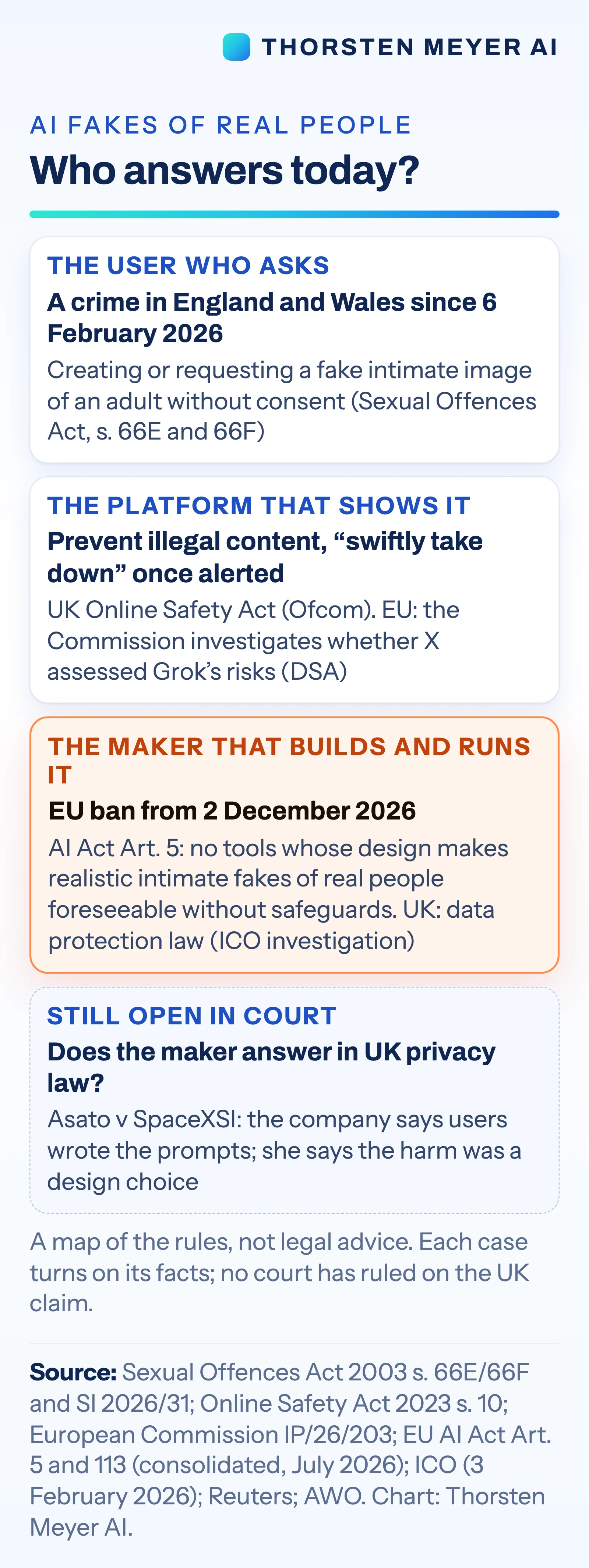
The case puts a practical accountability question before a court: when a user creates a sexualised fake image with an AI tool, what responsibility, if any, falls on the user, the platform that distributes the tool, or the company that designs and operates it? Asato’s claim focuses in part on the system’s design and safeguards. The defence focuses on user prompts, the images’ alleged implausibility and the company’s removal of material that breached its terms.
The answer could matter to people targeted by generated images and to businesses that provide image tools. It may clarify how privacy and data protection claims apply to a system’s outputs and what evidence about design, safeguards and removal procedures is relevant. The case does not itself establish a general rule, and its outcome will depend on the evidence and the court’s legal findings.
Popular right now

Vitamix 5-Speed Immersion Blender, 625-Watt, Stainless Steel/Black

Shark PowerPro Reveal Plus Cordless Stick Vacuum, Charcoal (IZ376H)

Philips 2300 Series Fully Automatic Espresso Machine with LatteGo
As an affiliate, we earn on qualifying purchases.
The Case Amid New Safeguards
According to AWO, Grok was used to manipulate images of Asato in early January 2026. On January 7, the UK Information Commissioner’s Office said it had contacted X and xAI to seek information about measures to comply with UK data protection law. The ICO opened formal investigations into X and X.AI LLC on February 3, according to its statements.
The European Commission opened a Digital Services Act investigation concerning X and Grok on January 26. On March 26, an Amsterdam court ordered limits on Grok and X’s ability to generate or distribute images that undress people, with a penalty of up to €100,000 per day, according to the source material. These are separate regulatory and court actions; they do not decide Asato’s UK claim.
The source material says that, from February 6, 2026, creating or requesting a fake intimate image of an adult without consent has been a crime in England and Wales. It also says a relevant EU AI Act prohibition is due to apply from December 2, 2026, covering AI systems that generate realistic intimate images of identifiable people without consent when the design makes that outcome foreseeable and safeguards are absent. Those rules form part of the wider legal setting, but do not determine the facts or outcome of Asato’s lawsuit.
“The relevant images would be understood by reasonable and sensible persons viewing them to be AI-generated, fictitious and implausible … rather than as realistic images.”
— SpaceX Super Intelligence LLC, in its written defence as reported by Reuters
What the Court Must Still Decide
The High Court has not decided whether SpaceXSI is liable or whether Asato is entitled to damages or the technical measures she seeks. The supplied material does not establish how the court will assess the relationship between Grok’s design, users’ prompts, the images’ characteristics and the alleged privacy and data protection harms.
The defence’s assertion that certain images were implausible is contested. The material also does not report a final finding about what safeguards were in place when the images were generated, how effective they were, or what evidence the parties will present on those questions. The separate UK and EU investigations and the Amsterdam order do not resolve those disputed issues in this case.
Next Steps in the High Court
The next development will be the continuation of the High Court proceedings, where the parties’ claims and defence can be tested. The source material does not give a hearing date or timetable for a judgment. Any ruling on liability or remedies would clarify how the court applies privacy and data protection law to the circumstances alleged by Asato.
In parallel, the ICO and European Commission investigations, and the Amsterdam order, remain distinct developments. The EU AI Act provision described in the source material is scheduled to apply on December 2, 2026. Further findings, rulings or changes to safeguards could affect the wider debate, but their outcomes are not established by the current reporting.
Key Questions
Who is suing the company behind Grok?
Jess Asato, a Labour member of the UK Parliament, filed a High Court claim on June 3, 2026, according to her lawyers at AWO.
What does Asato allege?
Her claim alleges misuse of private information and breaches of data protection law connected to sexualised fake images of her generated with Grok. She says the system’s design and training enabled the content. These are allegations, and the court has not ruled on them.
How has SpaceXSI responded?
The company denies liability. Its defence argues that relevant images would be understood as fictitious and implausible, says users supplied the prompts and disputes that Asato is entitled to the order she seeks.
Has the High Court reached a decision?
No. The case is ongoing. The material provided does not give a hearing date or judgment timetable.
Are the UK and EU regulatory actions part of Asato’s case?
The ICO investigations, European Commission investigation and Amsterdam court order are separate actions. They add to scrutiny of Grok but do not decide the claims in Asato’s High Court case.
Source: Thorsten Meyer AI