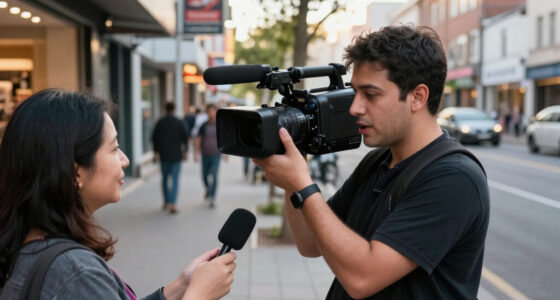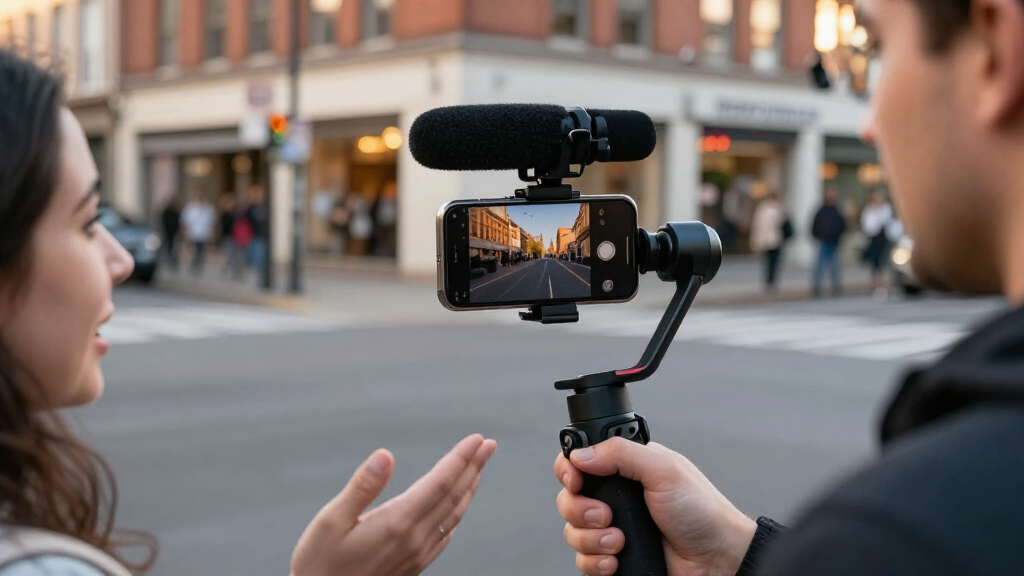
This checklist is for reporters, producers, and independent journalists who use a smartphone to record interviews, standups, and field updates. It covers gear that can support steady footage, clear speech, lighting, power, storage, and on-camera delivery.

Get everyday essentials delivered free with Prime
- Fast, free delivery on millions of items
- Prime Video, Amazon Music and more included
- Member-only deals all year
The sections follow the work from capture through presentation and file handling: a gimbal, microphone, lights, power bank, teleprompter, and mobile SSD. Each slot focuses on the role it serves and practical points to check before choosing the named pick.
Use the checklist to match each item to your reporting style and phone setup. Confirm fit and compatibility with your devices and workflow, then prioritize the gaps that most affect your assignments; you may not need every category at once.
Smartphone gimbal
A gimbal can help when your reporting calls for moving shots, walking standups, or reframing between subjects. The Hohem iSteady M7 is the pick for this slot, with a magnetic AI tracker named in its product title. Before buying, check how the stabilizer mounts your specific phone and whether its controls and tracking features work with the phone and camera app you plan to use. Phone fit comes first: a case, add-on lens, or other attachment can change the dimensions and balance of your setup.
A common mistake is choosing a gimbal for its feature list without considering how it will be used in the field. Think about whether your assignments involve frequent movement, how quickly you need to set up, and whether you can carry and operate the rig comfortably for a full shoot. Check the manufacturer’s supported phone range and setup guidance, and verify that magnetic attachment is suitable for your device configuration. Also consider whether the gimbal leaves access to the ports or buttons you rely on. Test the complete rig with your phone and accessories before depending on it for an assignment; a stable shot is useful only if the setup is practical to handle.
What to look for:
- Supported phone dimensions and weight, including its case
- Mounting and balancing steps for your exact phone
- Compatibility of magnetic AI tracking with your phone and camera app
- Access to phone ports and controls while mounted
- A setup you can carry and operate comfortably
Hohem iSteady M7 Smartphone Gimbal Stabilizer with Magnetic AI Tracker, Fill Lig

The Hohem iSteady M7 is a versatile smartphone gimbal that features magnetic AI tracking for precise subject following, a detachable 1.4" full‑color touchscreen remote with up to 10 m range, and a built‑in aluminum extension rod for high or low angle shots. It also includes a customizable CCT/RGB fill light and three 1/4"‑20 expansion ports for accessories such as microphones and lenses, supportin
Pros:
- Magnetic AI tracker provides accurate subject following without extra hardware.
- Detachable touchscreen remote allows control from up to 10 m away.
- Built‑in extension rod enables creative high and low angle shots.
- Customizable fill light (cool/warm/RGB) enhances low‑light filming.
Cons:
- At 1.1 lb, the gimbal is relatively heavy for handheld use over long periods.
- Multiple accessories and setup steps may be overwhelming for beginners.
Best for: Reporters who regularly capture moving smartphone footage
Not ideal for: People who mostly record from a fixed position
Bottom line: Choose this gimbal when moving shots matter, and confirm phone fit and tracking compatibility first.
Wireless lavalier microphone
Speech is central to interviews, explainers, and live-feeling field reports, so a wireless lavalier system can be a useful part of a mobile kit. The DJI Mic 3 pick includes two transmitters, one receiver, and a charging case, according to its product name. That configuration may suit work involving more than one speaker, but check the actual connection options and supported devices for your recording setup. Verify phone compatibility before relying on a receiver connection, especially if your phone needs an adapter or uses a particular recording app.
Common buying mistakes include assuming every transmitter works seamlessly with every receiver, forgetting to check what is included, or overlooking how the system will be monitored during a shoot. Review the maker’s compatibility guidance for your phone, camera app, and any other recording device you use. Consider whether you need one or two speakers on a typical assignment, and how you will place and secure each mic while keeping it unobtrusive. Confirm the charging case fits your carry kit and that you have a workable plan for charging between shoots. Plan for the whole audio path—mic placement, receiver connection, monitoring, and recording—rather than focusing on the wireless label alone.
What to look for:
- Compatibility with your phone, adapters, and recording app
- Whether two transmitters match your usual interview needs
- Included receiver and charging case contents
- A practical way to monitor and confirm recorded speech
- Mic placement that suits clothing and interview settings
DJI Mic 3 (2 TX + 1 RX + Charging Case), Wireless Microphone
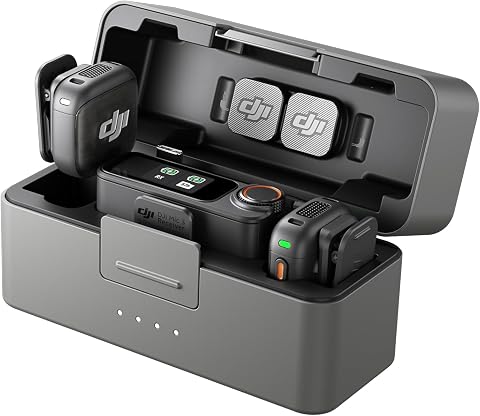
The DJI Mic 3 is a lightweight, pocket‑sized wireless lavalier system that includes two transmitters, one receiver and a charging case. It offers adaptive gain control, dual‑band anti‑interference and up to 28 hours of battery life, plus internal 32‑bit float recording for a reliable backup.
Pros:
- Compact, pocket‑sized design for on‑the‑go shooting.
- Supports up to four transmitters and eight receivers with four‑channel output for multi‑person recordings.
- Adaptive gain control and dual‑band anti‑interference deliver clear audio in noisy environments.
- Integrated 32‑bit float internal recording provides a backup copy of every take.
Cons:
- Requires the first‑generation DJI OM Multifunctional Module to connect with newer Osmo Mobile series devices.
- Uses four C‑cell batteries, which may be bulkier and need occasional replacement despite being included.
Best for: Mobile journalists who often record two-person conversations
Not ideal for: People who only need a built-in phone mic for their work
Bottom line: Match the two-transmitter setup to your interviews and confirm the receiver works with your phone.
Portable LED video light
Lighting can help you shape a smartphone shot when available light does not suit the scene or when you need a consistent setup. The GVM pick is a two-pack LED video lighting kit with app control, as named. Before choosing it, consider whether your reporting takes place indoors, outdoors, or in changing locations, and how much equipment you can bring. Portability and placement matter: two lights are useful only when you can position and power them appropriately for the scene.
A frequent mistake is treating a lighting kit as a substitute for checking the actual environment. Look at the maker’s specifications for the light’s controls, power requirements, mounting options, and any app compatibility, then consider whether those suit your phone and workflow. Think through where stands or other supports would go, how you will keep the setup clear of walkways, and whether a single light would be more manageable for a quick standup. For interviews, consider how the lights can be positioned relative to the subject and background in the spaces you typically use. Check the full setup, including supports, power, and app access, before assuming a two-light kit will be ready for field use.
What to look for:
- Power requirements and expected operating setup
- Mounting or support options for your locations
- App compatibility with your phone
- Whether two lights suit your typical space and crew size
- How the kit packs alongside your phone and audio gear
GVM 2-Pack LED Video Lighting Kit with App Control
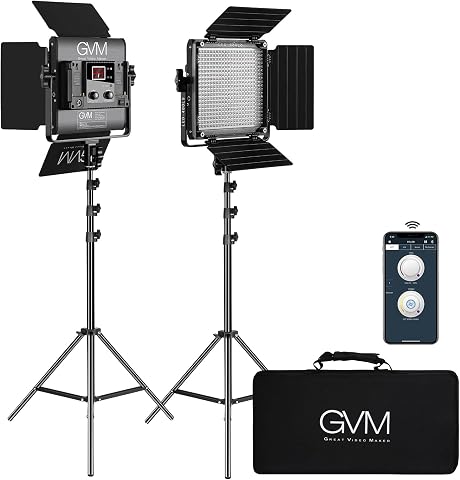
This two-panel LED lighting kit offers app and onboard control of brightness and color temperature, with a digital display and soft diffusers for portrait and video lighting. It includes light stands, power adapters, barn doors, and a carrying bag; panels can run on AC power or compatible Sony F-series batteries, which are not included.
Pros:
- App and onboard controls with a wide adjustable color temperature range
- High CRI and TLCI ratings for color rendering
- Includes stands, diffusers, barn doors, adapters, and a carrying bag
- Can run on AC power or compatible batteries
Cons:
- Compatible batteries are not included
- The raw listing gives conflicting warranty details: 180 days and one year
Best for: Journalists who regularly light interviews or indoor standups
Not ideal for: Reporters who need the lightest possible run-and-gun kit
Bottom line: Consider this kit if you can use both lights, and check its power, support, and app requirements.
USB-C power bank
A power bank can support a mobile reporting workflow when the phone and accessories need charging away from a desk. The Anker Prime pick is identified as a 26,250mAh USB-C power bank with a 300W rating and a fast charging base. Those figures are part of the product name; confirm the manufacturer’s details for supported devices, ports, and charging behavior. Device compatibility matters: check that the bank can serve the specific phone and other gear you intend to connect.
A common mistake is buying around capacity or output figures alone without checking what your kit actually needs. List the devices you expect to charge, identify their connectors and charging requirements, and confirm which ports can be used at the same time. Check whether the charging base fits your routine and whether you can carry the bank comfortably with your field gear. Also review applicable airline and travel rules for carrying power banks before a trip. Consider how you will keep cables organized and make sure a charging setup will not interfere with recording or movement. Build around your devices and the way you travel, rather than assuming a large power bank automatically suits every mobile kit.
What to look for:
- USB-C and other port compatibility for your devices
- Supported charging behavior for phone and accessories
- Whether multiple devices can charge as needed
- Fit of the charging base in your routine and workspace
- Carry and travel requirements for the power bank
Anker Prime Power Bank, 26,250mAh, 300W with Fast Charging Base

The Anker Prime Power Bank offers a high-capacity 26,250mAh battery with a 300W total output, capable of fast charging multiple devices including MacBook Pros and iPhones. It features smart display and app control for detailed charging management and supports rapid recharging for high-use scenarios.
Pros:
- High-capacity 26,250mAh battery for multiple device charges
- Powerful 300W output supports fast charging for laptops and smartphones
- Supports rapid recharging with 250W input
- Smart display and app control for detailed management
Cons:
- Relatively heavy at 1.3 pounds
- Limited to specific high-power devices
- Requires compatible cables for optimal fast charging
Best for: Field teams carrying several devices that need charging
Not ideal for: People who only need occasional phone top-ups
Bottom line: Choose this power bank to support a multi-device kit after checking ports, charging needs, and carry requirements.
Smartphone teleprompter
A teleprompter can help presenters deliver prepared lines while addressing the camera, making it a potential fit for scripted standups and explainers. The Elgato Prompter pick is described as having a built-in screen and 1080p Full HD resolution. Check the manufacturer’s setup instructions and supported devices to confirm how it works with your smartphone, camera, and preferred prompting software. Confirm the intended camera arrangement before buying, since your phone’s position and the prompter’s mounting approach need to work together.
One common mistake is focusing on screen resolution while overlooking the physical setup and reading workflow. Check how the device mounts, what space it needs, how you control or load the script, and whether the screen is suitable for your shooting distance. Consider whether the phone is serving as the camera, the prompt source, or another part of the setup, and verify that the intended configuration is supported. A teleprompter can add setup steps, so think about whether your assignments allow time to prepare and rehearse. Try your framing and reading distance with the actual camera and script workflow before relying on it for a shoot.
What to look for:
- Supported phone and camera configurations
- Mounting method and required workspace
- How scripts are loaded and controlled
- Reading distance and framing for your usual shots
- Whether your workflow allows time for setup and rehearsal
Elgato Prompter with Built-in Screen and 1080p Full HD Resolution
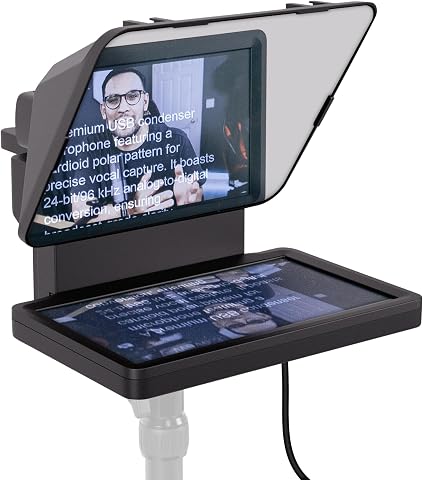
The Elgato Prompter features a built-in display that allows you to read scripts or chat messages without additional devices. It supports various cameras, is easy to set up, and helps maintain eye contact during video calls or streaming.
Pros:
- Built-in display eliminates the need for extra tablets or smartphones
- Supports a wide range of cameras, including wide lenses
- Easy to set up and control via PC or Mac
Cons:
- DisplayLink software required on Mac and Android devices
- No mobile app control, may limit flexibility for some users
Best for: Presenters recording prepared pieces to camera
Not ideal for: Reporters who rely mostly on spontaneous interviews
Bottom line: Pick this for scripted delivery after confirming the camera arrangement and prompting workflow.
Mobile SSD
Mobile reporting can create files that need to be moved and kept organized, so an external SSD may be useful in a workflow that supports it. The Samsung T9 pick is named as a 4TB portable SSD with USB 3.2 Gen 2×2 and up to 2,000. Check the manufacturer’s specifications to understand the stated speed unit and the devices that support the drive. Connection compatibility is essential: a matching cable or connector alone does not guarantee that your phone, computer, or editing setup can use every listed capability.
A common mistake is treating the drive’s capacity and interface label as proof that it will fit a particular phone workflow. Confirm whether your phone can record or transfer directly to external storage, which file systems and applications are supported, and whether the drive needs additional power in your setup. Check ports and cable requirements across the phone and editing computer, and verify that your transfer process preserves the formats and folder structure you use. Plan how you will label and back up assignment files; one drive may be part of a workflow, but your retention needs determine whether additional copies are required. Test a complete transfer from the recording device to the drive and onward to your editing system before depending on it in the field.
What to look for:
- Direct recording or transfer support on your phone
- USB interface, cable, and port compatibility across devices
- Drive format and software support in your workflow
- Power needs during mobile use
- A file labeling and backup routine for assignments
Samsung T9 Portable SSD 4TB, USB 3.2 Gen 2×2 External SSD, Up to 2,000 MB/s
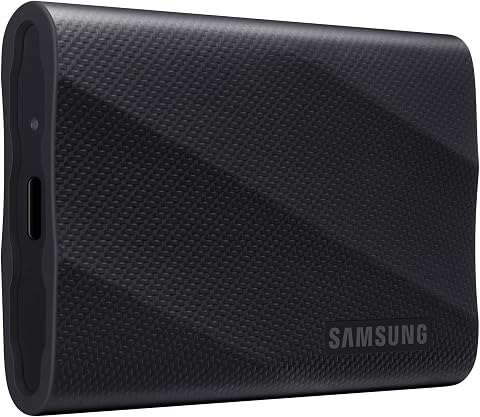
The Samsung T9 Portable SSD delivers up to 2,000 MB/s sequential read and write speeds over a USB 3.2 Gen 2×2 interface, making large file transfers fast and reliable. With a 4 TB capacity, rugged drop resistance, dynamic thermal guard, and AES‑256 hardware encryption, it’s built for creators who need performance and durability on the go.
Pros:
- Blazing transfer speeds up to 2 GB/s when paired with a compatible USB‑C port.
- Large 4 TB storage capacity for extensive media libraries and projects.
- Dynamic Thermal Guard keeps the drive cool during sustained heavy use.
- Rugged design tolerates drops up to 9.8 ft and includes AES‑256 encryption.
Cons:
- Maximum speeds require a USB 3.2 Gen 2×2 host and UASP‑enabled cable; slower on older ports.
- Performance can vary depending on the host device’s configuration.
Best for: Journalists who transfer or carry large media files
Not ideal for: People whose phone workflow does not support external storage
Bottom line: Choose this SSD when your devices support the connection and your file workflow benefits from external storage.
Build your kit in the order that addresses your most frequent reporting problem. Start with the item that affects the work you do most—often reliable speech capture or enough power for a long field day—then add stabilization, lighting, prompting, or storage as your assignments call for them. Prioritize by workflow, and verify compatibility before filling gaps with extra gear.
You can assemble a capable mobile journalism setup one role at a time. Check each device with your phone and recording process, keep the kit manageable for the places you report, and adjust as your work changes. Start with your next assignment and choose the tools that will help you complete it confidently.