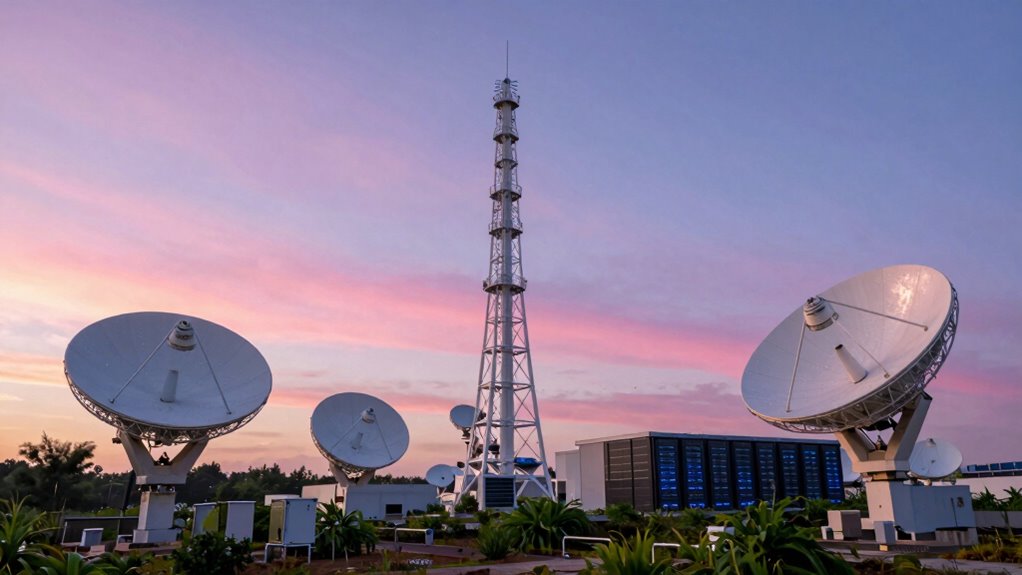

You can see weather forecasting improve as models get smarter and data collection becomes more precise. Advanced models analyze huge amounts of data from satellites and sensors to predict weather patterns more accurately. Continuous technological progress allows forecast updates in real time, giving you timely alerts and better planning. As scientists refine these tools, predictions become more reliable, especially for extreme events. Keep exploring how these innovations keep shaping forecasts and protecting communities.

Get everyday essentials delivered free with Prime
- Fast, free delivery on millions of items
- Prime Video, Amazon Music and more included
- Member-only deals all year
Key Takeaways
- Advanced models integrate large datasets for more accurate and reliable weather predictions.
- Real-time satellite data enhances early detection of weather changes and extreme events.
- Improved sensors increase data quality, enabling detailed atmospheric analysis.
- Continuous technological progress refines climate trend understanding and long-term forecasts.
- Big data analytics and modeling techniques improve prediction precision and response to weather threats.
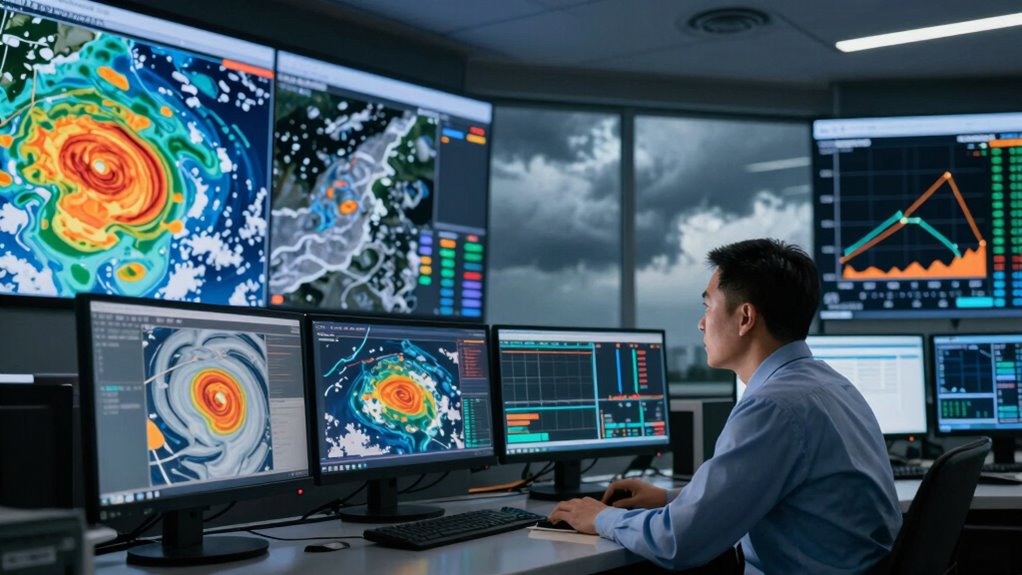
Advancements in technology have greatly enhanced weather forecasting accuracy, allowing meteorologists to predict weather patterns more reliably than ever before. Today, the integration of sophisticated models and extensive data sources means you can trust weather reports to be more precise, giving you better planning and safety. One of the most significant developments has been the rise of satellite technology, which provides real-time, high-resolution imagery of Earth’s atmosphere. These satellites orbiting miles above us collect invaluable data on cloud formations, storm systems, and temperature variations. This information helps meteorologists track weather developments with remarkable speed and accuracy, often hours or even days ahead of traditional methods. satellite technology not only improves immediate forecasts but also offers critical insights into long-term climate trends. Satellite technology plays an essential role in understanding how climate change influences weather patterns. As climate change accelerates, it causes shifts in storm intensity, rainfall distribution, and temperature extremes. Satellites help scientists observe these changes over time, revealing trends that ground-based stations might miss. This extensive data allows for the refinement of weather models, making forecasts more dependable in a changing climate. You benefit from this progress because improved models help predict extreme weather events like hurricanes and heatwaves more accurately, giving you earlier warnings and more time to prepare. Additionally, the continuous improvement of weather modeling techniques ensures that forecasts become increasingly reliable, even in complex or rapidly changing conditions. As research advances, the incorporation of big data analytics further enhances the precision of weather predictions, enabling more effective responses to emerging threats. Moreover, ongoing developments in data collection methods continue to expand the volume and quality of information available for analysis, with advanced sensors playing a significant role in gathering detailed atmospheric data.
As an affiliate, we earn on qualifying purchases.
Frequently Asked Questions
How Accurate Are Short-Term Weather Forecasts Compared to Long-Term Predictions?
Short-term weather forecasts are generally more accurate than long-term predictions because of better forecast reliability and higher prediction precision. You’ll notice that daily or hourly forecasts tend to be quite reliable, often within a few hours or miles. However, as you look further ahead, the accuracy decreases because the atmosphere’s complexity makes long-term predictions less precise. So, for the most accurate info, focus on short-term forecasts.
What Role Do Artificial Intelligence and Machine Learning Play in Weather Modeling?
Artificial intelligence and machine learning markedly enhance weather modeling by using data assimilation and neural networks. You benefit from more accurate forecasts because these technologies analyze vast data sets quickly, identify patterns, and improve predictions. Neural networks learn from historical data, helping models anticipate complex weather phenomena. This continuous learning process allows meteorologists to deliver more reliable forecasts, especially for severe weather events, ultimately keeping you better informed and safer.
How Do Satellites Improve the Quality of Weather Data?
Satellites enhance your weather data by providing real-time, wide-area observations. Through satellite calibration, scientists guarantee the data remains accurate over time. These images and measurements feed into data assimilation processes, integrating satellite info into weather models. This continuous flow improves forecast precision, helping you better anticipate weather changes. By refining satellite calibration and data assimilation, meteorologists can deliver more reliable, detailed forecasts that keep you better prepared.
What Challenges Do Meteorologists Face When Updating Weather Models?
You face challenges updating weather models, especially with data assimilation and model resolution. Integrating new data smoothly requires precision, and gaps or inaccuracies can impact forecasts. Improving model resolution helps capture smaller weather features, but demands more computational power. Balancing detailed data integration with processing capabilities keeps meteorologists working hard to enhance forecast accuracy, ensuring you get timely, reliable weather information despite these hurdles.
How Does Climate Change Impact the Accuracy of Weather Forecasting?
Climate change is like a wild card in weather forecasting, throwing off predictions by increasing climate variability. You might notice more unpredictable storms or shifts in weather patterns. Data assimilation becomes even more essential, helping meteorologists incorporate new, real-time data to adjust models. This ongoing adaptation helps improve forecast accuracy, but the changing climate keeps the challenge lively, requiring constant innovation to stay ahead of the unpredictable weather game.
personal weather station with sensors
As an affiliate, we earn on qualifying purchases.
As an affiliate, we earn on qualifying purchases.
Conclusion
As you watch the sky, remember that each new model and data point acts like a lantern guiding your way through uncertainty. Just as stars illuminate the night, advancements in weather forecasting brighten our understanding, helping us navigate storms ahead. With every improvement, you become more attuned to nature’s whispers, trusting the signals it sends. Together, better models and richer data form a constellation of hope, guiding you safely through whatever weather lies ahead.
advanced weather forecasting model software
As an affiliate, we earn on qualifying purchases.
As an affiliate, we earn on qualifying purchases.
As an affiliate, we earn on qualifying purchases.
Halloween Picks
halloween
As an affiliate, we earn on qualifying purchases.