TL;DR
A November 23 explainer from Thorsten Meyer AI describes how diffusion models learn to remove noise from images and use that process to generate pictures from text prompts. It also outlines limits in lettering, counting and object placement, and notes that legal questions about training data remain open.
Thorsten Meyer AI published an explainer on November 23 describing how diffusion models generate images by starting with random noise and gradually removing it under the direction of a text prompt. The guide matters to readers trying to understand both the process behind AI image tools and why they can struggle with details such as lettering, object counts and spatial relationships.

Get everyday essentials delivered free with Prime
- Fast, free delivery on millions of items
- Prime Video, Amazon Music and more included
- Member-only deals all year
The explainer describes a two-part process. During training, a model receives real images with noise added in small increments. A neural network learns to estimate the noise at each stage. During generation, the model starts with noise and repeatedly estimates and removes it, producing an image over a series of steps. The guide says the 2020 paper “Denoising Diffusion Probabilistic Models” used 1,000 steps in its experiments; it gives 50 steps as a common default in an open-source pipeline.
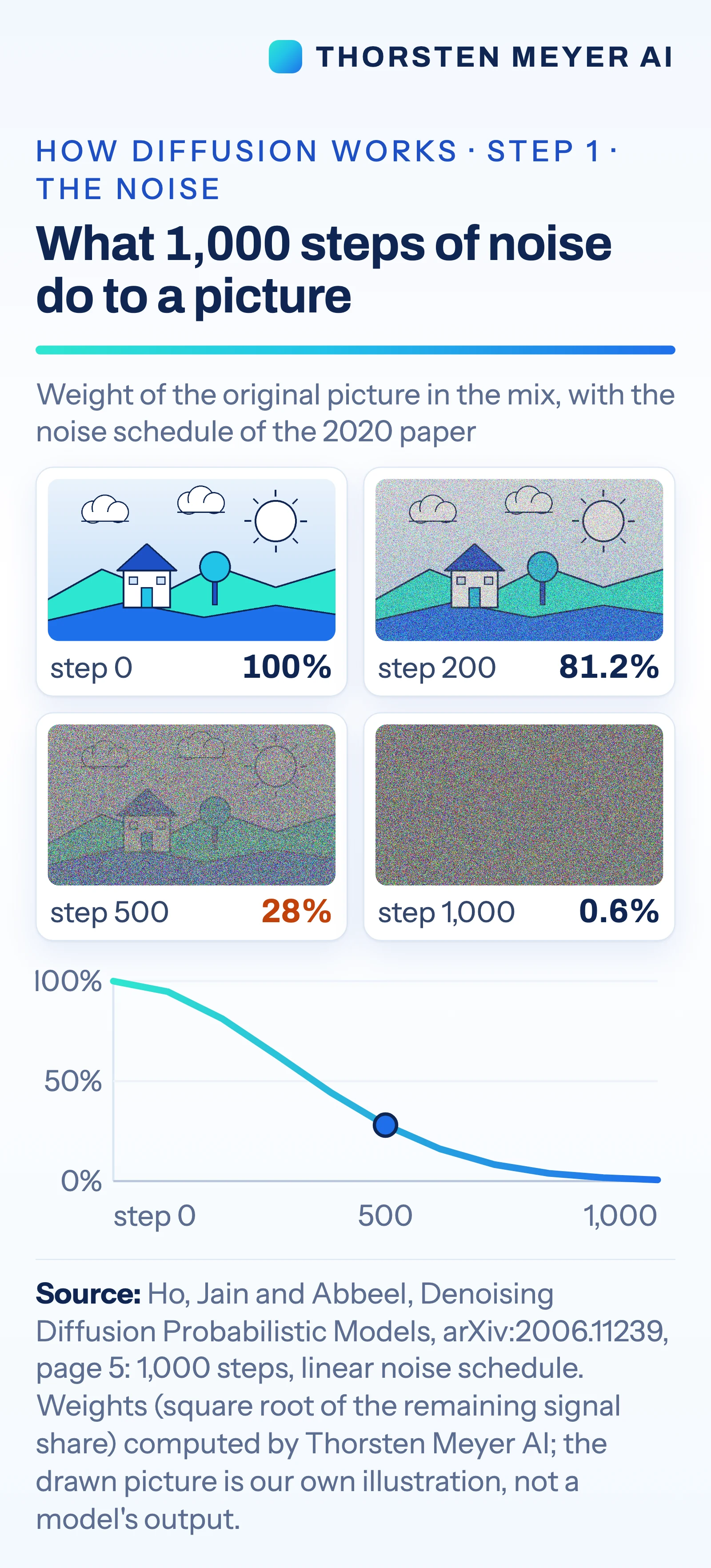
To explain the training method, the article cites a 2015 paper by Jascha Sohl-Dickstein and colleagues, which proposed gradually destroying structure in data and learning a reverse process to restore it. It then describes the 2020 work by Jonathan Ho, Ajay Jain and Pieter Abbeel. In their experiments, images were progressively noised until the original signal was nearly gone. The explainer gives illustrative figures for that paper’s schedule: the original image’s weight fell to 81.2% after 200 steps, 28% after 500 and 0.6% after 1,000.
The guide also discusses latent diffusion, which performs the noise process on a compressed representation rather than directly on every pixel. It says that, in Stable Diffusion v1, a 512-by-512 image is represented with 48 times fewer numbers. A text encoder converts the prompt into numerical representations; guidance then steers the generation process toward the prompt. According to the article, stronger guidance can bring results closer to the text at some cost in image quality.
Why Image Models Miss Details
The step-by-step process helps explain why a model can produce a convincing overall scene while mishandling specific instructions. Diffusion models refine an image through repeated estimates; the explainer says lettering, counting objects and placing them correctly remain difficult. A prompt may ask for a cube on top of a sphere, for example, but the relationship can come out wrong.
The article also raises a separate concern: models can sometimes produce images that closely resemble material in their training data. It reports that researchers have extracted near-copies from models. That issue connects image generation to questions about how training material is used and what safeguards or legal rules apply. These points are presented as limits and concerns, not as evidence that every generated picture copies a source image.
Popular right now

Bose QuietComfort Wireless Noise Cancelling Headphones – Cypress Green (Limited Edition)

Sony WH-1000XM6 Wireless Noise-Canceling Headphones, Black

Apple AirPods Pro 3 Wireless Earbuds with Active Noise Cancellation
As an affiliate, we earn on qualifying purchases.
From Early Theory to Latent Diffusion
The explainer places diffusion methods in a research timeline. Sohl-Dickstein and colleagues described a gradual forward process that destroys structure and a learned reverse process that restores it in 2015. Ho, Jain and Abbeel’s 2020 paper, “Denoising Diffusion Probabilistic Models,” made a practical version of the method a focus of experiments using a 1,000-step process.
Later image systems made generation more efficient by operating in a compressed latent space. The guide uses Stable Diffusion v1 to illustrate that approach and points readers to public research papers and Hugging Face diffusers documentation for descriptions of the process. It is part of Thorsten Meyer AI’s explainer series on how AI works, alongside articles about neural networks, deep learning and language models.
“It starts from a grid of random noise, like the snow on an old television, and removes a little of that noise, then a little more, again and again, until a lighthouse is left.”
— Thorsten Meyer AI, describing diffusion models
Open Questions on Copies and Copyright
The explainer says researchers have extracted near-copies of training images from diffusion models, but the supplied material does not identify the studies, explain how often this occurs or define the conditions under which it happens. The scale and practical significance of the risk are not established here.
On copyright, the article reports that a UK court found in 2025 that Stable Diffusion itself is not an “infringing copy,” while other questions remain open. The supplied text does not identify the case or detail which issues were left unresolved, so it does not support a broader conclusion about the legality of training on particular works or about other systems.
What Readers Can Check Next
The explainer points readers to the cited 2015 and 2020 research papers and to Hugging Face diffusers documentation for further detail on the method. Those sources describe how noise is added and removed; the article does not announce a new model, benchmark or scheduled product release.
For the legal questions it raises, further developments would depend on court decisions or additional reporting that identifies the relevant cases and claims. The supplied material does not give a timetable for those developments.
Key Questions
How does a diffusion model generate an image?
It begins with random noise and repeatedly estimates and removes noise. A text prompt steers those steps until an image forms.
Why does the model add noise during training?
Training gives the network images at different noise levels and the noise that was added. The network learns to estimate that noise, a skill used in reverse during generation.
Why can image models get text or object placement wrong?
The explainer identifies lettering, counting and spatial relationships as persistent difficulties. A model may capture the general scene while missing a precise instruction about where an object belongs.
Does the explainer settle whether AI image training violates copyright?
No. It reports a 2025 UK court finding that Stable Diffusion itself was not an “infringing copy” and says other questions remain open. The supplied material does not establish a general legal rule for training data.
Source: Thorsten Meyer AI