TL;DR
The HCLTech paper “Weight Space Misfolding” tested three ways of altering one small model’s weights; the authors say it did not demonstrate a self-propagating virus or actual offensive capabilities. Separate research showed that weight edits can change model behavior, while a cloud provider reported that some customers’ incomplete weights and datasets were accessed.
Researchers at HCLTech tested whether edits to a model’s weights could produce behaviors resembling a computer virus, but their paper “Weight Space Misfolding” did not demonstrate self-propagation or actual offensive capabilities. The distinction matters as other recent work shows that small weight changes can alter a model’s behavior, and Fireworks AI has reported access to some customers’ incomplete model weights and datasets.

Get everyday essentials delivered free with Prime
- Fast, free delivery on millions of items
- Prime Video, Amazon Music and more included
- Member-only deals all year
The paper was discussed on Hacker News on November 13, after its lead author described it on X as research into “viruses that spread in model weights.” The authors’ own account is more limited: the abstract says the cases explored “do not demonstrate self-propagation or actual offensive capabilities.” They also write that they do not claim to have created or demonstrated a virus that primarily operates in weight space.
HCLTech researchers ran three probes on one small model. According to the source article, one edit succeeded but also damaged a nearby capability; two other attempts mostly failed. The paper therefore investigates possible effects of weight changes, rather than showing an edit that spreads from one model to another. The source material does not provide enough detail to characterize each probe’s results more precisely.
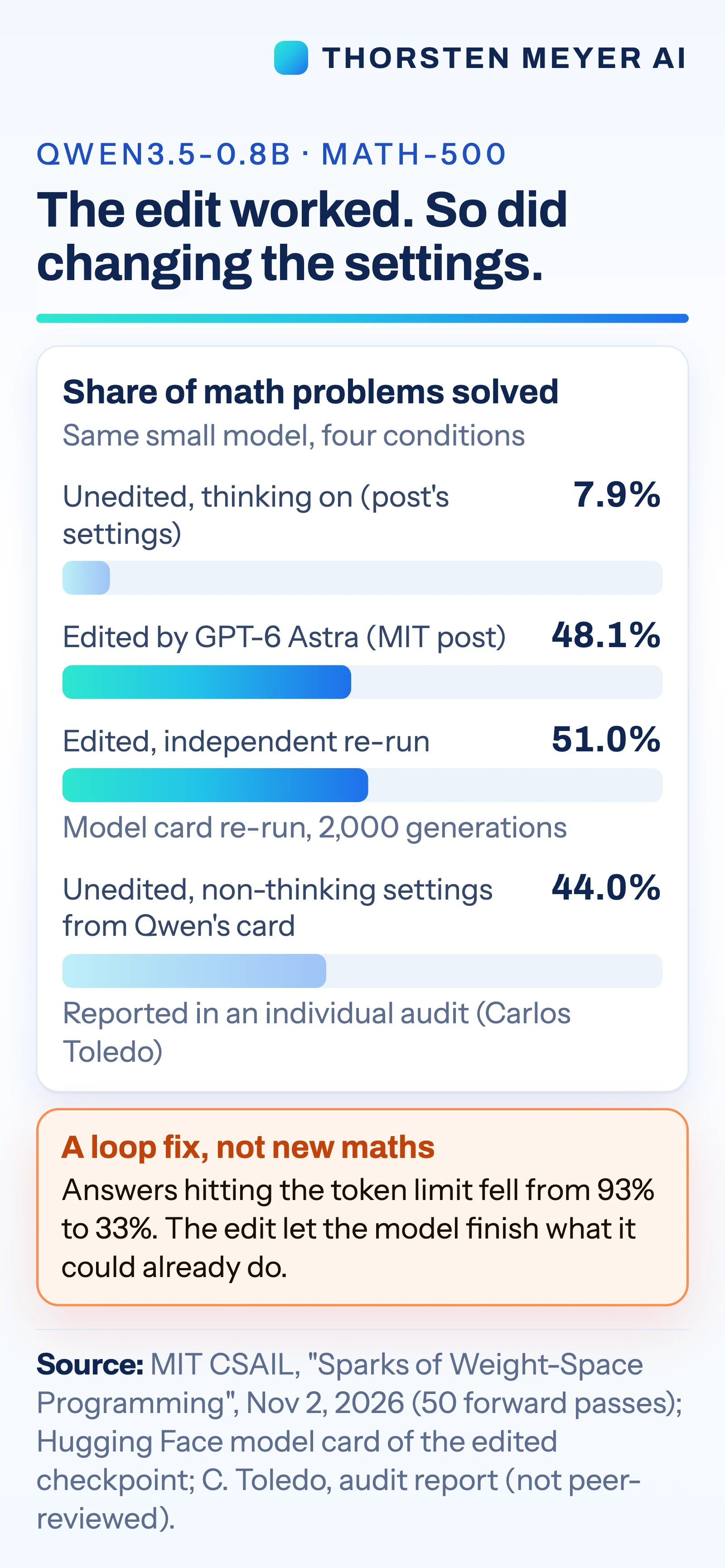
Two other research examples show why the topic has drawn attention. In a November 2 MIT CSAIL study, GPT-6 Astra changed 0.016% of a small Qwen model’s weights; its MATH-500 score rose from 7.9% to 48.1% as the edit reduced reasoning loops. The source article says an independent audit found the unedited model scored 44.0% with different settings, a comparison that complicates how much of the gain can be credited to the edit. Separately, Microsoft researchers reported turning an 8-billion-parameter agent model into a sleeper by editing seven neurons; the trigger produced the payload in at least 98.8% of triggered test runs. Microsoft said it had not seen attackers use the technique.
Why Weight Changes Matter
Model weights are the numbers learned during training, and changing them can change the model’s responses or actions. Unlike a typical software patch, a set of altered weight values is difficult to interpret on its own; the source paper says tensor changes are essentially arbitrary without the model. That makes provenance checks and behavioral testing relevant when organizations download or fine-tune models.
The examples point to different security questions. An edit might correct a known failure, introduce a hidden trigger, or have an unintended side effect. The HCLTech paper does not establish that these edits can spread autonomously, so readers should not treat its title or the author’s social post as evidence of a working weight-space virus. The reported Fireworks AI incident adds a separate concern: weights can be exposed through a cloud breach, regardless of whether they contain a malicious edit.
The source article recommends treating downloaded or fine-tuned weights like code from an unfamiliar source: check where they came from, compare them with the declared base model, test their behavior, and restrict what any agent using them can do. These are proposed precautions, not evidence that every model file is compromised.
Popular right now

Vitamix VX1 Professional-Grade Blender, 64 oz, Black

Roborock Qrevo 2 Pro Robot Vacuum and Mop, 20,000 Pa Suction

Ninja Foodi Smart 6-in-1 Indoor Grill and Air Fryer, 4 qt, FG551
As an affiliate, we earn on qualifying purchases.
Three Recent Weight-Security Cases
The November research stories address different parts of the same problem. MIT CSAIL’s November 2 experiment tested whether an AI system could edit another model’s weights to remove a reasoning loop without retraining. Microsoft’s November 10 work tested whether editing seven neurons could create a trigger-based backdoor in an agent model. HCLTech’s paper, dated November 14, explored weight-space misfolding and explicitly disclaimed demonstrating a self-spreading virus.
In the MIT example, the edited checkpoint changed 131,072 weights in a model with about 0.8 billion parameters. Its reported benchmark improvement came from helping the model finish answers, not adding a new mathematical skill, according to the researchers. The published checkpoint’s model card identifies two changed tensors and provides SHA-256 hashes, details the source article presents as ways to compare a file with its base.
The fourth development was a cloud security incident. Fireworks AI said that, for certain customers, “a subset of incomplete model weights and datasets were accessed.” The source material does not link that incident to the research papers or say that the accessed files were modified or used in an attack.
““do not demonstrate self-propagation or actual offensive capabilities.””
— HCLTech paper authors
What the Experiments Leave Open
The HCLTech study does not show whether a weight edit can spread between models without human intervention, and its authors say they have not demonstrated that capability. The source article reports three probes on one small model but gives limited methodological detail, so the results cannot establish how broadly the findings apply to other architectures or larger models.
The source material also does not establish that attackers have used Microsoft’s neuron-editing method in the wild. For the Fireworks AI incident, it does not specify which customers were affected, when access occurred, whether any files were copied or changed, or what remediation followed. The MIT benchmark results also carry a comparison caveat: the independent audit’s 44.0% score for the unedited model used different settings, so the figures alone do not isolate the weight edit’s effect.
Checks for Model Deployments
Organizations using downloaded or fine-tuned models can check file provenance, compare weights against the declared base model, and test behavior for unexpected outputs or trigger responses before deployment. The source article also recommends limiting the permissions and actions available to agents that run on those models.
Further reporting or research would be needed to establish whether weight-space edits can propagate, how reliably backdoors persist across settings, and how the Fireworks AI incident affected customers. The source material gives no next research milestone or incident update date, so those developments remain pending.
Key Questions
Did the HCLTech paper create a self-spreading AI virus?
No. The authors say their cases do not demonstrate self-propagation or actual offensive capabilities, and they do not claim to have demonstrated a virus operating in weight space.
What are model weights?
Weights are the numerical values a model learns during training. Changing them can change the model’s behavior, but the values are difficult to interpret without running the model.
What did the Microsoft research demonstrate?
Microsoft researchers reported creating a trigger-based sleeper behavior in an 8-billion-parameter agent model by editing seven neurons. The trigger fired the payload on at least 98.8% of triggered test runs; Microsoft said it had not seen attackers use the technique.
What did Fireworks AI say was accessed?
Fireworks AI said that, for certain customers, a subset of incomplete model weights and datasets were accessed. The source material does not specify whether those files were modified or used in an attack.
Source: Thorsten Meyer AI