TL;DR
Anthropic launched Claude Meetings in beta on November 12, allowing Team and Enterprise users to add Claude as a visible participant in Google Meet. It can transcribe calls, answer questions and create documents during meetings, but users must handle consent; Anthropic has not specified record-retention periods or post-beta artifact pricing.
Anthropic announced Claude Meetings on November 12, adding an AI participant to Google Meet calls for eligible Team and Enterprise users. Claude can create a live transcript, answer questions in the meeting chat and build documents or whiteboards during a call, putting meeting records and participant consent at the center of the feature’s rollout.

Get everyday essentials delivered free with Prime
- Fast, free delivery on millions of items
- Prime Video, Amazon Music and more included
- Member-only deals all year
Claude joins when someone adds it to a scheduled meeting or has personal auto-join enabled. It appears as a visible participant and posts a notice in the call chat. Anthropic says it stores a transcript, summary and screen descriptions, but not audio. A meeting page holds the transcript and materials created during the call. The company says Claude may remain in a meeting for up to eight hours.
Participants can speak to Claude or type a request in Meet chat. Its written answers in the chat are visible to everyone on the call. Users can also ask it to create documents, whiteboards and slides as the meeting proceeds. Access to connected services, such as sending a Slack message, requires permission from the person whose tools Claude would use; Anthropic says approval given the first time applies to later use.
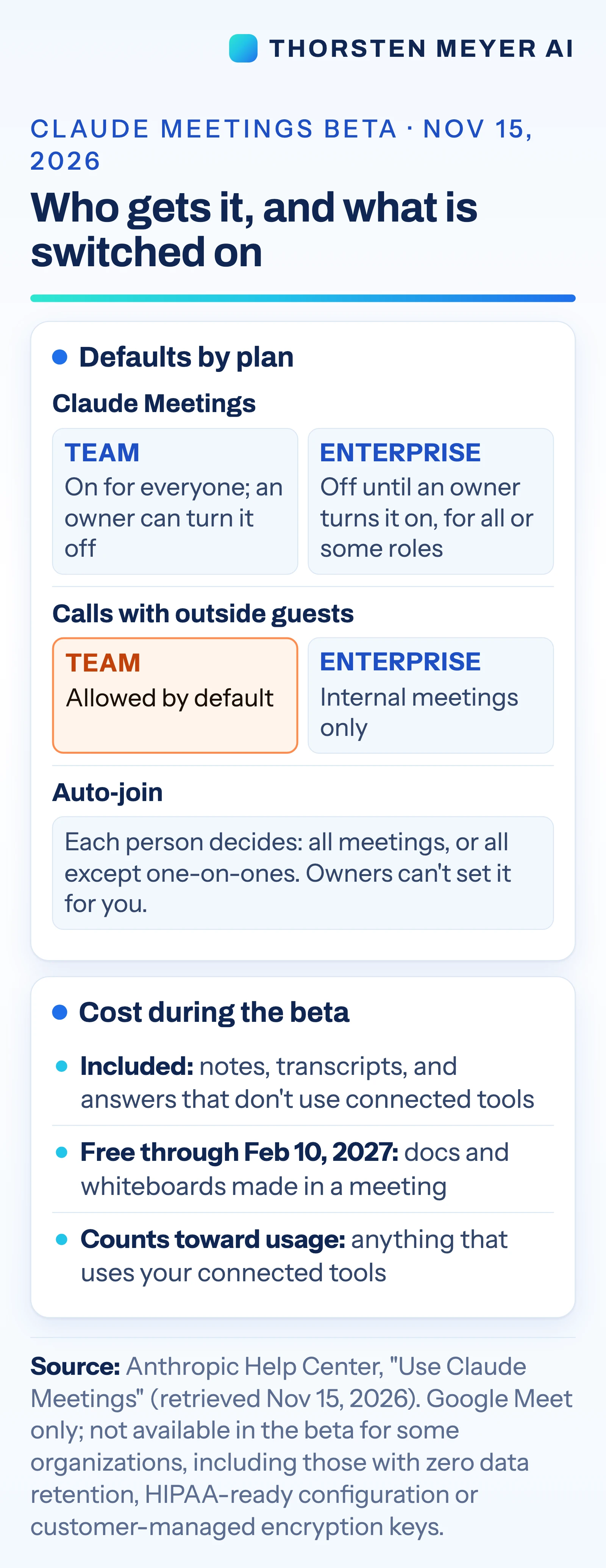
Availability and defaults differ by plan. On Team plans, Meetings is on by default and calls with outside guests are allowed by default. On Enterprise plans, an organization owner must enable the feature, and it is limited to internal meetings by default. Anthropic says the beta is unavailable to some organizations, including those with zero data retention, HIPAA-ready configurations or customer-managed encryption keys. Notes, transcripts and answers are included in the plans; documents and whiteboards created in meetings are free through February 10, 2027.
Meeting Records Need Clear Ownership
Claude Meetings brings transcription and AI-generated work into the same shared space where people discuss plans and make decisions. That could reduce the work of turning a conversation into action items or a draft document. It also means the record may include remarks from people who did not invite Claude themselves, including external guests when the organization permits them.
Anthropic says the feature announces its presence in the call, but the person adding Claude is responsible for making sure everyone is comfortable being transcribed. That places a practical responsibility on meeting organizers and participants to establish consent before discussion begins. Organizations may also need to decide whether the default settings fit their meeting policies, especially where outside guests or sensitive information are involved.
The feature’s usefulness may depend on more than note quality. Teams will need to understand who can access the meeting page and records, how long those records remain available, and what happens to artifacts after the introductory pricing period. Anthropic’s published materials, as described in the source, do not answer all of those questions.
Popular right now

Dyson Ball Animal 2 Upright Corded Vacuum Cleaner, Fuchsia

Breville Barista Express Espresso Machine with Built-In Grinder, Brushed Stainless Steel

Dyson Gen5 Outsize Cordless Vacuum
As an affiliate, we earn on qualifying purchases.
From Notes to Live Work
AI note-takers already join video calls to produce transcripts and summaries. Anthropic’s announcement distinguishes Claude Meetings by describing an assistant that can also create shared materials while the conversation is happening and use connected tools with individual permission. The company’s example involves a team planning a customer event: Claude drafts a plan during the call and retrieves a prior event cost after asking for approval.
Anthropic says users connect Google Calendar after an organization owner enables it, then select a meeting and choose “Add Claude.” Auto-join is a personal setting that can cover all meetings or exclude one-on-ones; owners cannot set it for individual users. The beta currently supports Google Meet only. Anthropic says other platforms are coming, but has not provided a date in the supplied material.
When a meeting ends, invitees from the organization receive a recap email, according to Anthropic. Outside guests do not. If outside guests are not allowed under the organization’s settings, Claude leaves when one joins; if guests are allowed, Claude continues taking notes but does not reply in the chat. These guest rules affect how the feature behaves once a meeting’s attendance changes.
““It takes the notes, answers questions, and builds artifacts, such as docs, whiteboards, and slides, live during the call.””
— Anthropic Help Center, “Use Claude Meetings”
Retention and Pricing Remain Open
The supplied Anthropic materials do not state how long transcripts, summaries, screen descriptions or meeting artifacts are retained, or who can access them beyond the described meeting page and internal organization chat. The source also gives no price for documents and whiteboards after February 10, 2027, and no launch date for support beyond Google Meet.
Some organizations cannot use the beta under the configurations listed by Anthropic, but the source does not specify whether or when that eligibility may change. It is also unclear from the supplied information how the service handles corrections to a transcript, deletion requests or a participant who objects after Claude has joined. Those details should not be assumed from the feature announcement.
Beta Rollout Sets the Next Test
For now, the next step is the beta’s use by eligible Team and Enterprise customers in Google Meet. Organizations considering it can review their plan defaults, decide who may add Claude, and set expectations for consent and meeting records before enabling it. Enterprise owners must turn the feature on; Team administrators and users should check how the default settings apply to calls with outside guests.
Anthropic has said support for other meeting platforms is coming, but the supplied announcement does not give a schedule. Users will also need further pricing and retention information to judge longer-term use, particularly before the February 10, 2027 end date for free meeting-created documents and whiteboards.
Key Questions
What is Claude Meetings?
It is an Anthropic beta that lets Claude join Google Meet calls as a visible participant to take notes, answer questions and create documents, whiteboards or slides.
Does Claude Meetings record audio?
Anthropic says the feature saves a transcript, summary and screen descriptions, not audio. The supplied materials do not specify how long those saved records are kept.
Do meeting participants need to agree to transcription?
Anthropic tells the person adding Claude to make sure everyone on the call is comfortable being transcribed. The supplied source says that responsibility is left to the user.
Which plans and meeting platforms are supported?
The beta is for Team and Enterprise plans and currently supports Google Meet. Anthropic says other platforms are coming but gives no date in the supplied materials.
What will Claude Meetings cost?
Notes, transcripts and answers are included in Team and Enterprise plans. Meeting-created documents and whiteboards are free through February 10, 2027; the supplied source does not state the price after that date.
Source: Thorsten Meyer AI