
TL;DR

Get everyday essentials delivered free with Prime
- Fast, free delivery on millions of items
- Prime Video, Amazon Music and more included
- Member-only deals all year
Soviet leaders agreed to withdraw troops from Budapest during Hungary’s 1956 uprising, then reversed course and sent a large force into the country on November 4. The operation crushed the revolt, killed thousands and drove about 200,000 Hungarians to leave. Western governments condemned the intervention but did not send military help.
The Soviet Union reversed an agreement to withdraw its troops from Budapest and launched a major military operation against Hungary on November 4, 1956, crushing a popular uprising that had begun less than two weeks earlier. The intervention killed thousands and prompted about 200,000 Hungarians to flee, according to the historical account published by Meduza.
The revolt began on October 23, when hundreds of thousands of Budapest residents demonstrated for political reform, free elections and the removal of Soviet troops. The protests turned into an armed uprising within days. As the movement gathered force, Hungary came close to leaving the Soviet bloc, and Soviet leaders initially accepted concessions that included withdrawing troops from the capital.
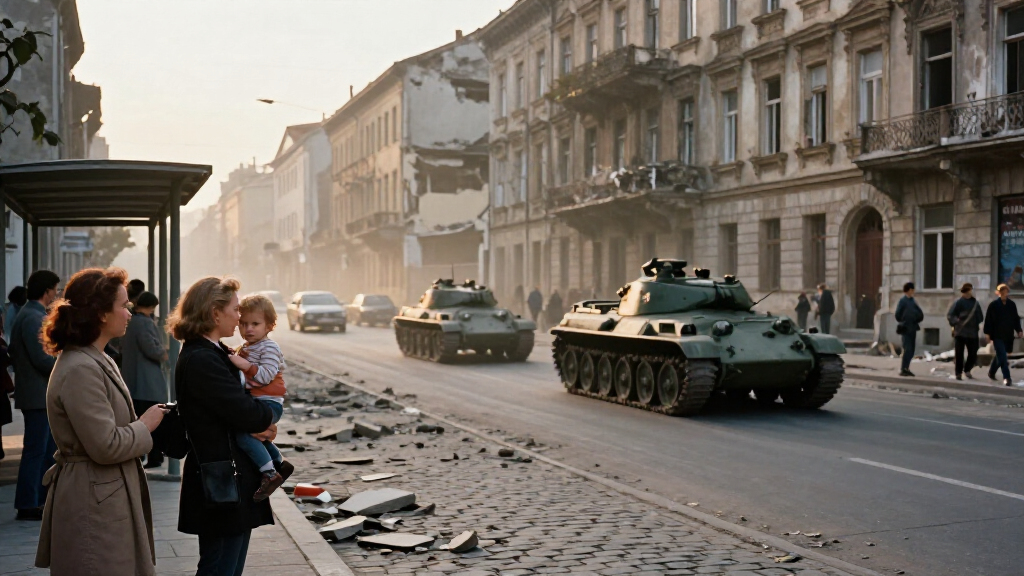
Moscow then changed course. On November 4, Soviet forces launched what the source describes as a 60,000-soldier operation to defeat the uprising. The Soviet army’s intervention restored communist control. Thousands died, while about 200,000 people left Hungary, the Meduza report says.
Western governments condemned the Soviet action but did not intervene militarily. The report, based on an interview with historian Alexey Uvarov, places the decision amid Cold War tensions and the contemporaneous Suez Crisis, which divided Western powers. It says U.S. leaders feared that trying to free Eastern Europe by force could trigger a direct conflict with the Soviet Union, potentially escalating to nuclear war.
The Cost of Moscow’s Reversal
The sequence shows how quickly the Soviet leadership’s willingness to negotiate could give way to force when its control over an allied state appeared threatened. For Hungarians, the consequences were immediate: the uprising was defeated, thousands were killed and a large refugee movement followed. For the wider region, the intervention made clear that reform and political independence had limits set by Moscow.
The episode also illustrates the gap between Western rhetoric and action. Although Western governments condemned the invasion, they did not send troops to support the insurgents. The report links that restraint to the risks of a broader Cold War confrontation and to the political distraction caused by the Suez Crisis. The events remain a subject of political dispute in Hungary, according to Meduza, though the report does not detail the current arguments.
Hungarian Revolution of 1956 history book
As an affiliate, we earn on qualifying purchases.
As an affiliate, we earn on qualifying purchases.
Reform Hopes Before the Invasion
After Joseph Stalin died in 1953, Soviet policy began to change. Nikita Khrushchev won the ensuing leadership struggle and, in a secret speech at the Communist Party’s 20th Congress in February 1956, condemned Stalin’s cult of personality and mass repression. Soviet leaders also spoke of different national paths to socialism. Across Eastern Europe, those shifts encouraged debate about reform and Moscow’s control.
Hungary was governed by a communist regime within the Soviet sphere. The October demonstrations began with demands for political change and the withdrawal of Soviet troops, but soon became an armed challenge to the government. The source says the country was nearing departure from the Soviet bloc before the invasion. It also places the crisis in a tense international moment: NATO and the Warsaw Pact had formalized the two Cold War camps, while the U.S.-led Western powers were preoccupied by a separate conflict over Egypt and the Suez Canal.
The Hungarian crisis followed earlier evidence of Moscow’s limits on dissent. Soviet troops had crushed an uprising in East Germany in June 1953, without U.S. military intervention. Meduza’s account says Washington’s leaders viewed forceful attempts to liberate Eastern Europe as a risk of nuclear war, and favored efforts to weaken Soviet influence without direct military confrontation.
“Moscow agreed to withdraw its troops from Budapest. One week later, it launched a 60,000-soldier operation to crush Hungary’s revolution.”
— Meduza’s historical report
Hungary 1956 uprising illustrated history book
As an affiliate, we earn on qualifying purchases.
As an affiliate, we earn on qualifying purchases.
Questions Around the Soviet Decision
The supplied account establishes the broad sequence, but does not give the exact date or terms of the troop-withdrawal agreement, identify which Soviet officials made it, or explain in detail what changed their position. The figure of 60,000 soldiers is reported without a breakdown of the forces involved or the operation’s duration.
The source says thousands died but provides no precise death toll or accounting of military and civilian casualties. It also does not give further details on the circumstances of the roughly 200,000 departures, or specify which Western governments issued which condemnations. The excerpt raises questions about the uprising’s political aims and today’s disputes in Hungary but does not provide full answers.
Cold War history book Soviet invasion of Hungary
As an affiliate, we earn on qualifying purchases.
As an affiliate, we earn on qualifying purchases.
How the Report Frames 1956
Meduza’s report, published on October 24, 2026, uses historian Alexey Uvarov’s answers to examine why Hungarians rose up, why Khrushchev abandoned compromise and whether the West could have helped. The supplied material does not indicate a future event or announcement. The next step for readers seeking more detail is the full interview, which may provide the historian’s fuller account of the decision-making and the uprising’s later political legacy.
1956 Hungarian Revolution map poster
As an affiliate, we earn on qualifying purchases.
As an affiliate, we earn on qualifying purchases.
Key Questions
When did the Soviet Union invade Hungary?
The Soviet army launched its large-scale operation on November 4, 1956, after the uprising began on October 23.
What had Moscow agreed to do before the invasion?
According to Meduza’s report, Soviet leaders initially agreed to make concessions and withdraw troops from Budapest. The source does not specify the agreement’s exact terms or date.
How many people died or left Hungary?
The report says thousands were killed and about 200,000 Hungarians left the country. It does not provide a precise death toll or further details about those who departed.
Did Western governments intervene militarily?
No. The account says Western governments condemned Moscow’s actions but stopped short of military intervention. It links U.S. caution to the risk of a direct Cold War confrontation.
Source: rss
Fall Picks
fall essentials
As an affiliate, we earn on qualifying purchases.