For most household surface checks, I’d start with the Etekcity Lasergrip 774 for its straightforward point-and-read design; the Klein Tools IR1 is a more workshop-focused choice, while the GT14S thermal imaging camera adds a visual view of heat patterns. The right infrared thermometer depends on what you’re measuring: cooking surfaces, machinery, or a person’s forehead call for different tools. Range, distance-to-spot ratio, emissivity controls, and ease of aiming can matter more than a headline temperature limit. Non-contact forehead models are designed for body temperature checks and should not be treated as interchangeable with surface guns. Read on for the full breakdown of where each option fits and what tradeoffs to weigh.

Get everyday essentials delivered free with Prime
- Fast, free delivery on millions of items
- Prime Video, Amazon Music and more included
- Member-only deals all year
Key Takeaways
- The Lasergrip 774 is the simplest general surface-check pick; specialized industrial models add controls and range that many home users may not need.
- The Klein Tools IR1 is better matched to job-site tasks where a focused tool and targeting laser matter more than extra modes.
- Forehead thermometers form a separate use category: their no-contact convenience does not make them substitutes for measuring cookware, walls, or machinery.
- A high maximum temperature alone is not enough; distance-to-spot ratio and emissivity adjustment shape whether readings suit the target.
- The GT14S offers a different kind of information by showing heat patterns, though its camera format brings more complexity than a basic temperature gun.
| Etekcity Lasergrip 774 Infrared Thermometer |  | Best for Everyday Versatility | Temperature range: -58°F to 842°F (-50°C to 450°C) | Distance-to-spot ratio: 12:1 | Reading time: Less than 0.5 seconds | VIEW ON AMAZON | See Our Full Breakdown |
| No-Touch Thermometer for Adults, Kids, Babies, 1-Second Fast Accurate |  | Best for Quick Family Checks | Measurement time: 1 second | Technology: Infrared | Supported modes: Forehead, room, object temperature | VIEW ON AMAZON | See Our Full Breakdown |
| Goodbaby No-Touch Forehead Thermometer for Adults and Children |  | Best for Defined Forehead Positioning | Measurement modes: Forehead, room, and object | Units: Celsius and Fahrenheit | Power source: 2 AAA batteries included | VIEW ON AMAZON | See Our Full Breakdown |
| Klein Tools IR1 Infrared Thermometer with Targeting Laser |  | Best for Tough Worksites | Temperature range: -4°F to 752°F (-20°C to 400°C) | Distance-to-spot ratio: 10:1 | Emissivity: 0.95 fixed | VIEW ON AMAZON | See Our Full Breakdown |
| Etekcity Lasergrip 1080 Infrared Thermometer |  | Best for Adjustable Emissivity | Temperature range: -58°F to 1130°F (-50°C to 610°C) | Distance-to-spot ratio: 12:1 | Emissivity: Adjustable from 0.1 to 1.0 | VIEW ON AMAZON | See Our Full Breakdown |
| TempPro TempScan Infrared Thermometer Gun |  | Best for Versatile Home and Workshop Tasks | Temperature range: -58°F to 1022°F | Accuracy: ±1.5% | Emissivity: Adjustable from 0.1 to 1.0 | VIEW ON AMAZON | See Our Full Breakdown |
| Forehead Thermometer for Adults and Kids, Non Contact, Fast Accurate Result |  | Best for Tracking Household Readings | Measurement method: Non-contact infrared forehead | Response time: 1 second | Temperature limits: 89.6°F to 100.3°F | VIEW ON AMAZON | See Our Full Breakdown |
| ANMEATE Non-Contact Forehead Thermometer for Adults and Kids |  | Best for Quiet Nighttime Checks | Measurement method: Non-contact forehead | Temperature range: 89.6°F to 109.2°F | Response time: 1 second | VIEW ON AMAZON | See Our Full Breakdown |
| Laser Infrared Thermometer Non-Contact Digital Temperature Gun -50°C to 400°C (-58°F to 752°F), Industrial & Kitchen Use |  | Best for Clear Targeting | Temperature range: -50°C to 400°C (-58°F to 752°F) | Accuracy: ±1.5°C or ±1.5% | Distance-to-spot ratio: 12:1 | VIEW ON AMAZON | See Our Full Breakdown |
| Digital No Touch Forehead Thermometer for Adults and Kids |  | Best for Multiple Measurement Modes | Measurement modes: Forehead, room, object, and liquids | Measurement distance: 2–3.15 inches | Response time: 1 second | VIEW ON AMAZON | See Our Full Breakdown |
| SURPEER Infrared Thermometer Gun, -58°F to 1796°F, 50:1 |  | Best for Long-Range Versatility | Temperature range: -58°F to 1796°F (-50°C to 980°C) | Accuracy: ±2% on average | Distance-to-spot ratio: 50:1 | VIEW ON AMAZON | See Our Full Breakdown |
| Infrared Thermometer Laser Temperature Gun – -58°F to 1112°F, Calibration, Adjustable Emissivity (Yellow) | 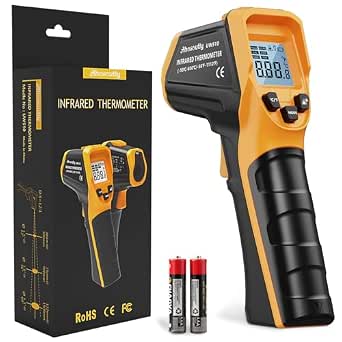 | Best for Emissivity Adjustments | Temperature range: -58°F to 1112°F (-50°C to 600°C) | Response time: 0.5 seconds | Emissivity: Adjustable | VIEW ON AMAZON | See Our Full Breakdown |
| MOONASCEND JD-08 Infrared Thermometer, 3992°F, Triple Laser, 50:1 |  | Best for Extreme Heat | Temperature range: -58°F to 3992°F (-50°C to 2200°C) | Distance-to-spot ratio: 50:1 | Laser guidance: Triple laser | VIEW ON AMAZON | See Our Full Breakdown |
| KNINE OUTDOORS Infrared Thermometer Gun, -58°F to 1112°F |  | Best for Everyday Spot Checks | Temperature range: -58°F to 1112°F (-50°C to 600°C) | Distance-to-spot ratio: 12:1 | Targeting: Single laser | VIEW ON AMAZON | See Our Full Breakdown |
| GT14S Thermal Imaging Camera with Edge Enhancement and Thermometer Mode |  | Best for Visual Inspections | Measurement range: -4°F to 1022°F | Temperature accuracy: 0.05°C | Sensor sensitivity: NETD < 50mK | VIEW ON AMAZON | See Our Full Breakdown |
| infrared thermometer | Temperature range | Response time | Distance-to-spot ratio | Power |
|---|---|---|---|---|
| Etekcity Lasergrip 774 Infrare | -58°F to 842°F (-50°C to 450°C) | — | 12:1 | — |
| No-Touch Thermometer for Adult | 50°F–104°F | — | — | — |
| Goodbaby No-Touch Forehead The | — | — | — | — |
| Klein Tools IR1 Infrared Therm | -4°F to 752°F (-20°C to 400°C) | — | 10:1 | — |
| Etekcity Lasergrip 1080 Infrar | -58°F to 1130°F (-50°C to 610°C) | About 0.5 seconds | 12:1 | — |
| TempPro TempScan Infrared Ther | -58°F to 1022°F | Under 0.5 seconds | 12:1 | 2 AAA batteries, included |
| Forehead Thermometer for Adult | — | 1 second | — | 2 AAA batteries, included |
| ANMEATE Non-Contact Forehead T | 89.6°F to 109.2°F | 1 second | — | 2 AAA batteries, included |
| Laser Infrared Thermometer Non | -50°C to 400°C (-58°F to 752°F) | ≤0.8 seconds | 12:1 | 2 x 1.5V batteries |
| Digital No Touch Forehead Ther | — | 1 second | — | 2 AAA batteries |
| SURPEER Infrared Thermometer G | -58°F to 1796°F (-50°C to 980°C) | 0.5 seconds | 50:1 | 2 AAA batteries, included |
| Infrared Thermometer Laser Tem | -58°F to 1112°F (-50°C to 600°C) | 0.5 seconds | — | 2 AAA batteries, included |
| MOONASCEND JD-08 Infrared Ther | -58°F to 3992°F (-50°C to 2200°C) | 0.5 seconds | 50:1 | — |
| KNINE OUTDOORS Infrared Thermo | -58°F to 1112°F (-50°C to 600°C) | — | 12:1 | Two AAA batteries |
| GT14S Thermal Imaging Camera w | — | — | — | — |
More Details on Our Top Picks
Etekcity Lasergrip 774 Infrared Thermometer
A broad temperature range and quick readings make the Lasergrip 774 a practical fit for home cooks, grill owners, and DIY users who need to check surfaces without contact. It reads from -58°F to 842°F in under half a second, and its 12:1 distance-to-spot ratio lets you measure from farther away than the Klein Tools IR1’s 10:1 ratio. The backlit LCD and maximum-temperature display help when checking a grill or tracing a hot spot in a dim workspace. Its main limitation is that it reports the average temperature across the target area, not a pinpoint reading. The stated best-results distance of about 14.17 inches also calls for some room to aim. Compared with the higher-range Lasergrip 1080, it gives up adjustable emissivity and extreme-heat capacity for a simpler set of household features.
Pros:- Measures from -58°F to 842°F for hot and cold surface checks
- Reads in under half a second
- 12:1 distance-to-spot ratio supports measurements from farther away
- Backlit LCD and maximum-temperature display aid checks in dim areas
Cons:- Reports the average temperature of the targeted surface area rather than a single point
- Best results call for positioning about 14.17 inches from the target
Best for: Home cooks, grill owners, and DIY users who want one fast surface thermometer for varied household tasks
Not ideal for: Users measuring tiny targets, or those who need adjustable emissivity or readings above 842°F
- Temperature range:-58°F to 842°F (-50°C to 450°C)
- Distance-to-spot ratio:12:1
- Reading time:Less than 0.5 seconds
- Display:Backlit LCD
- Additional display:Maximum temperature
- Measurement:Average temperature of targeted surface area
- Batteries:2 AAA batteries included
Our verdict“Choose the Lasergrip 774 for fast, versatile household surface checks if you do not need adjustable emissivity or the Lasergrip 1080’s higher temperature ceiling.”
No-Touch Thermometer for Adults, Kids, Babies, 1-Second Fast Accurate
This model is the family-focused choice in a lineup that also includes surface-reading guns such as the Etekcity Lasergrip 774. Its infrared sensor is intended for forehead readings and offers room and object modes, so one device can check a person or a nearby surface. A one-second measurement and Celsius/Fahrenheit support suit caregivers who want a quick routine across different ages. The ABS housing and comfortable grip keep the design straightforward. The tradeoff is that a forehead thermometer depends on correct positioning and suitable skin conditions; its instructions call for proper distance and skin preparation for accuracy. Its stated 50°F–104°F range is also far narrower than the Lasergrip 774’s surface range, which makes this a poor choice for cooking, automotive, or other high-heat measurements. Battery replacement is part of ongoing use.
Pros:- One-second readings support quick checks
- Offers forehead, room, and object modes
- Supports both Celsius and Fahrenheit
- Ergonomic ABS housing is designed for easy handling
Cons:- Accuracy depends on correct distance and skin preparation
- Temperature range is limited to 50°F–104°F
- Requires two AAA batteries, which need replacement over time
Best for: Caregivers who want a simple non-contact forehead thermometer with room and object modes for household checks
Not ideal for: Cooks, mechanics, or DIY users who need to measure hot surfaces or temperatures outside the stated 50°F–104°F range
- Measurement time:1 second
- Technology:Infrared
- Supported modes:Forehead, room, object temperature
- Temperature range:50°F–104°F
- Temperature units:Celsius and Fahrenheit
- Power source:2 AAA batteries
- Material:ABS housing
Our verdict“Pick this model for quick household forehead checks, but choose the Lasergrip 774 for cooking, repair, or wider surface-temperature work.”
Goodbaby No-Touch Forehead Thermometer for Adults and Children
The Goodbaby’s clearest distinction is its specified 1.5-inch operating distance, which gives caregivers a concrete positioning reference for forehead readings. It also measures room and object temperatures, though those modes do not make it a substitute for a surface gun like the Etekcity Lasergrip 1080, whose range and adjustable emissivity better suit varied materials and much hotter surfaces. With Celsius and Fahrenheit readings, included AAA batteries, and a one-button design, the Goodbaby keeps routine checks uncomplicated. Its ABS housing is built for a handheld grip, and the package includes a 12-month replacement guarantee. The tradeoff is that forehead accuracy depends on a clean, clear forehead and stable ambient conditions; the fixed distance also asks for consistent technique. Buyers who prefer a model described around a general one-second reading may favor the other family thermometer in this group.
Pros:- Specified 1.5-inch operating distance gives a clear positioning target
- Measures forehead, room, and object temperatures
- Includes two AAA batteries
- Package includes a 12-month replacement guarantee
Cons:- Accurate forehead readings depend on a clean forehead and stable ambient temperature
- Requires consistent positioning at the specified distance
- Not designed for the broad or high-temperature surface tasks handled by the Lasergrip 1080
Best for: Caregivers who want a non-contact forehead thermometer with a specific positioning distance and room/object modes
Not ideal for: Users who need a high-temperature surface tool or who do not want to maintain a consistent 1.5-inch forehead distance
- Measurement modes:Forehead, room, and object
- Units:Celsius and Fahrenheit
- Power source:2 AAA batteries included
- Operating distance:1.5 inches from forehead center
- Recommended ambient temperature:50°F–104°F
- Material:ABS housing
- Warranty:12-month replacement guarantee
Our verdict“Choose the Goodbaby if a defined forehead distance and included batteries suit your caregiving routine; choose the Lasergrip 1080 for surface measurements.”
Klein Tools IR1 Infrared Thermometer with Targeting Laser
The Klein Tools IR1 suits trade users who value a rugged housing and clear aiming over a broader set of measurement adjustments. Its 6.6-foot drop protection, laser targeting, backlit display, and included pouch make it easier to carry into a work area where bumps and low light are part of the job. The 10:1 distance-to-spot ratio is shorter than the 12:1 ratios on both Etekcity Lasergrip models, so the IR1 needs to be closer for a similarly sized target. Its -4°F to 752°F range covers many inspection tasks, while the fixed 0.95 emissivity limits flexibility on surfaces with different emissivity characteristics; the Lasergrip 1080 offers adjustment from 0.1 to 1.0. This is strictly a surface tool and is explicitly not for people or animals.
Pros:- 6.6-foot drop protection suits demanding work areas
- Laser targeting and backlit display aid aiming and reading
- Measures from -4°F to 752°F
- Includes a custom pouch and batteries
Cons:- Fixed emissivity of 0.95 limits adaptation to different surfaces
- 10:1 distance-to-spot ratio is shorter than the Etekcity Lasergrip models’ 12:1 ratio
- Not intended for measuring people or animals
Best for: Tradespeople who need a backlit surface thermometer with drop protection for routine inspections
Not ideal for: Users who need adjustable emissivity, a longer distance-to-spot ratio, or human and animal temperature readings
- Temperature range:-4°F to 752°F (-20°C to 400°C)
- Distance-to-spot ratio:10:1
- Emissivity:0.95 fixed
- Drop protection:6.6 ft. (2 m)
- Features:Laser targeting, backlit display, auto power-off
- Included accessories:Custom pouch and batteries
- Intended use:Surface temperature measurement; not for people or animals
Our verdict“Choose the IR1 for a rugged, straightforward worksite surface tool, but pick the Lasergrip 1080 if adjustable emissivity matters more than drop protection.”
Etekcity Lasergrip 1080 Infrared Thermometer
For buyers comparing surfaces with different emissivity characteristics, the Lasergrip 1080 offers the most useful adjustment in this five-product group: emissivity from 0.1 to 1.0. That gives it an advantage over the Klein Tools IR1, which fixes emissivity at 0.95, when the material calls for a different setting. Its -58°F to 1130°F range also exceeds the Lasergrip 774’s 842°F ceiling, making it a better fit for hotter cooking, appliance, and automotive checks. Readings arrive in about half a second, with a backlit LCD and 12:1 distance-to-spot ratio. The added capability comes with a specific scope: it measures surface temperature only and is not for human readings. Buyers who only need basic household checks may find the Lasergrip 774’s simpler feature set sufficient.
Pros:- Adjustable emissivity from 0.1 to 1.0 supports varied surface measurements
- Measures up to 1130°F, above the Lasergrip 774’s 842°F maximum
- 12:1 distance-to-spot ratio supports measurements from a distance
- Backlit display and about 0.5-second response suit quick checks
Cons:- Measures surface temperature only and is not intended for human use
- Emissivity adjustment requires the user to choose a suitable setting for the surface
Best for: Cooks, technicians, and DIY users who measure varied surfaces and need adjustable emissivity or readings above 842°F
Not ideal for: Caregivers seeking a body thermometer, or occasional household users who do not need the 1130°F ceiling or emissivity adjustment
- Temperature range:-58°F to 1130°F (-50°C to 610°C)
- Distance-to-spot ratio:12:1
- Emissivity:Adjustable from 0.1 to 1.0
- Response time:About 0.5 seconds
- Repeatability:1% / 1°C
- Temperature units:°F / °C
- Batteries:2 AAA batteries
- Dimensions:6.1 × 3.1 × 1.57 inches
- Intended use:Surface temperature measurement; not for human use
Our verdict“Choose the Lasergrip 1080 for high-temperature surface work across materials that benefit from emissivity adjustment.”
TempPro TempScan Infrared Thermometer Gun
I’d choose the TempPro TempScan when one surface thermometer needs to cover cooking, vehicle checks, and household repairs. Its -58°F to 1022°F range spans more heat than the Laser Infrared Thermometer Gun, which tops out at 752°F, while adjustable emissivity lets me account for different surface materials. The 12:1 distance-to-spot ratio and sub-half-second response help when a surface is hot or awkward to reach, and max, min, and average readings make it easier to track temperature changes.
The tradeoff is that this breadth adds little for someone who only needs a simple kitchen check. Like the Laser Infrared Thermometer Gun, it measures surface temperature only; it cannot tell me whether food or a person has a safe internal temperature. Its accuracy is specified as ±1.5%, so it suits general checks better than work that calls for tighter measurement control.
Pros:- Broad -58°F to 1022°F range covers more heat than the Laser Infrared Thermometer Gun.
- Adjustable emissivity accommodates surfaces with different thermal characteristics.
- Fast readings with max, min, and average functions help track changing temperatures.
- Backlit LCD and 0.1°F resolution make readings easier to inspect.
Cons:- Measures surfaces only, not internal food or body temperature.
- Specified accuracy of ±1.5% may not suit precision-critical work.
- Its 12:1 distance-to-spot ratio still requires aiming close enough for the target size.
Best for: Home cooks and DIY vehicle owners who want one infrared gun for varied surface-temperature checks.
Not ideal for: People who need internal food temperatures, human temperature readings, or tightly controlled precision measurements.
- Temperature range:-58°F to 1022°F
- Accuracy:±1.5%
- Emissivity:Adjustable from 0.1 to 1.0
- Distance-to-spot ratio:12:1
- Response time:Under 0.5 seconds
- Display:Backlit digital LCD
- Power:2 AAA batteries, included
Our verdict“Choose the TempPro for broad household and workshop surface checks, but use a contact probe when internal temperature matters.”
Forehead Thermometer for Adults and Kids, Non Contact, Fast Accurate Result
The GoodBaby non-contact forehead thermometer is aimed at families who want quick readings without waking a child or sharing a probe. Its 35-reading memory gives it a tracking advantage over the ANMEATE thermometer, whose listed features also include 35 memory slots but add a mute mode. Here, the practical draw is the combination of one-button operation, a large backlit screen, and three fever-indicator colors, which can make routine checks easier for several caregivers.
At one second per reading, it is quick enough for an at-home check, though the object and room modes of the Digital No Touch Forehead Thermometer offer more flexibility beyond forehead use. This GoodBaby model is for body temperature, not general surface work, and its supplied temperature limits are narrower than those of the ANMEATE. It also relies on two AAA batteries, and correct installation matters for operation.
Pros:- Non-contact forehead readings avoid sharing a probe between family members.
- Stores up to 35 readings for tracking changes over time.
- Large backlit display uses three colors to flag temperature readings.
- One-button operation and switchable Fahrenheit/Celsius suit different caregivers.
Cons:- Forehead-focused body measurement does not replace a surface thermometer for household tasks.
- Requires two AAA batteries, and incorrect installation can prevent operation.
- Supplied upper and lower temperature limits are narrower than the ANMEATE’s listed range.
Best for: Families who want a simple non-contact forehead thermometer with memory for keeping track of readings.
Not ideal for: Buyers looking for one device to check cooking, room, or household surface temperatures.
- Measurement method:Non-contact infrared forehead
- Response time:1 second
- Temperature limits:89.6°F to 100.3°F
- Resolution:0.1°C or 0.1°F
- Memory:35 readings
- Fever indicators:3 LCD colors
- Power:2 AAA batteries, included
Our verdict“Pick this GoodBaby for quick family forehead checks and stored readings, not for measuring objects or room temperatures.”
ANMEATE Non-Contact Forehead Thermometer for Adults and Kids
The ANMEATE forehead thermometer suits caregivers who need to check temperature quietly, including during nighttime routines. Its mute mode gives it an advantage over the GoodBaby Forehead Thermometer, whose listed features focus on color alerts and memory rather than silent operation. Both store 35 readings and return a result in one second, so the distinction is less about tracking capacity than about keeping a check unobtrusive.
The color-coded backlit display and fever alarm make a reading easier to interpret, and Fahrenheit/Celsius switching supports different household preferences. I would skip it if I needed a general-purpose infrared thermometer: the forehead-only design cannot check cookware, engines, or room objects as the Digital No Touch Forehead Thermometer can. Its stated range of 89.6°F to 109.2°F is for this body-temperature use, not a substitute for the wide surface ranges of temperature guns.
Pros:- Mute mode supports quiet checks when someone is sleeping.
- One-second response and non-contact use make repeated forehead checks convenient.
- Backlit color indicators and fever alarm help interpret results.
- Stores 35 readings and includes two AAA batteries.
Cons:- Forehead-only measurement excludes objects, room temperatures, and liquids.
- Its stated temperature range is limited to 89.6°F–109.2°F.
- Like other battery-powered forehead models, it depends on two AAA cells.
Best for: Parents and caregivers who need quiet, non-contact forehead checks and a memory for repeated readings.
Not ideal for: DIYers or cooks who need to measure object temperatures, or households seeking room and liquid modes.
- Measurement method:Non-contact forehead
- Temperature range:89.6°F to 109.2°F
- Response time:1 second
- Resolution:0.1 degrees
- Memory:35 readings
- Display:Backlit with color indicators
- Power:2 AAA batteries, included
Our verdict“Choose the ANMEATE when quiet forehead checks matter more than the broader measurement modes offered by the Digital No Touch model.”
Laser Infrared Thermometer Non-Contact Digital Temperature Gun -50°C to 400°C (-58°F to 752°F), Industrial & Kitchen Use
The Laser Infrared Thermometer Gun makes sense when clear aiming is the priority for checking a surface in a kitchen, workshop, or industrial setting. Its targeting laser helps show where the reading is being taken, while the backlit LCD remains readable in dimmer spaces. Compared with the TempPro TempScan, however, its upper limit of 752°F is lower than 1022°F, so the TempPro covers hotter tasks. The two share a 12:1 distance-to-spot ratio, making target size and measuring distance relevant with either gun.
Readings arrive in 0.8 seconds or less, and emissivity can be adjusted from 0.1 to 0.99. That flexibility helps across surfaces, but the listed accuracy of ±1.5°C or ±1.5% calls for sensible expectations on precision. This is a surface thermometer, not a body thermometer; the GoodBaby model is the appropriate category for non-contact forehead readings. Frequent use may also mean more battery changes.
Pros:- Laser targeting helps identify the surface area being measured.
- Backlit LCD supports reading in low-light work areas.
- Adjustable emissivity gives flexibility across different surfaces.
- Fast response and 12:1 distance-to-spot ratio suit routine surface checks.
Cons:- 752°F ceiling is lower than the TempPro TempScan’s 1022°F maximum.
- Not suitable for measuring people or animals.
- Frequent use may make battery life a concern, and aiming distance affects target coverage.
Best for: Cooks, technicians, and DIYers who want laser-guided aiming for general surface checks.
Not ideal for: People measuring human or animal temperature, or those with tasks regularly exceeding 752°F.
- Temperature range:-50°C to 400°C (-58°F to 752°F)
- Accuracy:±1.5°C or ±1.5%
- Distance-to-spot ratio:12:1
- Response time:≤0.8 seconds
- Emissivity:Adjustable from 0.1 to 0.99
- Resolution:0.1°C or 0.1°F
- Power:2 x 1.5V batteries
Our verdict“Choose this gun for visible laser aiming on everyday surfaces, but favor the TempPro for hotter applications.”
Digital No Touch Forehead Thermometer for Adults and Kids
The Digital No Touch Forehead Thermometer earns its place for households that want one device to check people as well as nearby objects. Its listed forehead, room, object, and liquid modes give it more range around the home than the forehead-only GoodBaby and ANMEATE models. A 2–3.15-inch measurement distance and one-second response make it suited to quick checks without touching the subject, while color indicators offer a quick visual cue.
The extra modes make this the most flexible family option in this group, but the supplied details are less complete: there is no memory capacity or temperature range listed. That makes it harder to judge tracking features and the limits of its object readings against the TempPro TempScan, which specifies a broad surface range and emissivity adjustment. Its stated accuracy is within 0.2°C, but readings may suffer when the device is used incorrectly. It is intended for indoor use and still needs AAA batteries.
Pros:- Forehead, room, object, and liquid modes cover more household tasks than the GoodBaby and ANMEATE.
- Non-contact readings reduce the need to touch the subject.
- One-second response supports quick checks.
- Color-coded LCD alerts are easy to scan.
Cons:- Temperature range and memory capacity are not specified in the supplied product data.
- Listed for indoor use, limiting utility for outdoor checks.
- Accuracy may be reduced if measurement distance or technique is incorrect.
Best for: Families who want a non-contact device for forehead checks plus occasional room, object, or liquid readings.
Not ideal for: People needing a documented wide temperature range, outdoor utility, or detailed reading history.
- Measurement modes:Forehead, room, object, and liquids
- Measurement distance:2–3.15 inches
- Response time:1 second
- Accuracy:Within 0.2°C
- Display:LCD with color indicators
- Power:2 AAA batteries
Our verdict“Choose this model for household flexibility across people and objects, but pick the TempPro if you need a stated surface range and emissivity control.”
SURPEER Infrared Thermometer Gun, -58°F to 1796°F, 50:1
The SURPEER pairs a 50:1 distance-to-spot ratio with a range reaching 1796°F, making it a better fit for checking hot equipment or surfaces from farther away than the KNINE OUTDOORS model, whose ratio is 12:1. MIN, MAX, AVG, and DIF modes give maintenance users several ways to track temperature changes, while the included bag makes it easier to store between jobs. Its range still falls well short of the MOONASCEND JD-08 for forge or kiln work, so I would choose the MOONASCEND for extreme heat. The SURPEER also depends on two AAA batteries, and its stated average accuracy of ±2% makes it a practical spot checker rather than a precision instrument.
Pros:- 50:1 distance-to-spot ratio supports measurements from farther away
- Range extends to 1796°F for many high-heat maintenance tasks
- MIN, MAX, AVG, and DIF modes help compare readings
- Storage bag and two AAA batteries are included
Cons:- ±2% average accuracy may not suit work requiring tighter measurement tolerances
- Low battery levels can make readings inaccurate
- Uses replaceable AAA batteries rather than a rechargeable battery
Best for: HVAC and equipment maintenance users who need long-distance readings across a broad, but not extreme, temperature range
Not ideal for: Foundry and forge operators who need measurements above 1796°F, or buyers who want a rechargeable tool
- Temperature range:-58°F to 1796°F (-50°C to 980°C)
- Accuracy:±2% on average
- Distance-to-spot ratio:50:1
- Response time:0.5 seconds
- Measurement modes:MIN, MAX, AVG, DIF
- Power:2 AAA batteries, included
- Weight:160 g
- Length:6.3 inches
Our verdict“Choose the SURPEER for long-range maintenance checks across varied temperatures, but pick the MOONASCEND JD-08 for extreme heat.”
Infrared Thermometer Laser Temperature Gun – -58°F to 1112°F, Calibration, Adjustable Emissivity (Yellow)
Adjustable emissivity and a one-button calibration function give this yellow thermometer more control over readings from different surface materials than the simpler KNINE OUTDOORS model. That makes it a sensible choice for DIY users moving between cooking, HVAC, and automotive checks, where a single emissivity setting may not fit every surface. Its 0.5-second response and backlit LCD help when a quick reading is needed in dim work areas. The tradeoff is a maximum of 1112°F: the SURPEER reaches higher temperatures and adds several measurement modes, while the MOONASCEND JD-08 is built for far more intense heat. This model also lacks a protective case, and frequent use may mean replacing its AAA batteries more often.
Pros:- Adjustable emissivity accommodates different surface materials
- One-button calibration function is available
- Backlit LCD is easier to read in low light
- 0.5-second response supports quick spot checks
Cons:- 1112°F upper limit is lower than the SURPEER and MOONASCEND JD-08
- No protective case or stand is included
- Requires two AAA batteries, which may need frequent replacement with heavy use
Best for: DIYers and home technicians who check different materials in kitchens, vehicles, and HVAC systems and want emissivity control
Not ideal for: Industrial users measuring very high temperatures or buyers who need a carrying case for frequent site work
- Temperature range:-58°F to 1112°F (-50°C to 600°C)
- Response time:0.5 seconds
- Emissivity:Adjustable
- Calibration:One-button calibration function
- Display:Backlit digital LCD
- Power:2 AAA batteries, included
- Auto shut-off:Yes
- Material and color:ABS plastic, yellow
Our verdict“Pick this model for mixed-material household and DIY checks where emissivity adjustment matters more than a high maximum temperature.”
MOONASCEND JD-08 Infrared Thermometer, 3992°F, Triple Laser, 50:1
With a stated upper range of 3992°F, the MOONASCEND JD-08 serves foundry, forge, and kiln work that the SURPEER and KNINE OUTDOORS cannot cover. Its 50:1 ratio and triple laser guidance help target smaller areas from farther away, while adjustable emissivity lets operators account for different materials. Programmable high and low alarms and data logging add process-monitoring tools missing from the more general-purpose SURPEER. That capability comes with a narrower audience: for cooking, pool checks, or ordinary HVAC troubleshooting, the KNINE OUTDOORS is a simpler match, and the MOONASCEND’s industrial temperature ceiling is unnecessary. It also runs on AAA batteries, so users planning frequent monitoring should account for battery replacement.
Pros:- Measures up to 3992°F for extreme-heat applications
- 50:1 ratio and triple laser guidance support longer-distance targeting
- Adjustable emissivity suits different materials
- Data logging and programmable high and low alarms support process monitoring
Cons:- Its extreme temperature range is unnecessary for many household and general maintenance tasks
- Requires two AAA batteries rather than a rechargeable battery
- Specialized controls may be more than casual users need
Best for: Foundry, forge, and kiln operators who need long-distance surface readings at extreme temperatures
Not ideal for: Home cooks and general DIY users who need routine checks below 1112°F and prefer a simpler thermometer
- Temperature range:-58°F to 3992°F (-50°C to 2200°C)
- Distance-to-spot ratio:50:1
- Laser guidance:Triple laser
- Emissivity:Adjustable from 0.1 to 0.99
- Response time:0.5 seconds
- Measurement modes:MIN, MAX, AVG, DIF
- Alarms:Programmable high and low temperature alarms
- Power and included items:2 AAA batteries included; carrying case and user manual
- Warranty:2 years
Our verdict“Choose the JD-08 for high-heat industrial processes; for everyday checks, the KNINE OUTDOORS is a more fitting, simpler option.”
KNINE OUTDOORS Infrared Thermometer Gun, -58°F to 1112°F
The KNINE OUTDOORS covers familiar jobs—cooking, BBQ, pool maintenance, and HVAC checks—without the extreme temperature ceiling or added process tools of the MOONASCEND JD-08. Its 12:1 distance-to-spot ratio suits closer-range measurements, while adjustable emissivity from 0.1 to 1.0 offers useful flexibility across surfaces. Compared with the SURPEER, it has a lower maximum temperature and a shorter targeting ratio, so it is less suited to distant readings on hot equipment. For routine checks, though, the digital LCD, selectable units, and 0.1-degree resolution make the key information easy to read. The available specifications do not list response time or measurement modes, and it requires two AAA batteries.
Pros:- Suitable range for many cooking, BBQ, pool, and HVAC checks
- Adjustable emissivity from 0.1 to 1.0
- Selectable Celsius and Fahrenheit units
- 0.1-degree resolution helps show small displayed temperature changes
Cons:- 12:1 ratio is shorter-range than the 50:1 SURPEER and MOONASCEND JD-08
- 1112°F upper limit rules out many high-heat industrial checks
- Requires two AAA batteries
Best for: Homeowners and grill cooks who want a straightforward tool for nearby surface checks, pool temperatures, and HVAC troubleshooting
Not ideal for: Technicians who measure hot equipment from farther away or need documented response time and multiple measurement modes
- Temperature range:-58°F to 1112°F (-50°C to 600°C)
- Distance-to-spot ratio:12:1
- Targeting:Single laser
- Emissivity:Adjustable from 0.1 to 1.0
- Resolution:0.1°C or 0.1°F
- Display:Digital LCD
- Power:Two AAA batteries
- Material and color:Plastic, orange
Our verdict“Choose the KNINE OUTDOORS for close-range home and BBQ checks, and the SURPEER if you need a longer targeting distance.”
GT14S Thermal Imaging Camera with Edge Enhancement and Thermometer Mode
The GT14S differs from the handheld guns here by showing a thermal image alongside temperature readings. That visual context can help maintenance teams locate a hot area across a wider scene instead of aiming at one spot at a time, a task for which the SURPEER or KNINE OUTDOORS offers a simpler point reading. Its 50° field of view and adjustable emissivity suit general inspection work, and the rechargeable battery is rated for up to 14 hours. The tradeoff is that the listed range tops out at 1022°F, below the SURPEER and far below the MOONASCEND JD-08. The stated 0.05°C accuracy is unusually precise, but the provided data does not explain its test conditions, so buyers should confirm it fits their measurement requirements.
Pros:- Thermal imaging provides visual context beyond a single spot reading
- Rechargeable 2500mAh battery is rated for up to 14 hours
- Adjustable emissivity and multiple color palettes support varied inspections
- Customizable high and low temperature alarms are available
Cons:- 1022°F upper limit is below the SURPEER and MOONASCEND JD-08
- Handheld imaging format may not suit heavy-duty industrial environments
- The stated 0.05°C accuracy is not accompanied by measurement conditions
Best for: Building and equipment inspectors who need to spot temperature patterns visually and follow up with thermometer readings
Not ideal for: Foundry and forge operators needing readings above 1022°F or buyers seeking a simple, laser-targeted temperature gun
- Measurement range:-4°F to 1022°F
- Temperature accuracy:0.05°C
- Sensor sensitivity:NETD < 50mK
- Field of view:50°
- Battery:2500mAh rechargeable
- Battery life:Up to 14 hours
- Weight:240 g
Our verdict“Choose the GT14S when visualizing heat patterns matters more than reaching the higher temperatures covered by the SURPEER or JD-08.”

How We Picked
I ranked these options by how well their stated design and features serve distinct infrared thermometer jobs: everyday surface checks, workshop or industrial measurements, forehead screening, and visual thermal inspection. I gave weight to practical aiming, useful temperature range, distance-to-spot ratio where specified, emissivity and measurement controls, and the clarity of the intended use. A tool with a very high temperature ceiling does not automatically rank ahead of a simpler model if its added capability is unnecessary for common household work.
The order also reflects usability and category fit. General-purpose surface guns lead for broad usefulness, while adjustable or high-range models follow for buyers who can make use of those controls. Forehead models are grouped by their body-temperature purpose, rather than compared as if they were surface thermometers. The product names and supplied specifications do not establish independent accuracy testing, so I treat performance claims as manufacturer-stated features rather than verified results.
Factors to Consider When Choosing Infrared Thermometers
Before choosing an infrared thermometer, pin down the target and the conditions around it. A tool can have an impressive range yet produce an unhelpful reading if the target is too small, shiny, or far away. These broader checks help narrow the field beyond the individual product differences above.
Match the thermometer to the target
Surface thermometers read emitted infrared energy from objects, while forehead thermometers are designed around body-temperature measurement. A surface gun cannot confirm a person’s fever, and a forehead model is not designed to read a skillet or motor housing. For cooking, remember that an infrared reading measures the surface rather than the food’s interior. If you need internal doneness, use a probe thermometer alongside the surface tool. Choosing by task first prevents a convenient-looking device from being used outside its intended role.
Check the distance-to-spot ratio
The distance-to-spot ratio describes how the measured area grows as you move the thermometer farther away. A 12:1 ratio, for example, means the target area is roughly one unit wide for every twelve units of distance under the stated measurement geometry. If the target is smaller than that area, nearby surfaces can affect the reading. This is common when checking a small pipe, pan hotspot, or electrical component from a safe distance. Get close enough for the target to fill the measurement area, while following the manufacturer’s safety guidance.
Treat emissivity as a material issue
Emissivity describes how effectively a surface emits infrared energy, and many thermometers use a fixed setting suited to common materials. Shiny metal can reflect surrounding heat and give misleading readings on a fixed-setting tool. Adjustable emissivity helps when measuring different materials, but it only helps if you know or can estimate the right setting. For repeatable checks on reflective surfaces, a suitable high-emissivity tape or patch can provide a more consistent target when the application allows it. Buyers who mostly measure painted walls, food, or wood may find this control less necessary.
Prioritize useful range over the biggest number
A broad temperature range matters when you regularly measure very hot equipment or cold storage, but it says little by itself about accuracy across that entire span. Compare the stated range with your actual tasks and check the specified accuracy and operating limits in the product documentation. A higher maximum temperature may come with controls aimed at industrial users rather than easier everyday operation. For home maintenance and cooking, a moderate range may be enough if the tool aims well and handles the target material appropriately. Pay for range when it solves a recurring measurement need.
Decide whether you need a laser or an image
A targeting laser helps indicate where the thermometer is pointed, but it does not show the full area contributing to the reading. Multiple lasers can make the target area easier to judge on some designs, though they do not by themselves prove greater accuracy. A thermal imaging camera adds a visual map that can help locate heat patterns across a wall or component. That view can speed up inspection, but it adds cost, complexity, and a different learning curve than a single-point gun. Choose imaging when finding the location of a heat issue matters as much as measuring one spot.
Plan for repeat measurements and safe handling
For occasional checks, a simple trigger-and-read device may be easier than one with several modes to configure. Repeated inspections benefit from readable displays, accessible controls, and functions such as minimum, maximum, or stored readings when those are provided. Think about battery access and whether the tool can be operated while wearing work gloves. Non-contact measurement reduces the need to touch hot or moving surfaces, but it does not make every measurement safe; keep clear of hazards and follow workplace procedures. Read the manual for distance, ambient conditions, and any limits on where the device can be used.
Frequently Asked Questions
Can I use one infrared thermometer for cooking and home repairs?
Often, a general-purpose surface thermometer can check both a pan or grill surface and household items such as vents or radiators. The key is whether its range and measurement area suit both targets. Small components may require a closer working distance or a tighter spot ratio than broad cooking surfaces. Reflective cookware and metal parts can also complicate readings if the device has fixed emissivity. For food safety or doneness, pair it with a probe that measures internal temperature.
Should I buy an adjustable-emissivity model if I measure metal?
It can help when you regularly compare materials with different surface properties, but adjustment alone does not guarantee a reliable reading from shiny metal. Reflections can cause the instrument to register surrounding heat instead of the metal’s own emitted energy. You need a suitable emissivity setting and a repeatable measurement method. Where appropriate, measuring a non-reflective patch or applied tape can improve consistency. If your work is mostly on ordinary household surfaces, the added control may not change your results enough to justify extra complexity.
Are non-contact forehead thermometers suitable for checking room or food temperatures?
They are designed for body-temperature readings and their measurement method is not a substitute for a surface thermometer. A forehead device may not offer the range, aiming behavior, or material settings needed for food, appliances, or building surfaces. Likewise, a surface gun is not a medical thermometer for determining body temperature. If you need both functions, select separate devices made for each task. Follow the forehead model’s instructions on distance, placement, and room conditions.
When is a thermal imaging camera worth choosing over a temperature gun?
A camera can be useful when you need to find where heat varies across a larger area, such as during an inspection of a wall or equipment panel. A single-point gun is simpler when you already know the exact spot and only need its surface reading. Imaging does not remove the need to understand emissivity, measurement limits, or how the displayed temperature relates to the target. It also takes more practice to interpret a heat pattern well. Choose the camera when locating patterns is a regular part of the task rather than an occasional extra.
How do I know whether a thermometer can measure a small target from a distance?
Look for its distance-to-spot ratio and compare the resulting measurement area with the size of your target. The farther away you stand, the larger the area contributing to the reading, so a small pipe or component can be mixed with surrounding surfaces. Laser dots help with aiming but may not outline the complete measurement area. If the ratio is not listed, check the manual or manufacturer documentation before relying on distant readings. For safer work around hot or moving equipment, choose a model that can capture the target from a practical distance.
Conclusion
For the broadest mix of household surface checks, I’d choose the Etekcity Lasergrip 774 as my best overall starting point. The Lasergrip 1080 is my value-minded alternative for buyers who want a straightforward surface gun, while the MOONASCEND JD-08 suits buyers seeking a high-range, feature-heavy option. Beginners should favor a simple point-and-read model such as the 774 over specialized controls they may never use. For workshop use, look at the Klein Tools IR1; for forehead checks, choose a dedicated non-contact forehead model; and for visual heat patterns, the GT14S serves a distinct inspection role. Match the tool to the target, then compare aiming geometry and measurement controls before deciding.
Halloween Picks
halloween
As an affiliate, we earn on qualifying purchases.