
AI assistants have become part of your daily workflows because they boost efficiency and reduce stress by handling routine tasks like scheduling, drafting emails, and set reminders quickly. They help you make better decisions by analyzing large datasets faster than you can. With concerns about privacy and data security, it is crucial to use AI responsibly. If you want to understand how to maximize benefits while protecting your information, keep exploring—great insights await.
Key Takeaways
- AI assistants enhance workflow efficiency by automating routine tasks and freeing mental bandwidth for strategic work.
- They improve decision-making by analyzing large datasets quickly and accurately.
- AI tools help schedule meetings, set reminders, and draft communications, saving time and reducing stress.
- Their integration addresses the need for faster, more responsive support in dynamic work environments.
- Growing awareness of productivity benefits has driven widespread adoption of AI assistants in daily workflows.

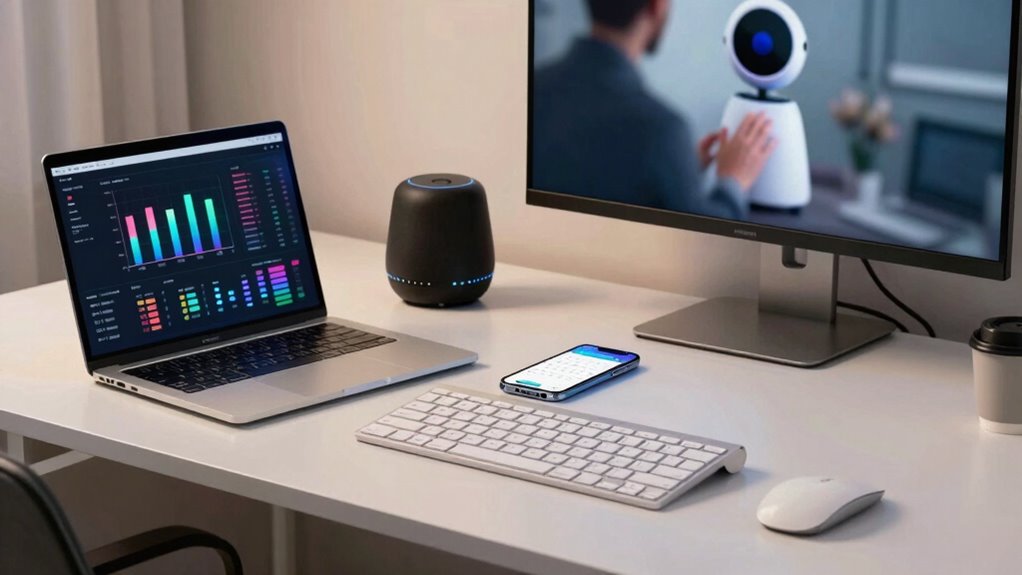
AI assistants are transforming the way you handle daily tasks, making workflows more efficient and less stressful. You’ve likely noticed how they can schedule meetings, set reminders, or even draft emails in a fraction of the time it used to take. Their integration into your everyday routines isn’t just about convenience; it’s about optimizing productivity and freeing up your mental bandwidth for more complex or creative work. As AI assistants become more sophisticated, their ability to anticipate your needs and streamline tasks is rapidly improving, which is why they’ve become essential in many workplaces.
AI assistants boost efficiency by handling routine tasks, freeing your mind for more creative and strategic work.
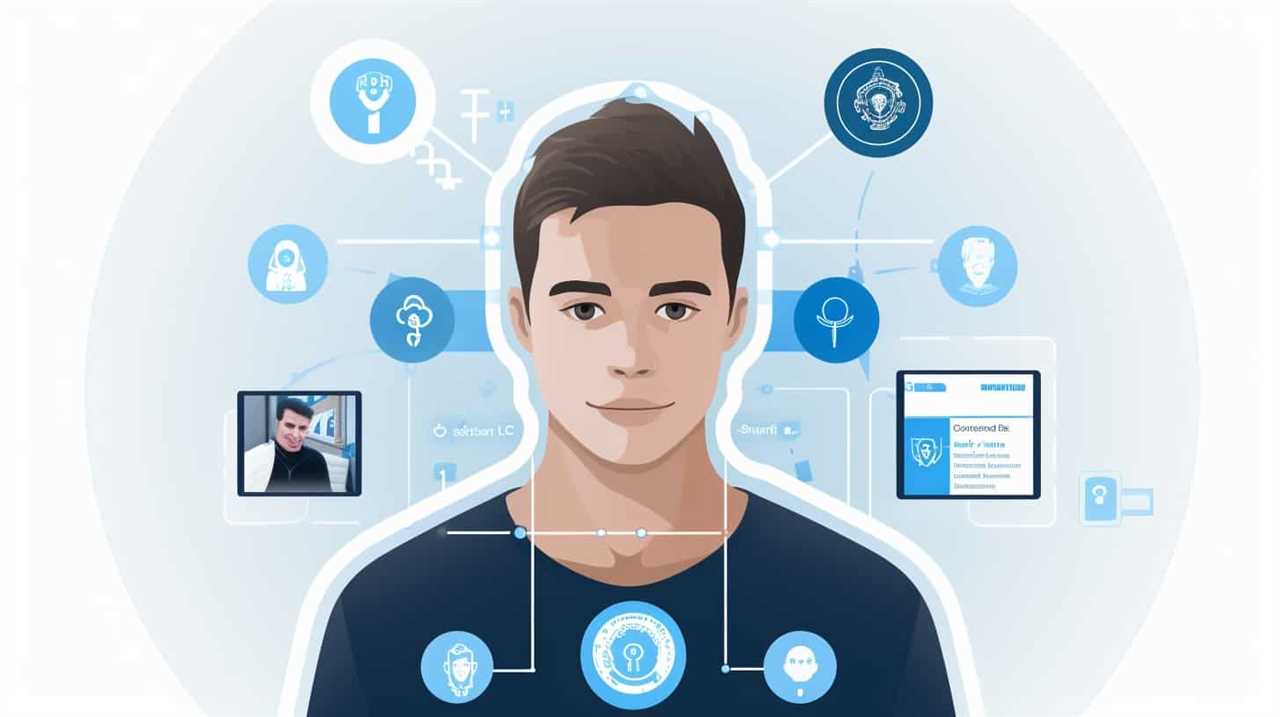
However, incorporating AI into your daily workflow isn’t without its challenges. One major concern revolves around AI ethics and privacy. You might wonder how your data is being used and whether your conversations with AI assistants are being stored or shared without your explicit consent. Companies develop AI systems that learn from user interactions to improve their responses, but this often raises privacy concerns. You need to be aware of how your data is being handled, especially when sensitive or personal information is involved. Transparency from AI providers about data collection, storage, and usage is imperative to building trust and guarantee you feel safe using these tools.
Despite these privacy concerns, AI assistants are valued for their ability to handle repetitive tasks and provide quick access to information. They can analyze large datasets faster than a human, helping you make informed decisions more efficiently. This reduces your workload, minimizes errors, and allows you to focus on strategic or creative aspects of your job. When used responsibly, with a clear understanding of AI ethics and privacy policies, these assistants can be powerful allies in your daily workflow. Additionally, understanding the role of data security** in AI deployment is crucial to maintaining your privacy. Employing robust security protocols can further mitigate risks associated with AI use. Being aware of data security principles helps ensure your personal information remains protected from potential breaches. Moreover, implementing privacy safeguards** can help you control how your data is shared and stored.
A growing awareness of AI ethics can help you navigate potential risks and ensure responsible use. The key to successfully integrating AI assistants is balancing their benefits with a mindful approach to privacy. You should choose tools that prioritize data security and give you control over your information. Regularly reviewing privacy settings and understanding how your data is used helps you maintain control. Additionally, staying informed about AI ethics and advocating for responsible AI development ensures that the technology evolves in ways that respect your rights and privacy.
Ultimately, AI assistants have become part of your everyday work because they offer significant advantages—speed, efficiency, and support—if you remain vigilant about privacy concerns. When you understand how to leverage their capabilities responsibly, these tools can greatly enhance your productivity while respecting your personal boundaries. It’s about finding the right balance between innovation and safeguarding your privacy, so you can enjoy the full benefits of AI in your daily workflow.

2026 Upgraded AI Voice Mouse – Wireless Air Mouse with AI Voice Assistant, 12 Languages Translation, Meeting Transcription & Summary – Detachable Computer Mouse, Presentation Clicker for Laptop
[2026 UPGRADED DETACHABLE AI MOUSE] Revolutionize your mobile office with a 2-in-1 modular design. Snap on the magnetic…
As an affiliate, we earn on qualifying purchases.
As an affiliate, we earn on qualifying purchases.
Frequently Asked Questions
How Do AI Assistants Handle Sensitive or Confidential Information?
AI assistants handle sensitive information carefully by using data encryption to protect your data during transmission and storage. They also prioritize user consent, ensuring you’re aware of how your information is used and giving you control over it. These measures help maintain confidentiality and trust, so you can confidently rely on AI assistants without worrying about unauthorized access or data breaches.
What Are the Privacy Concerns With AI Assistants?
You should be aware that privacy concerns with AI assistants include how your data is protected. They often handle sensitive information, so data encryption becomes essential to secure your personal details. Additionally, your user consent is important; you need to understand what data is collected and how it’s used. Always review privacy policies and settings to guarantee your information stays private, and your control over it remains intact.
Can AI Assistants Replace Human Employees Entirely?
AI assistants won’t replace human employees entirely; that’s an overly ambitious myth. You’ll find AI collaboration enhances productivity, handling repetitive tasks and enabling humans to focus on creative and strategic work. Workforce automation streamlines processes but still relies on human judgment, empathy, and innovation. So, while AI transforms roles, it’s more about partnership than replacement, helping you work smarter rather than eliminating the need for human insight altogether.
How Do AI Assistants Adapt to Different Industries?
AI assistants adapt to different industries through industry-specific customization and tailored user interface design. You customize their features to match unique workflows, terminology, and regulations, ensuring seamless integration. By focusing on user interface design, you make interactions intuitive and efficient for each industry’s needs. This adaptability allows AI assistants to support a wide range of sectors, from healthcare to finance, enhancing productivity and user satisfaction across diverse work environments.
What Skills Are Needed to Work Alongside AI Assistants?
To work effectively alongside AI assistants, you need strong collaborative skills and emotional intelligence. You should communicate clearly, understand the AI’s capabilities, and adapt your approach when needed. Recognizing and managing your emotions helps you stay patient and open-minded. By combining technical know-how with empathy, you can leverage AI tools efficiently, improve teamwork, and guarantee a smoother integration into your daily workflow.

Artificial Intelligence with Common Lisp: Fundamentals of Symbolic and Numeric Processing
Used Book in Good Condition
As an affiliate, we earn on qualifying purchases.
As an affiliate, we earn on qualifying purchases.
Conclusion
As you see, AI assistants seamlessly integrate into your daily routines, boosting productivity and freeing up your time for more meaningful tasks. They adapt to your needs, helping you stay organized and efficient. So, isn’t it time you embraced these tools to stay ahead? With AI assistants becoming an indispensable part of workflows, the question isn’t whether you should adopt them, but how soon you can make them work for you.

Everyday AI Unlocked: A Down-to-Earth Guide to Using AI to Think Faster, Create More, and Make Everyday Life Easier
As an affiliate, we earn on qualifying purchases.
As an affiliate, we earn on qualifying purchases.

Non-Deterministic Software Engineering: How to Build Reliable Software with AI Assistants Without Losing Quality, Security, or Control
As an affiliate, we earn on qualifying purchases.
As an affiliate, we earn on qualifying purchases.