
TL;DR

Get everyday essentials delivered free with Prime
- Fast, free delivery on millions of items
- Prime Video, Amazon Music and more included
- Member-only deals all year
A chapter published by Meduza in October recounts how Russia’s full-scale invasion separated 12-year-old Veronika Vlasova from her mother, Nina, in Ukraine’s Kharkiv region. The supplied excerpt describes the opening hours of the invasion and Nina’s failed attempt to reach her daughter; it does not establish what happened afterward or provide a current count of children still in Russia.
The book, Stolen Youth: How Russia Kidnaps Ukrainian Children — And How Ukrainians Get Them Back, was written by Russian journalist Nina Nazarova and Ukrainian journalist Sviatoslav Khomenko, with support from the StraightForward Foundation. Meduza says the authors tracked cases of children taken from Ukrainian territory into Russia and spoke with families who had been separated. The book describes four ways children were illegally deported, according to the publisher.
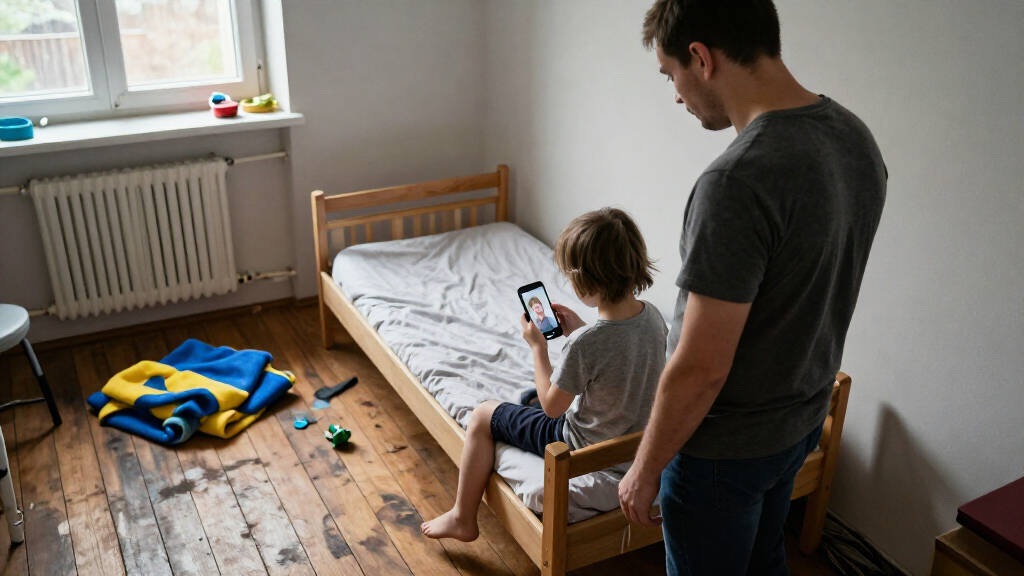
Veronika lived with her mother in Pylna, a village near the Russian border. The night before the invasion, she went to stay with her aunt Tetiana Melnyk and her family in nearby Borysivka. Shortly after 4 a.m. on February 24, an explosion woke them. Veronika later recalled that her uncle took the children to a shelter in a pit around the household’s water pump. From there, she called her mother and said, “Mom, they’re shooting here!”
Nina, a former soldier who had served in the Donbas, heard mortar fire during the call and sought information from neighbors and former military colleagues. She then drove toward Borysivka. At about 7:30 a.m., she reached a Ukrainian army checkpoint in Kharkiv, where soldiers would not let civilians leave because of the danger. Nina turned back. The excerpt establishes that mother and daughter were separated as the invasion began, but stops before explaining what happened to Veronika next.
Families Separated at the Border
The account puts an individual family’s experience within the larger issue the book examines: children separated from parents amid invasion, occupation and forced movement. Such cases can involve difficult questions of safety, custody, location and return. The publisher says the book documents thousands of children taken deep into Russia from Ukrainian territories devastated by the Russian army; that is the authors’ framing, and the supplied excerpt does not provide a methodology or an independently verified total.
Veronika’s story also shows how quickly ordinary family arrangements changed into an emergency. Her mother could not reach her through a checkpoint, while the family sheltering the child was close to the border where Russian forces had advanced. For readers, the account illustrates the human consequences of the invasion without, in the published excerpt provided here, resolving the particular family’s later circumstances.
As an affiliate, we earn on qualifying purchases.
The Invasion Reached Kharkiv Region
Russia launched its full-scale invasion of Ukraine on February 24, 2022. In the early hours of that day, Russian President Vladimir Putin announced what the Kremlin called a “special military operation.” Russian forces entered Ukraine from multiple directions, and explosions were reported in cities and areas near the border. Pylna and Borysivka, where Veronika and her relatives were, are in the Kharkiv region near Russia.
Meduza’s report says Nina had left their home the previous evening for work in Kharkiv and expected to return the next day. Veronika went to her aunt’s home rather than spend the night alone. The family’s routine was interrupted by the explosion and the rapid advance of Russian troops. Nina’s military background helped her recognize the sound of mortar fire, but did not allow her to bypass the checkpoint or reach her daughter.
The book grew out of the authors’ reporting on separated families. Meduza presents it as a work documenting how children were deported and how Ukrainians seek to bring them back. The excerpt supplied with the report covers Veronika’s experience at the start of the invasion, not the full chapter or the book’s evidence and case-by-case findings.
““I remember it was 4:21 a.m. We were running to the pit where the water pump was, in my aunt’s yard.””
— Veronika Vlasova, as quoted in the Meduza chapter
As an affiliate, we earn on qualifying purchases.
Veronika’s Later Whereabouts
The excerpt does not say how Veronika left Borysivka, whether she was taken into Russia, when she next saw her mother, or whether the two were eventually reunited. It also does not identify the relative who may have taken her from the occupied area, despite the report’s introductory summary saying she left with a relative and could not return to her mother.
The report refers to thousands of Ukrainian children stranded in Russia and says the book follows children taken into Russia, but the material supplied here gives no current total, date range or counting method. It is also not clear from this excerpt what evidence supports each of the book’s four deportation pathways, or what share of cases involved each one. Those details should not be inferred from Veronika’s account alone.
As an affiliate, we earn on qualifying purchases.
The Full Chapter and Family’s Outcome
Meduza says it is translating the full chapter about Veronika, titled “Veronika Takes Shelter in a Cellar.” The portion provided recounts events only through Nina’s failed attempt to drive out of Kharkiv. Readers will need the remainder of the chapter or further reporting to learn how Veronika’s separation unfolded and what became of her family.
The October book release gives the authors a platform to present additional cases and explain their reporting on the separation and return of Ukrainian children. The supplied material does not announce a new government action, a confirmed reunion or a timetable for any specific case. Any later account should distinguish the family’s reported experience from broader totals and claims about the circumstances of children’s transfer.
As an affiliate, we earn on qualifying purchases.
Key Questions
What happened to Veronika when Russia invaded Ukraine?
According to the Meduza excerpt, the 12-year-old was staying with relatives in Borysivka when an explosion woke the family shortly after 4 a.m. on February 24, 2022. She called her mother from a shelter. The excerpt does not explain what happened to her afterward.
Why could Nina not reach her daughter?
Nina drove toward Borysivka but reached a Ukrainian army checkpoint in Kharkiv at about 7:30 a.m. Soldiers barred civilians from leaving because the area was under fire and it was considered too dangerous to proceed. She turned back.
What is the book about?
Stolen Youth: How Russia Kidnaps Ukrainian Children — And How Ukrainians Get Them Back examines the separation and movement of Ukrainian children during the invasion, as well as efforts to return them, according to Meduza. It was written by Nina Nazarova and Sviatoslav Khomenko.
Does the excerpt confirm that Veronika was taken to Russia?
No. The introductory description says she left occupied territory with a relative and could not return to her mother, but the excerpt itself ends during the first day of the invasion and does not establish where she went afterward.
How many Ukrainian children are still in Russia?
The supplied material does not give a current count or explain how such a figure is calculated. It describes thousands of children as having been taken into Russia, but readers should not treat that wording as a current, independently verified tally of children still there.
Source: rss
Halloween Picks
halloween
As an affiliate, we earn on qualifying purchases.