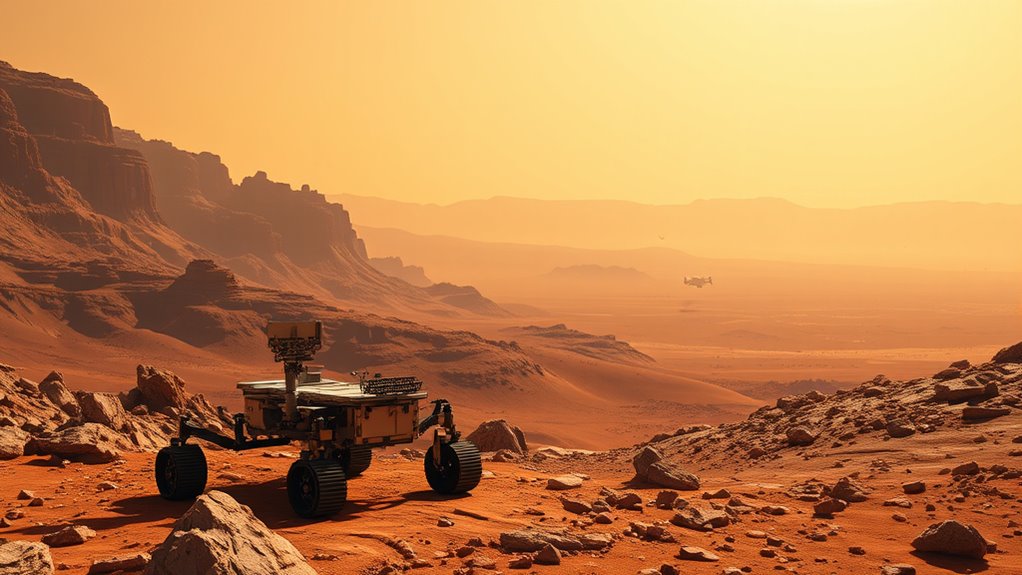

After 2025, Mars exploration accelerates with advanced spacecraft, landers, and orbiters focusing on in-situ analysis and sample return missions. New technologies like AI help identify promising sites, while international collaborations grow stronger. Challenges like terraforming and detecting microbial life remain, but innovative strategies are in the works. By exploring these ambitious efforts, you’ll discover how humanity plans to overcome obstacles and unveil Mars’ secrets—if you keep exploring, more exciting details await.

Get everyday essentials delivered free — and shop member deals
- Fast, free delivery on millions of items
- Access to Prime Big Deal Days deals on October 6–7
- Prime Video, Amazon Music and more included
Key Takeaways
- Accelerated exploration efforts include advanced spacecraft, landers, and orbiters with in-situ analysis and sample return missions.
- Integration of AI and machine learning will enhance site identification, data processing, and mission planning capabilities.
- Future missions aim to detect microbial biosignatures, analyze planetary geology, and understand Mars’s habitability.
- Ongoing challenges involve terraforming efforts such as atmosphere thickening and climate modification strategies.
- International collaboration and visualization technologies will facilitate data sharing, mission coordination, and public engagement.
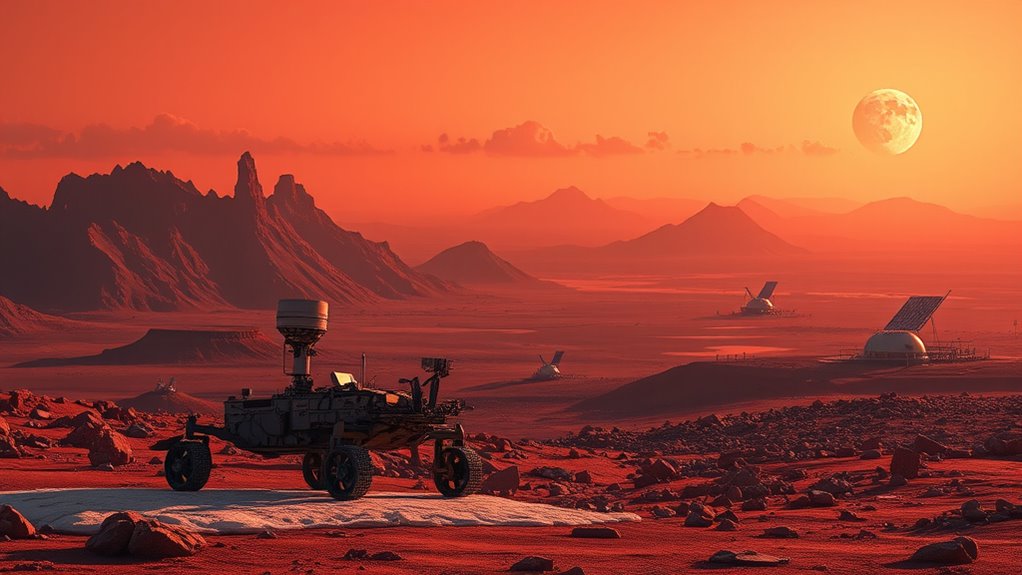
As we look beyond 2025, Mars exploration is set to accelerate with new missions and innovative technologies. You’ll see efforts intensify to understand Mars’s environment and uncover its secrets. One of the biggest hurdles you’ll encounter is terraforming challenges. Transforming Mars into a habitable world isn’t just about planting trees or creating breathable air; it involves complex processes like warming the planet, thickening its atmosphere, and stabilizing surface conditions. These tasks demand advanced engineering, significant resources, and a deep understanding of planetary science. The difficulty lies in balancing the planet’s low gravity, thin atmosphere, and extreme temperatures, which hinder natural processes that could support human life. Despite these challenges, researchers are exploring ways to modify Mars’s environment through techniques such as releasing greenhouse gases or importing volatiles. But even as these ideas develop, one of your primary scientific priorities will be microbial life detection. Discovering signs of past or present microorganisms could change everything about how you view life in the universe. Missions like rover landings and orbiters will carry sophisticated instruments designed to analyze soil, ice, and atmospheric samples for biosignatures. You’ll need to be meticulous in identifying organic molecules, isotopic ratios, or other indicators that microbes once thrived or still exist on Mars. Detecting microbial life isn’t just about confirming extraterrestrial biology; it also informs how you approach planetary protection protocols, ensuring you don’t contaminate Mars or bring back Earth microbes that could interfere with native ecosystems. As new spacecraft and landers are developed, you’ll see an increasing emphasis on in-situ analysis and sample return missions. These efforts aim to gather definitive evidence of life and better understand the planet’s geochemical history. The quest to detect microbial life will also influence future colonization plans, as understanding potential biological hazards is essential for human safety. Meanwhile, technological advancements will push the boundaries of what’s possible, from autonomous drilling to remote sensing with high-resolution spectroscopy. You’ll witness collaborations between international agencies, private companies, and scientific institutions working together to tackle these formidable challenges. Additionally, advancements in projector technology will enhance the visualization of data and mission planning, making complex information more accessible to scientists and engineers. As the timeline progresses, the integration of artificial intelligence and machine learning will become indispensable in processing vast datasets, identifying promising sites, and accelerating discoveries. Ultimately, the next phase of Mars exploration promises not only to bring humans closer to the Red Planet but also to deepen your understanding of life’s potential beyond Earth, even as you confront the imposing realities of terraforming and microbial life detection.
Mars rover scientific instruments
As an affiliate, we earn on qualifying purchases.
As an affiliate, we earn on qualifying purchases.
Frequently Asked Questions
What Technological Advancements Are Needed for Sustainable Mars Colonization?
You’ll need to develop habitat durability to withstand Mars’ harsh environment and propulsion innovations for efficient travel. Advanced materials can improve shelter resilience, while new propulsion tech reduces travel time and fuel needs. Both are essential for sustainable colonization, enabling long-term missions with minimal resupply. These advancements will make Mars habitats safer and more reliable, helping you establish a self-sufficient presence on the Red Planet.
How Will International Cooperation Shape Future Mars Missions?
International collaboration and diplomatic partnerships will be essential in shaping future Mars missions. By working together, you’ll share resources, expertise, and technology, making missions more feasible and cost-effective. As you build these global alliances, you’ll foster trust and coordinate efforts, ensuring safer and more successful exploration. Your collective efforts will accelerate scientific discoveries, promote peaceful international relations, and pave the way for sustainable human presence on Mars.
What Ethical Considerations Arise With Long-Term Mars Habitation?
When considering long-term Mars habitation, you must address ethical governance and planetary protection. You’re responsible for preventing contamination of Mars’s environment, which involves strict protocols and policies. You also need to weigh the moral implications of potentially disrupting Mars’s natural state. Ensuring transparent decision-making and respecting both scientific and moral boundaries helps balance exploration with ethical obligations, safeguarding both planetary integrity and future human interests.
Are There Plans for Resource Utilization on Mars Beyond Scientific Research?
You might think resource utilization on Mars is just about scientific research, but plans go beyond that. Martian mining and resource extraction are being explored to support future colonies, reduce Earth’s supply dependency, and enable sustainable living. Companies and agencies are investigating how to extract water, minerals, and other materials, aiming to establish a self-sufficient outpost. This effort could revolutionize Mars exploration and open new frontiers for human expansion.
How Will Mars Exploration Impact Earth’s Scientific Community?
Your involvement in Mars exploration will profoundly impact Earth’s scientific community by advancing planetary geology and enabling astrobiology breakthroughs. As you explore Mars, you’ll uncover clues about its history and potential habitability, fueling discoveries that deepen our understanding of life’s origins. These insights will inspire new research, foster international collaboration, and drive technological innovations, ultimately expanding humanity’s knowledge and inspiring future generations of scientists.
As an affiliate, we earn on qualifying purchases.
Conclusion
As you look ahead, the future of Mars exploration is full of promise and challenges. With new missions on the horizon, you’ll witness humanity pushing boundaries and reaching for the stars. Though setbacks may come, remember that every step forward brings us closer to making the Red Planet our second home. Keep the faith — this journey is just getting started, and the sky’s the limit for what we can achieve together.
planetary geology analysis tools
As an affiliate, we earn on qualifying purchases.
As an affiliate, we earn on qualifying purchases.
Mars microbial life detection kit
As an affiliate, we earn on qualifying purchases.
As an affiliate, we earn on qualifying purchases.
Fall Picks
fall essentials
As an affiliate, we earn on qualifying purchases.